
The Tool Desk
Outbyte Driver Updater FREEScan for outdated or missing drivers - takes under a minuteDriver Scan →Outbyte PC Repair FREEClear out junk files and repair common Windows errorsFree Scan →iTechGuides is reader-supported. When you buy through links on our site, we may earn an affiliate commission. As an Amazon Associate I earn from qualifying purchases. Learn more
AI creates business value only when its output reaches a decision-maker in time, fits the work they need to do, and leads to an accountable action. That “last mile” is the organizational and operational path from a prediction, recommendation, or summary to a changed decision or measurable result. Better model performance helps, but it cannot by itself fix stale data, missing context, unclear ownership, low trust, or a workflow that gives people no practical way to respond.
What the last mile of AI includes
Deploying a model is not the same as implementing it. An AI system can return a technically sound answer while leaving the organization with unanswered questions: Which decision should change? Who is responsible for acting? What information supports the recommendation? How quickly does it matter? And how will anyone know whether the action helped?


The gap is therefore socio-technical. Data pipelines and interfaces matter, but so do business definitions, authority, governance, user judgment, and the steps people already follow to complete work. An output that sits in a separate dashboard may still be useful for exploration; it is less likely to affect a time-sensitive decision if the person who can act must find it, interpret it, and move its information into another system.
Do these 3 things before closing this tab:
1Repair Windows errors before they cause bigger problems2Scan for outdated or missing drivers - takes under a minute3Clear out junk files and repair common Windows errorsWhy an AI insight may not change what people do
The data is late, fragmented, or hard to interpret
Recommendations depend on more than model accuracy. If records are spread across systems, arrive after the decision window, or use inconsistent definitions, a user may not be able to verify what the output means. The article matching this topic describes a useful information picture as combining core business systems, external ecosystem data, and live operational signals. These sources can provide context, but their presence does not guarantee that data is accurate, current, consistently governed, or relevant to a particular decision.
#1 Best Overall
In a clinical setting, a 2020 review of AI implementation describes a “machine experience” gap: systems need enough reliable, accurate data to work in practice. The review also discusses data governance, data work, data awareness, and data hygiene. Those observations are grounded in healthcare; they offer relevant implementation concepts, not proof that every industry faces identical problems or effects. Read the review in JMIR / PubMed Central.
The recommendation lacks business context
A prediction may be plausible in isolation but incomplete for the decision at hand. A fraud flag, for example, is harder to use if investigators cannot see the relevant records together. A manufacturing warning about equipment failure may be more actionable when considered alongside the production schedule, supplier delays, and maintenance information. The examples reported in the topic-matching article illustrate the value of context; they should not be read as independently audited case studies or evidence that a particular platform caused a result.
Rank #2
No one owns the decision
If a recommendation crosses team boundaries, it can be unclear who may approve a response, who must review it, or who is accountable for what follows. Governance needs to specify the decision rights and escalation path, not just the rules for building or accessing a model. Where an AI output is advisory, a named role should own the human decision. Where an action is automated, the organization still needs an owner for its operating rules, monitoring, and exceptions.
Quick wins for a faster PC:
Repair Windows errors before they cause bigger problemsFix Now →Scan for outdated or missing drivers - takes under a minuteDriver Scan →People do not trust the output—or trust it too much
Users may reject a recommendation they cannot understand or verify. The opposite risk is automation bias: accepting a system’s suggestion without enough scrutiny. The 2020 clinical review describes both trust-related obstacles, including usability problems, overreliance on technology, and prejudice against machine recommendations. It summarizes one “hiatus” as encompassing barriers to concrete use at the point of care, including availability and usability as well as these opposing cognitive responses. The clinical setting matters: this is a useful lens for implementation, not a universal estimate of user behavior in every field.
The output does not fit the operating workflow
Even relevant advice can arrive at the wrong time or in the wrong place. If a team must leave its normal system, search for an alert, and manually reconstruct the case, the extra work may outweigh the benefit. Conversely, putting recommendations directly into a workflow is not automatically better: the interface must support review, explain what matters, and allow people to handle uncertainty and exceptions.
The organization measures model performance but not outcomes
Predictive accuracy, response rates, and technical uptime describe parts of a system, not whether it improved a business decision. Teams also need to check whether people saw and used the output, whether it changed a decision or process, and whether the intended outcome followed. A sequence of events after an AI recommendation does not, on its own, establish that the AI caused the result.
How to connect an AI output to action
- Start with a specific decision. State what decision the AI is meant to inform, who makes it, and when the answer is still useful. Avoid beginning with a model or dashboard and searching afterward for a job it might support.
- Map the real workflow. Identify where the decision happens, what information the user already needs, what approvals apply, and what happens when the recommendation is uncertain or wrong. Include the people who do the work, not only the system owners.
- Check the evidence behind the output. Establish the relevant sources, their freshness, provenance, quality, and definitions. Decide how users can see missing or conflicting information and how data changes are governed.
- Set ownership and guardrails. Name the decision owner, reviewer where needed, escalation route, and accountable party for monitoring. Define which outputs are advisory and which can trigger an automated action, as well as how exceptions are handled.
- Design for calibrated use. Present a recommendation with enough context for a person to assess it. Make uncertainty and relevant limitations visible where they affect the decision. Usability should help users neither dismiss useful advice reflexively nor accept it uncritically.
- Put the support where the decision occurs. Integrate the insight into the operational system or handoff where the responsible person can act. A dashboard can be appropriate when it serves a real monitoring or planning task; the problem is an isolated output with no clear route to a decision.
- Measure the full path. Track whether the output reached the intended user, whether it influenced the decision or process, what action followed, and whether the target outcome changed. Review misses, overrides, delays, and unintended effects, then use them to improve data, workflow, governance, or the model.
What implementation evidence can—and cannot—tell you
A 2023 California Management Review study reports a survey of 2,525 decision-makers with AI experience in China, Germany, India, the United Kingdom, and the United States, plus interviews with 16 AI implementation experts. It examines technological, organizational, and cultural challenges and develops a diagnostic framework. The sample describes the study’s scope; it is not a census of organizations, a global prevalence estimate, or a percentage of companies that succeed or fail. Read the study in California Management Review.
Sector examples also require care. In the topic-matching article, a finance example concerns fraud investigators dealing with records distributed across systems, while a manufacturing example combines equipment-failure signals with production, supplier, and maintenance context. These examples help show what a last-mile problem can look like, but do not establish audited causal effects or guarantee the same approach will work elsewhere. Read the article’s examples and framing.
Best Value
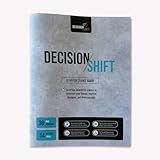
- MAKE BETTER DECISIONS, FASTER: Overcome decision fatigue and stop overthinking with a proven, science backed Productivity guidebook that keeps it simple and sharp. No dates, no Pressure just a clear flexible Undated framework. With our Playbook, gain clarity & confidence to make smarter daily choices quickly - whether at work, home or in life. “Smart decisions start here”
- DECISION QUADRANTS & GUIDED EXERCISES: Level up your decision making with tools like the Decision Quadrant & Guided Prompts. Get clear explanations of biases, heuristics and slow vs. fast thinking. Apply these insights instantly through guided exercises. This Workbook style Organizer is perfect for use as a Productivity Planner or journal - plus, it comes with a free downloadable template you can use again and again.
- TIME & ENERGY SAVING FRAMEWORK: Use this Priority Decision guide with a clear, structured system to focus on what matters most. Categorize decisions in the Time blocking planner by impact & difficulty. streamline low value choices & match your effort to their importance. This Personal Growth tracker helps you make behavior shifts that free up mental energy, reduce stress & move from reactive to proactive thinking.
- VERSATILE USAGE FOR LIFE, WORK & WELLNESS: This Life Companion brings clarity & confident decisions making to every area of life. Build stronger leadership, sharpen your strategy and make smarter career moves with this all-in-one Framework. Take control of your money by using goal setting guide & behavioural science to guide your spending, saving & investing - "For every goal and every role."
- PREMIUM 8.5” x 11” DESIGN: This elegant, compact and durable workbook is built to last. The Brain Dump notepad blends professional style with everyday functionality, making it the perfect task companion for your desk, bag or office. Lightweight and easy to carry wherever you go, this daily Reflection journal features a generous 8.5” x 11” size that fits seamlessly into your Premium collection.
A 2026 study of home-delivery routing offers a more specific caution: AI-assisted predictions of whether someone will be present may encounter privacy and driver-compliance hurdles, while added route complexity could offset savings projected by earlier work. That is a logistics-specific reminder to assess adoption and net benefit in the operating context, not a conclusion about every AI deployment. Read the study in Transportation Research Procedia.
Independent reader supportYour contribution helps us test, update, and keep practical guides available for everyone.A practical test before expanding an AI pilot
Use these questions to find the missing link before scaling. They are a diagnostic synthesis of implementation considerations, not a published universal scorecard.
- Data: Are the inputs reliable, current enough for the decision, traceable to their sources, and governed consistently?
- Context: Can the user see the business facts needed to interpret the recommendation across relevant systems?
- Workflow: Does the output arrive where the work happens and early enough for someone to respond?
- Ownership: Is one role clearly accountable for the decision, approval, exceptions, and follow-through?
- Trust and usability: Can users assess the recommendation, including its limits, without undue effort or pressure to accept it?
- Feedback: Can the organization tell whether the output changed a decision and whether the desired outcome followed?
If one answer is no, a stronger model may not be the next useful step. The appropriate fix could be better data stewardship, a clearer decision process, an interface change, an explicit reviewer, or a different measure of success. Treat the cause as an operational question to investigate rather than assuming every adoption problem is a model problem.
Quick Recap
Product prices and availability are accurate as of the date/time indicated and are subject to change. Any price and availability information displayed on Amazon at the time of purchase will apply.

