
iTechGuides is reader-supported. When you buy through links on our site, we may earn an affiliate commission. As an Amazon Associate I earn from qualifying purchases. Learn more
To create an investment portfolio tracker, first decide whether you need a quick snapshot of current holdings or a transaction ledger that records every purchase and sale. A snapshot is easier to maintain; a ledger can support transaction history and realized-gain reporting. For a basic spreadsheet, record each holding’s identifier, share count, average cost, and current price, then calculate market value and dollar gain or loss.
Choose what your tracker needs to show
A holdings snapshot answers “what do I own now, and what is it worth?” It typically uses one row per position. A transaction ledger records activity over time and can rebuild holdings from purchases and sales. Decide which you need before building formulas: a snapshot is simpler, while a ledger takes more upkeep and requires more complete records.


Before setting up the sheet, decide whether to include multiple accounts, cash, dividends, fees, currencies, asset allocation, benchmarks, or historical performance. Add only fields you expect to maintain. For example, the Measure of a Plan describes a tracker with setup and trade-log tabs and realized-gain reporting, but says cash is not included by default (The Measure of a Plan).
Windows Errors? Fix Them Before They Spread
Repair common Windows errors and clear accumulated junk for a smoother, more stable PC - no reinstall needed.Free scan · no reinstallCrashes, No Sound, or Screen Glitches?
Random freezes, missing sound and display glitches usually trace back to one bad driver. Find and replace yours safely.Free scan · under a minuteSet up a holdings snapshot
Create a spreadsheet with one row for each holding. Keep the quantity, average cost, and current price in separate columns; the price of your latest purchase is not necessarily your average cost if you bought shares at different times.
| Column | What to enter | Why it matters |
|---|---|---|
| Account | Account name or a non-sensitive label, if you track more than one | Separates positions held in different accounts |
| Security identifier | Exchange and ticker when available | Helps identify the intended security and retrieve prices accurately |
| Shares | Current number of shares or units | Used to calculate market value |
| Average cost | Your recorded average purchase cost per share or unit | Provides a simple cost basis for a snapshot’s dollar gain or loss |
| Current price | Price from a data feed or manual entry | Used with share count to estimate current market value |
| Market value | Shares multiplied by current price | Shows the position’s estimated value at the recorded price |
| Dollar gain or loss | Market value minus recorded cost value | Shows a simple dollar difference, not a complete investment return or tax result |
| Last updated | Date and time you checked or refreshed the price | Makes stale or manually entered prices easier to spot |
For a simple position, calculate market value as shares multiplied by current price. Add the market values of the positions for a basic portfolio total. These calculations depend on the accuracy and timing of the underlying inputs.
A free template described by FinancialAha uses a row per position and requires the user to enter prices manually. Its free version reports dollar gain rather than percentage return; the page notes that dollar gains alone make differently sized positions difficult to compare (FinancialAha’s investment tracker spreadsheet).
Rank #2
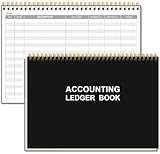
- EASY TO MANAGE - Use this accounting ledger book to track your payments, deposits, and balances, and develop good bookkeeping habits to meet your financial goals.
- UNDATED ACCOUNT TRACK - Use a ledger book to record every expense you make no matter what day it starts. The accounting book is plenty of space to record each transaction you make, and state its number, date, description, account, payment or deposit amount, and total balance.
- MANAGE YOUR FINANCES & SUCCEED - Use this business expense tracker notebook, You will be able to easily analyze your financial activities and quickly prepare accurate financial statements. Use your records to regularly assess your spending and income and find any unnecessary expenses you can cut to improve your financial performance.
- HIGH QUALITY - The A5 expense tracker notebook is used to high quality 100gsm pure white paper, pink elastic band and a back pocket for extra space. A total of 64 sheets(128 pages), it comes with 3480 entry lines (29 lines per page, 60sheets/120pages), 1 page Year Overview, 7 lined notes pages. The accounting book is plenty of space to record each transaction you make, and state its number, date, description, account, payment or deposit amount, and total balance.
- THE PERFECT GIFT - Use account ledger book for your personal or business finances, give it to your friends, colleagues as a gift for Birthday| Easter|Children's Day|Halloween|Thanksgiving|Christmas|Back to school and New Year's Day.
Use a transaction ledger for activity over time
If you want to preserve purchases and sales rather than only record today’s holdings, create a separate transaction table. A practical starting set of columns is:
- Date
- Account
- Ticker or other security identifier
- Transaction type, such as buy or sell
- Quantity
- Price per share or unit
- Fees
- Currency
This structure can support a transaction history and reporting on realized activity, but the details needed for accurate cost and gain calculations depend on your records and the reporting method. Decide explicitly how to record dividends, cash movements, transfers, fees, and corporate actions. Do not assume that a ledger automatically handles those items.
After entering transactions or importing activity, compare holdings and cash with broker statements. Check again after corporate actions such as splits or mergers. Reconciliation is a useful quality-control practice; the cited tracker descriptions do not establish that any particular workbook or import process is error-free.
Choose a price source and make its limits visible
Google Sheets price data
Google Sheets’ GOOGLEFINANCE function can retrieve current or historical data for supported securities. Google recommends including both the exchange symbol and ticker for accuracy. Its documentation says quotes may be delayed by up to 20 minutes, not all markets are covered, most international exchanges are unsupported, and mutual-fund attributes are not supported (Google Docs Editors Help: GOOGLEFINANCE).
Rank #4

- EASY TO USE - Use this accounting ledger book to track your payments, deposits, balances, and develop good bookkeeping habits to meet your financial goals.
- ACCOUNT TRACKER - Use a colorful ledger book to record every expense you make no matter what day it starts. The accounting book is plenty of space to record each transaction you make, and state its number, date, description, account, payment or deposit amount, and total balance
- MANAGE YOUR FINANCES & SUCCEED - Use this account tracker notebook, You will be able to easily analyze your financial activities and quickly prepare accurate financial statements. Use your records to regularly assess your spending and income and find any unnecessary expenses you can cut to improve your financial performance.
- HIGH QUALITY - The expense tracker is size of 5.8" x 8.3", is used to high quality 100gsm pure white paper, brown elastic band and a back pocket for extra space.
- PERFECT FOR - Use monthly account log book for your personal or business finances, improve your productivity with this financial organizer.
Google also says functions that fetch data from outside a spreadsheet recalculate on their own schedules. Changing spreadsheet recalculation settings does not guarantee fresher market data (Google Docs Editors Help: spreadsheet calculation settings). Historical data cannot be retrieved through the Sheets API or Apps Script, according to Google’s function documentation.
For unsupported securities, missing quotes, or prices that appear stale, keep a manual price field or override and record when you last checked it. A visible update date helps prevent an old quote from looking current.
Best Value

- EASY TO MANAGE - Use this accounting ledger book to track your payments, deposits, and balances, and develop good bookkeeping habits to meet your financial goals.
- UNDATED ACCOUNT TRACK - Use a ledger book to record every expense you make no matter what day it starts. The accounting book is plenty of space to record each transaction you make, and state its number, date, description, account, payment or deposit amount, and total balance.
- HIGH QUALITY - The A5 expense tracker notebook is used to high quality 100gsm pure white paper, brown elastic band and a back pocket for extra space. A total of 64 sheets(128 pages), it comes with 3480 entry lines (29 lines per page, 60sheets/120pages), 1 page Year Overview, 7 lined notes pages.
- MANAGE YOUR FINANCES & SUCCEED - Use this business expense tracker notebook, You will be able to easily analyze your financial activities and quickly prepare accurate financial statements. Use your records to regularly assess your spending and income and find any unnecessary expenses you can cut to improve your financial performance.
- THE PERFECT GIFT - Use account ledger book for your personal or business finances, give it to your friends, colleagues as a gift for Birthday| Easter|Children's Day|Halloween|Thanksgiving|Christmas|Back to school and New Year's Day.
Manual price entry
Manual entry works when you hold a limited number of positions and are willing to refresh them yourself. Its main trade-off is upkeep: the portfolio total is only as current as the prices you entered. Keep the source and update date alongside manually entered prices if you need to audit them later.
Independent reader supportYour contribution helps us test, update, and keep practical guides available for everyone.Label performance so it is not misleading
Dollar gain or loss is a straightforward difference between recorded value and recorded cost, but it is not a complete measure of performance. A larger position can show a bigger dollar gain simply because more money was invested. If you add a percentage return, state how you define it and whether it accounts for contributions, withdrawals, dividends, fees, currency conversion, and timing. Trackers differ in what they include, and no single return method fits every reporting goal.
Keep investment tracking separate from tax reporting and investment decisions. Google says its market data is provided for informational purposes, not trading or advice (Google Docs Editors Help: GOOGLEFINANCE). A spreadsheet total is not an investment recommendation or, by itself, a tax calculation.
The Tool Desk
Outbyte PC Repair FREERepair Windows errors before they cause bigger problemsFix Now →Outbyte Driver Updater FREEFix the driver behind crashes, sound loss and screen glitchesFind Drivers →Decide whether to add automation or use a service
A spreadsheet can be enough if you want control over the layout and are comfortable maintaining prices and records. Other approaches may reduce manual work or offer broader reporting, but feature descriptions are not independent comparisons; check current coverage, permissions, pricing, and terms before choosing.
| Approach | What the cited source describes | Questions to check |
|---|---|---|
| Manual holdings spreadsheet | FinancialAha describes a free position-by-position template with manual prices, value, and dollar gain or loss (FinancialAha). | Are you willing to update prices? Do you need percentage returns or transaction history? |
| Transaction-ledger spreadsheet | The Measure of a Plan describes setup and trade-log tabs, realized-gain reports, and manual price fallback; cash is not tracked by default (The Measure of a Plan). | Does it handle the accounts, currencies, cash, and activity you need? |
| Spreadsheet add-on | tradeGIST describes imports and reporting for stocks, crypto, and options within a Sheets workflow. These are vendor descriptions (Google Workspace Marketplace: tradeGIST). | Are your brokers and instruments supported? What permissions does it need? Does its reporting meet your requirements? |
| Dedicated tracking service | Sharesight’s product page states that it tracks stocks and ETFs across more than 40 exchanges, along with cash, currencies, and unlisted assets, and offers up to 10 holdings free. These are vendor-stated features and plan terms can change (Sharesight US). | Does its regional coverage, data handling, reporting, and current pricing suit you? |
Before connecting an add-on or service, review its current account permissions and data-handling details. Do not put passwords or full account credentials in a spreadsheet. A vendor’s description of how it handles portfolio data is not a substitute for checking the permissions you are granting.
Quick Recap
Check the tracker before relying on it
- Confirm tickers and exchange identifiers against your broker records.
- Check share counts, costs, cash, and recent activity against statements.
- Review formula results after adding a position, sale, dividend, or corporate action.
- Identify prices that are manual, missing, or potentially delayed, and note their update dates.
- Make sure totals are not mixing currencies without an explicit conversion method.
- Keep a backup or version history before making major structural changes.
Product prices and availability are accurate as of the date/time indicated and are subject to change. Any price and availability information displayed on Amazon at the time of purchase will apply.

