
iTechGuides is reader-supported. When you buy through links on our site, we may earn an affiliate commission. As an Amazon Associate I earn from qualifying purchases. Learn more
There is no single wire count for every smart thermostat. The number depends on the thermostat model, your heating and cooling equipment, the functions it controls, and how it gets power. Some models can work with the existing heating and cooling wires; others need a C wire or a compatible power accessory. Check the exact model’s compatibility instructions before buying or connecting anything.
Why smart thermostats need different numbers of wires
Thermostat wires connect specific HVAC controls, such as heating, cooling, or a fan. The required connections vary with the equipment and the thermostat. A conventional system, heat pump, heat-only setup, zoned system, or proprietary system may use different terminals and wiring arrangements. The thermostat’s compatibility checker and wiring diagram—not a universal wire-count rule—determine whether a particular setup will work.
A C wire is often part of the question because it provides continuous power to the thermostat. It does not call for heating or cooling. Google explains that many Nest thermostats can draw enough power through other system wires, but some installations need a C wire or a model-compatible power accessory. This guidance is specific to the models and systems covered by Google’s instructions, not a rule for every thermostat. Google Nest: Learn about the common or C wire.
How to check your existing wires and compatibility
- Find the exact thermostat model and system type. Check the thermostat maker’s compatibility tool and installation instructions for your HVAC equipment. Google, for example, provides a Nest compatibility checker and a custom wiring guide. Use the corresponding tools and instructions for other brands.
- Turn off HVAC power before inspecting connections. Photograph the existing thermostat wiring so you can refer to it later. If the wiring, voltage, or equipment type is unclear, stop and contact the thermostat manufacturer or an HVAC professional.
- Record terminal labels, not wire colors. Write down which terminals have wires connected. Colors can vary, so Google advises using the connector labels in its compatibility checker rather than identifying wires by color. Google’s wire-identification guidance also says to ignore short jumper wires that connect two terminals: they are not conductors running from the HVAC system.
- Check for an unused conductor at both ends. A spare wire visible behind the thermostat only helps if it is also available and can be connected at the HVAC control board according to the equipment and thermostat instructions. Do not assume that an unused wire at the wall is already providing C-wire power.
- Follow the exact system-specific diagram. Confirm that the model supports your equipment and the proposed wiring or power accessory. If the instructions do not cover your setup, get manufacturer or professional guidance rather than guessing.
If there is no C wire
A missing C wire does not automatically rule out a smart thermostat. Depending on the model and system, the thermostat may work using the existing connections, require a compatible power accessory, or need a new conductor. The manufacturer’s compatibility result and wiring instructions determine which option is valid.
#1 Best Overall
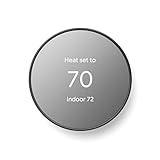
- ENERGY STAR certified smart thermostat for home that helps you save energy and stay comfortable.Connectivity : Wi-Fi - 802.11b/g/n 2.4 GHz, 802.11a/n 5 GHz Wi-Fi., Wireless interconnect : Bluetooth Low Energy Please refer to the product description section below for all applicable legal disclaimers.Product note: You can also check your system’s compatibility before purchasing a Nest thermostat with our online Nest Compatibility Checker on the Google Nest support page
- The Nest Thermostat is designed to work without a C wire in most homes, but for some systems, including heating only, cooling only, zone controlled, and heat pump systems, you’ll need a C wire or other compatible power accessory
- Nest Thermostat turns itself down when you leave, so you don’t waste energy heating or cooling an empty home. Lock feature: No
- Programmable thermostat that lets you create an energy efficient schedule in the Google Home app on your Android or iPhone
- Remote control lets family members change the thermostat temperature from anywhere on a phone, laptop, or tablet[1]
Some models work without one in many setups
Google says many Nest thermostats can draw enough power from the system wires, although some installations need a C wire or power accessory. For the Nest Learning Thermostat (4th gen) specifically, Google states that it is designed to work without a C wire, but that “In limited cases (<1%), a C wire or Nest Power Connector is necessary to ensure that your HVAC system can provide sufficient power to the thermostat in all conditions.” That figure applies only to Google’s specification for that model; it is not a statistic for smart thermostats overall. Google Nest Learning Thermostat (4th gen) technical specifications.
Power accessories are model- and system-specific
Google identifies the Nest Power Connector as a possible solution for certain compatible installations. Ecobee says its Power Extender Kit can be used when there is no C wire and at least four wires are available at the thermostat; the kit is installed at the furnace control board. Ecobee’s guidance also describes exceptions, including heat-only and dual-transformer systems. These accessories are not interchangeable or universal fixes. Verify compatibility and the instructions for the exact thermostat model and wiring configuration before using one. ecobee: Do I need a C wire to install an ecobee thermostat?
Rank #2

- An Alexa thermostat - Amazon Smart Thermostat is an easy way to switch from a traditional thermostats for homes and help reduce energy usage.
- Create comfort zones throughout your home by connecting to select Alexa devices to automatically adjust heating and cooling based on temperature readings or presence detection.
- Save money and energy - After purchase, Amazon will send you an email with details about home thermostat rebates that may be available from energy providers in your area.
- Save energy - According to EPA estimates, ENERGY STAR certified thermostats save an average of $90 on yearly energy bills.
- Programmable thermostat and automatic control - Create your own home, away and sleep schedules, or have Alexa automatically control the temperature with Alexa+ advanced features.
A new conductor may be needed
If the model requires a C wire and no suitable spare conductor is available, the installation may require new low-voltage thermostat wire. Check the equipment instructions first; routing and connecting a new wire can involve accessing the furnace or air-handler control board. An HVAC professional can assess the wiring and install it if needed.
When not to connect the thermostat yourself
Do not connect a low-voltage smart thermostat to high-voltage wiring. Google warns that a thermostat labeled 120 V or 240 V, or wiring with thick conductors and wire nuts, indicates a high-voltage system that is incompatible with a Nest thermostat. This is Nest-specific compatibility guidance, but high-voltage wiring is a clear reason to stop and seek professional help rather than trying to adapt the connection. Google Nest installation guidance.
Quick Recap
Rank #4

- EASY DIY INSTALLATION: Do it yourself fast with a built-in level and simple step-by-step instructions. Works with the HVAC equipment found in most homes
- COMMON WIRE REQUIREMENTS: Common wire(C-Wire) required for heat pump and heat/cool only systems. C-wire not required on most systems
- SAVE ABOUT 23% ON HVAC ENERGY: ENERGY STAR-certified and packed with features that help you save money, including flexible scheduling, geofencing, remote access and usage reports
- PRIVACY PROTECTION: Sensi won’t sell your personal information to third parties or leverage your thermostat activity data for targeting or advertising purposes
- CONTROL FROM ANYWHERE: The top-rated mobile app for Android and iOS devices makes it easy to control your comfort from a smartphone or tablet
Rank #3

- Save up to 23% every year on heating and cooling costs, adjusts to your set schedule to save energy when you’re gone and optimize comfort when you’re home. Compared to a hold of 72
- Compatible with 85% of systems, check your system’s compatibility with our online ecobee Compatibility Checker on the ecobee support page
- Change your temperature by easily tapping the color touchscreen or using the ecobee app. Plus, free software upgrades ensure you get the best out of your Smart Thermostat Essential, for years to come
- Automatically adjusts to your set schedule to save energy when you’re gone and optimize comfort when you’re home. Keep track of your energy consumption when you're on the go on the ecobee app
- Easy DIY install. No C Wire, no problem. Get the ecobee Power Extender Kit (PEK) for homes without a C-Wire and keep your walls looking nice with our trim kit – both sold separately
- Stop if the wiring is labeled 120 V or 240 V, has thick wires with wire nuts, or otherwise appears unfamiliar.
- Do not assume a thermostat is compatible with stranded wires, proprietary equipment, or a particular HVAC configuration; check the exact model’s instructions.
- Ask the manufacturer or an HVAC professional if you cannot identify the terminals, confirm the system voltage, or follow the wiring diagram safely.
What to confirm before choosing a thermostat
- The exact thermostat model’s compatibility result for your HVAC equipment.
- The terminal labels and functions at the existing thermostat—not just the number or color of visible wires.
- Whether a spare conductor is connected or can be connected at the HVAC control board.
- Whether the model supports operation without a C wire or specifies a power accessory for your setup.
- Whether accessory installation or new wiring requires access to equipment you are not qualified to work on.
Product prices and availability are accurate as of the date/time indicated and are subject to change. Any price and availability information displayed on Amazon at the time of purchase will apply.

