
Do these 3 things before closing this tab:
1Scan for outdated or missing drivers - takes under a minute2Clear out junk files and repair common Windows errors3Fix the driver behind crashes, sound loss and screen glitchesiTechGuides is reader-supported. When you buy through links on our site, we may earn an affiliate commission. As an Amazon Associate I earn from qualifying purchases. Learn more
To switch to an Agile workflow, first identify what needs to improve and which work and teams are in scope. Map how work currently moves, account for organizational constraints, choose practices that fit, and introduce them through a supported pilot or staged change. Then review evidence against your goals and adapt before expanding. Agile is not one prescribed workflow, so choosing a label or installing a board is not a transition plan.
What switching to Agile means
Agile is a set of values and principles for developing and delivering work, not a single process to copy. The Manifesto for Agile Software Development provides the values and principles; teams then select practices suited to their product, people, and constraints. A transition therefore changes how work is prioritized, delivered, reviewed, and improved—not just the names of meetings or the tool used to track tasks.

There is no general guarantee that adopting Agile will make delivery faster, cheaper, or more successful. Define the outcome you want and assess what happens in your own context. PMI’s Agile Practice Guide covers Agile approaches, life-cycle selection, implementation, team delivery, and organizational considerations.
Recommended Free Tools
1. Define the reason and scope
Start with the problem, not the framework. Be specific about what is not working and what a better outcome would look like. For example, you may want stakeholders to give feedback earlier, priorities to be clearer, or teams to respond more effectively when plans change. These are possible goals, not promised effects of Agile adoption.
#1 Best Overall
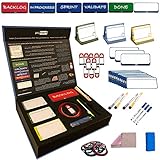
- ✔️ STACKABLE; Our magnetic cards have been designed and tested to ensure maximum stackability in any direction. They can be easily stacked, grabbed and move around on magnetic boards. Our unique magnetic properties ensure maximum flexibility on how you want to stack them in any direction and concept!
- ✔️ REUSABLE; Our magnetic boards can be cleaned easily with a wet cloth and reused. Our reliability tests proved that our cards can be used up to 50.000 times without any degradation in quality! They are designed to be your partner in long years to come
- ✔️ SMOOTH WRITING; We thought about everything on our products from selecting special materials to color tones of the cards, thicknesses, sizes and markers go best with cards in order to make your writing experience unique
- ✔️ VISUAL; Everything is about being visual! Our products provide maximum visualization by grouping tasks with different color codes, attaching blocker cards to ease the identification of critical tasks as well as help prioritizing. Moreover, you can specify task owners right on the task cards in the dedicated area!
- ✔️ WASHABLE; Our design is special and highest quality possible for a megnetic card. We did not use any paper based material on our products and card design is printed by using UV printing technology directly on a special PVC material. It makes our products fully washable
Write down the boundaries of the change before choosing ceremonies, roles, or software:
- The product, service, or work stream in scope.
- The team and the stakeholders who request, review, use, or support its work.
- The types of work the team handles and how priorities are currently set.
- The constraints the new workflow must respect, such as approval, compliance, release, or operational requirements.
- Observable indicators that would show progress toward the stated outcome.
Choose indicators that relate to the problem. If the issue is delayed feedback, look at when useful feedback arrives and whether it can still influence decisions. Do not adopt a universal metric simply because it is associated with Agile.
2. Map the current workflow and its constraints
Follow several representative work items from request to delivery. Note who handles each step, where decisions are made, and where work waits, is handed off, or must be redone. This gives the team and its partners a shared view of the current process rather than an assumption that the team’s meetings are the only source of delay.
The Tool Desk
Outbyte PC Repair FREERepair Windows errors before they cause bigger problemsFix Now →Outbyte Driver Updater FREEFix the driver behind crashes, sound loss and screen glitchesFind Drivers →Rank #2

- COMPLETE AGILE MANAGEMENT SOLUTION: All-in-one physical Agile board kit including a full magnetic Kanban & Scrum board, 84 reusable magnetic cards, easel stand, markers, and accessories for Kanban, Scrum, Lean, Agile workflows, task tracking, and visual project management
- FULL MAGNETIC DRY ERASE BOARD WITH MULTIPLE SETUP OPTIONS: Lightweight high-density EVA magnetic board can be used on the included easel, mounted on a wall, or snapped onto other magnetic surfaces. Write directly on the board and move cards effortlessly as work progresses
- CUSTOMIZABLE KANBAN & SCRUM CARDS (84 PCS): Includes task cards, blocker cards, and column headline cards for Backlog, To Do, Doing, and Done. Blank headline cards allow full customization to match your workflow, team structure, or project type
- DESIGNED FOR VISUAL CLARITY & TEAM COLLABORATION: Color-coded cards and magnetic markers help teams quickly identify priorities, blockers, and progress. Suitable for daily standups, sprint planning, retrospectives, classrooms, and team task boards
- REUSABLE, DURABLE & EASY TO MAINTAIN: Premium magnetic cards and dry-erase surface are built for long-term use. Cards clean easily with the included cloth and eraser, making this a cost-effective Agile planning solution
Include the groups that can affect the work or be affected by a change. PMI’s transition guidance identifies policies, standards, regulatory pressures, portfolio management, architecture, operations, and release management as factors that can shape adoption. Ask the owners of those areas what must be preserved, where decisions can change, and what needs to be resolved outside the delivery team.
Make constraints visible during planning. If a required approval, shared dependency, or release process cannot change immediately, account for it in the workflow and involve its owner. A team cannot remove obstacles that sit beyond its authority simply by changing its board.
3. Choose an approach that fits the work
Scrum and Kanban are not interchangeable labels. Scrum is a defined framework; Kanban practices can help teams visualize and improve flow through existing stages. Choose based on how work arrives, how the team can make decisions, and what kind of change the organization can support. PMI’s transition strategies paper discusses Kanban as a way to manage flow and as a possible complement to other approaches.
Rank #3
- AGILE-INSPIRED DESIGN: Features a calming Kanban-style project board with smooth flow arrows and a serene meditating manager illustration.
- HIGH-QUALITY GLOSSY PRINT: Printed on durable glossy photo paper measuring 13x19 inches with fade-resistant ink for long-lasting vibrancy.
- MODERN OFFICE DECOR: Soothing palette of soft blues and greens with clean lines and modern typography creates a productive, tranquil workspace.
- VERSATILE DISPLAY: Perfect for home offices, bedrooms, studios, kitchens, and hallways, complementing a wide range of modern decor styles.
- LIGHTWEIGHT AND EASY TO HANG: Weighing only 0.3 pounds, this unframed rectangular poster is simple to display anywhere inspiration is needed.
| Consideration | Scrum may fit when… | Kanban practices may fit when… |
|---|---|---|
| Shape of the work | The team can work toward a product goal and benefit from a regular cycle of planning and review. | Work arrives continuously and improving flow through the existing process is a useful starting point. |
| Structure | The team needs Scrum’s defined accountabilities, events, and artifacts to organize inspection and adaptation. | The team needs to make current work and its movement through stages visible and improve that flow. |
| Organizational change | The organization can support the framework and the responsibilities it defines. | A smaller change to how existing work is visualized and managed is more feasible at first. |
| Dependencies and boundaries | Work can be organized around a product goal with the relevant people able to collaborate. | Work crosses existing stages or functions whose flow needs to be understood and improved. |
These are tailoring considerations, not a formal decision test. Teams can combine practices, but they should be clear about which practices they use and why. Do not call a collection of altered routines Scrum while omitting its core elements and expecting the framework’s benefits. The 2020 Scrum Guide explains how Scrum’s accountabilities, events, and artifacts work together and cautions that changing or omitting core elements can obscure problems and limit benefits.
Crashes, No Sound, or Screen Glitches?
Random freezes, missing sound and display glitches usually trace back to one bad driver. Find and replace yours safely.Free scan · under a minutePC Slower Than It Used to Be?
A free scan shows the junk files, broken settings and background clutter dragging Windows down - then fixes them in one click.Free scan · Windows 10 & 114. Start with a supported pilot or staged change
A pilot lets a team learn how a proposed workflow works in a specific context before deciding whether to expand it. PMI’s transition guidance describes options that include starting with selected practices or using a supported pilot; its Disciplined Agile greenfield roadmap frames improvement as an ongoing process of small changes.
Choose a team and a meaningful piece of work with enough authority to experiment, access to stakeholders, and support from the groups that can affect delivery. Before starting, agree on the goal, the indicators you will review, and a date to assess what happened. Be explicit about what the pilot can establish: one team’s experience can inform the next decision, but it does not prove that the same approach will work unchanged everywhere.
Rank #4

- Stackable Magnetic Kanban Cards — Premium magnetic Agile cards for stacking, moving, sorting, and grouping on any metal board. Build Kanban, Scrum, Lean, or hybrid workflows with flexible layouts.
- Reusable & Washable Agile Cards — PET laminate writing surfaces wipe clean with a damp cloth for repeated sprint planning, standups, classrooms, and PMO use.
- Smooth Writing Experience — Includes fine-tip card markers and board markers sized for clear handwriting on every card type.
- Visual Agile Workflows — Color-coded task cards, blockers, and column headers make priorities, owners, and blockers easy to see at a glance.
- 156 Magnetic Pieces — Task cards, detail cards, column headlines (including blanks), blockers, markers, and column tapes for richer backlogs and board setups than smaller starter kits.
A pilot without stakeholder access or organizational support may show what happens when a team is isolated, not whether the proposed workflow is viable. Bring decision-makers and affected partners into the experiment early enough to address obstacles.
Independent reader supportYour contribution helps us test, update, and keep practical guides available for everyone.5. Agree on responsibilities and working rules
For Scrum, use the Scrum Guide to understand the Product Owner, Scrum Master, and Developers accountabilities, along with the purpose of Scrum’s events and artifacts. The framework is intended to work as a whole; treating its components as labels while ignoring their purpose can hide problems rather than help the team inspect and adapt.
Whatever approach you select, make the practical decision rules clear to the team and its partners:
- Who prioritizes incoming work, and how are priority changes communicated?
- Who reviews or accepts outcomes, and how quickly can stakeholders respond?
- How does the team surface blockers and get decisions from outside the team?
- How will quality be checked before work is considered complete?
- Who can make workflow decisions, and which policies or approvals require another owner?
Prepare leaders and stakeholders as well as the delivery team. Changing the team’s meeting schedule without changing how work is requested, prioritized, reviewed, or approved leaves important parts of the workflow untouched.
6. Review evidence and adjust the workflow
At the agreed review points, compare what the team observes with the outcome it set at the start. Consider whether work is reaching users or stakeholders more usefully, whether feedback arrives in time to change decisions, whether quality is being maintained, and where work is waiting or blocked. Use evidence to identify what needs adjustment rather than treating adoption itself as proof of success.
Scrum emphasizes transparency, inspection, and adaptation. Scrum.org’s Evidence-Based Management Guide, published in May 2024, addresses value delivery under uncertainty. Neither source establishes universal numerical targets for an Agile transition. Select measures that illuminate your stated goal, look at trends alongside discussion, and avoid turning a single metric into a target or an individual performance score.
7. Expand only after learning from the change
Before extending the workflow, share what changed, what evidence the team observed, and what remains uncertain. Resolve obstacles within the pilot and address cross-team dependencies or organizational barriers with the people who own them. Decide which practices to retain, adapt, or stop, then use those lessons to shape the next stage.
PMI’s Disciplined Agile roadmap presents transformation as ongoing small improvements supported by guidance structures. Revisit whether the approach still fits as products, constraints, and organizational conditions change; a workflow is something to improve, not a one-time switch.
Common transition mistakes to avoid
- Starting with a tool: A board can make work visible, but it cannot by itself change priorities, decision rights, feedback, or organizational constraints.
- Piloting without support: A team needs stakeholder access and help from the owners of policies, approvals, and dependencies to test a workable transition.
- Using Scrum as a label: Omitting core elements while keeping the name can obscure problems and limit the framework’s benefits, as the Scrum Guide explains.
- Changing only team routines: Leaders and partners also influence requests, reviews, approvals, and release decisions, so include them in the transition.
- Promising results in advance: Define intended outcomes and report observed evidence in context; Agile adoption does not guarantee faster, cheaper, or more successful delivery.
PMI’s transition papers cited here were published in 2012 and 2013. They offer practitioner guidance on implementation choices, not proof of a universal success formula.
Quick Recap
Product prices and availability are accurate as of the date/time indicated and are subject to change. Any price and availability information displayed on Amazon at the time of purchase will apply.

