
Recommended Free Tools
iTechGuides is reader-supported. When you buy through links on our site, we may earn an affiliate commission. As an Amazon Associate I earn from qualifying purchases. Learn more
Yes. Move the speakers away first, then run the CRT monitor’s built-in degauss function according to its manual. If the speakers must remain close, use models whose manufacturer explicitly specifies magnetic shielding and follow the placement distances for that exact equipment. There is no universal “safe” distance for every speaker and CRT.
Why speakers can distort a CRT picture
Loudspeakers contain magnets that can create a magnetic field near the monitor. IBM says a nearby magnetic-field source such as a loudspeaker, or changing the monitor’s orientation, can make CRT color lose uniformity. The result may appear as colored patches, tinting or uneven purity rather than a problem with the video signal. See IBM’s CRT troubleshooting guidance.
Use this troubleshooting sequence
- Move the speakers away. Disconnect or reposition the suspect speaker so it is no longer beside or directly behind the CRT. Check whether the discoloration improves; removing the continuing magnetic source is the most important step.
- Degauss the monitor. Use the CRT’s on-screen degauss control or the procedure in its manual after moving the speaker. IBM explains that degaussing demagnetizes the CRT’s metal frame so it can return to a neutral field for more uniform color.
- Wait before trying again. Do not repeatedly activate degauss. IBM advises waiting at least 20 minutes before a second degauss cycle.
- Recheck placement. If the color problem returns when the speaker is moved closer, the location is still too close for that combination of equipment.
- Follow the monitor’s service guidance if it persists. If discoloration remains after the magnetic source is removed and the manufacturer’s degauss procedure is followed, the cited guidance does not establish a single diagnosis or repair. Consult the monitor manual or a qualified CRT technician rather than opening the display.
When magnetic shielding helps
Magnetically shielded speakers use construction intended to limit the field reaching nearby CRT hardware. Shielding can make close placement possible, but it is not a universal guarantee: effectiveness, permitted distance and the monitor’s sensitivity vary by model.
Outdated Drivers Are Slowing You Down
One free scan finds every outdated or missing driver and matches the right update for your exact hardware.Free scan · exact hardware matchWindows Errors? Fix Them Before They Spread
Repair common Windows errors and clear accumulated junk for a smoother, more stable PC - no reinstall needed.Free scan · no reinstallLook for the exact phrase “magnetically shielded” in the speaker manufacturer’s specifications or manual. Do not infer shielding from a product category, appearance or a seller’s generic description. The Onkyo CS-265W manual, for example, says its speakers have internal magnetic shielding. It also says that if discoloration remains, the display should be turned off for 15 to 30 minutes, then turned on again, with the speakers moved farther away if necessary. That procedure applies to that Onkyo system, not to every shielded speaker.
#1 Best Overall
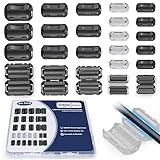
- 5-SIZE FERRITE BEADS KIT: 24pcs snap-on ferrite cores in 5 sizes (3.5mm×6, 5mm×6, 7mm×4, 9mm×4, 13mm×4). Universal fit for USB, HDMI, power cords, audio/video wires & data cables (3-13mm diameter)
- EMI/RFI FERRITE CHOKE TECHNOLOGY: Blocks electromagnetic & radio-frequency interference, enhances signal integrity for TVs, routers, speakers, home/office electronics
- SNAP-ON FERRITE RINGS, REUSABLE: Tool-free installation - open, wrap cables, snap shut! Removable and reusable without wire damage
- DURABLE FERRITE CHOKE CORE: Ni-Zn ferrite + Locking Clip. Blocks motor noise like a pro suppressor!
- ORGANIZED FERRITE STORAGE CASE: Sturdy plastic case for neat storage - ideal for electricians, IT pros, and DIY enthusiasts
Published placement distances are equipment-specific
Manufacturer recommendations differ substantially, so treat the figures below as examples for the named products rather than general standards.
| Equipment | Shielding status | Published guidance |
|---|---|---|
| Bose 601 Series IV | Not magnetically shielded | Place at least 18 to 24 inches from a monitor. Bose notes that the issue applies to CRT-style televisions. This model was sold from 2001 to 2004. |
| NEC XM37 CRT | Requires shielding for speakers placed next to the monitor | Keep unshielded speakers at least four feet away; speakers next to the monitor must be shielded. |
| Onkyo CS-265W | Manual says the speakers have internal magnetic shielding | If discoloration occurs, turn the display off for 15–30 minutes, turn it back on, and move the speakers farther away if needed. |
| Sarte Audio Concertino A5 | Manual discusses magnetic-field interference | Increase the distance between the speakers and CRT if interference occurs; no universal distance is given in the cited passage. |
How to choose a close-placement setup
Verify both manuals
Check the speaker documentation for an explicit shielding specification and the CRT manual for its degauss and placement instructions. A shielded speaker may still need separation from a particularly sensitive or large CRT.
Rank #2

- Packaging Includes: 20 snap-on ferrite cores with 5 different sizes included, suitable for cables with inner diameters of 3mm, 5mm, 7mm, 9mm, and 13mm
- Material Construction: Made of nickel-zinc ferrite material, which enhances the electromagnetic field around the coil and effectively resists external interference
- Easy Installation: Features a cylindrical snap-on design for simple installation-just open it, clip onto the cable, and it's ready to use without disconnecting wires
- Versatile Applications: Ferrite beads are widely suitable for electromagnetic interference (EMI) suppression in various electronic devices, such as data cables, USB cables, telephone lines, and network cables to shield against external electromagnetic interference
- Signal Quality Enhancement: Helps reduce RFI and EMI noise on cables to improve signal clarity and device performance across multiple cable types
Test before committing to the layout
With the monitor displaying a uniform white or gray image, place the speakers at the intended locations and look for color patches. If artifacts appear, move the speakers farther away and degauss once using the monitor’s prescribed procedure.
Do not rely on add-on “shields” without documentation
The cited manuals support changing speaker placement, using built-in shielding and degaussing the CRT. They do not establish that a random metal plate, foil wrap or aftermarket barrier will safely block the field or preserve audio performance. Such modifications can also affect speaker operation.
Quick Recap
Best Value
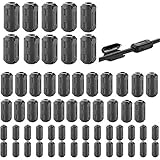
- Package included: 60 * cable clips (with 5 different size included) for cord with 3/ 5/ 7/ 9/ 13 mm inner diameter
- Ni-Zn ferrite. It can improve the electromagnetic field around the solenoid, thus avoiding outside interference.
- Easy to install and convenient to use. The cylinder can be dismountable, and the port has the elastic clip fastener.
- Helps reduce EMI on AC power lines. Black plastic enclosed ferrite core for 5 mm AC power cords. Great for cutting noise on USB, firewire, phone, power cord, coaxial, audio, video cables, etc.
- This rectangle ferrite Bead can be widely used in a variety of Data cables, USB cable, telephone line, network line to shield external electromagnetic interference.
Rank #4
![Clip-on Noise Filter,VSKEY[10pcs 5mm] Anti-interference High-Frequency Ferrite Core Choke Cable Clip for Home Audio System,Tvs,Speakers,Radio,Audio Equipment Noise Suppressor (0.2 inch inner diameter)](https://m.media-amazon.com/images/I/51LliP5djFL._SL160_.jpg)
- This RFI EMI Noise Filter 5.0mm(0.2inch)inner diameter: Suitable for Diameter 0.14 - 0.2inch(3.5mm- 5mm)cables, Application Occasion:Clip them on AC power lines, Car DVR Cord, Loudspeaker cable, Mouse cable,Keyboard cable,USB cable,AV cables,Video cable,Audio cable etc.
- This Noise Filter 0.2inch inner diameter, Suitable for Diameter 0.14 - 0.2inch cables, *These ferrite core noise Filter,superb at reducing EMI / RFI high frequency interference caused by home appliances and electronics.Effectively screen electromagnetic interference and filter out high-frequency noise pulses.the more effectively improve the signal quality of audio and video. (Please ensure that the sound is not caused by equipment failure.)
- This Noise Filter 0.2inch inner diameter, Suitable for Diameter 0.14 - 0.2inch cables, *Easy to install with double snap clips,can be dismountable,Just snap clip it on to a cable easily,Stop EMI and RFI effectively.and get clearer signal and audio sound quality.
- The ferrite cores come in two split halves, and clamp on to the cable whether it has a connector, or is hard wired to equipment. Install the ferrite core at the equipment side of the cable. If a cable has equipment that needs to be protected on both sides, install one at each end.(Depending upon circumstances, identifying and troubleshooting both of affected and offending devices are necessary for successful installation.)
- Packaging Includes:10PCS X 5.0mm inner diameter Noise Filter( VSKEY noise filter offer friendly customer service.If you're not completely satisfied, simply let us know and we will offer a prompt refund or replacement) )
Rank #3

- Complete Package Contents: 22PCS Snap on Ferrite Ring Cores Cable Clips with 5 Different Size 3.5mm/ 5mm/ 7mm/ 9mm/ 13 mm inner diameter.
- Snap on Ferrite Core Design: Features plastic housing that helps to reduce EMI and RFI on AC Power Lines.
- Wide Application Range: Ferrite Bead Choke widely used on a variety of data cables, including USB Cables, Telephone Lines, Aerial Feed, Satellite Cables, Network Cables to shield from external electromagnetic interference and reduce electro-magnetic interference while improving signal integrity.
- Easy Installation Process: Clip-on design allows for easy installation and change without tools or complicated procedures.
- Convenient Storage Solution: All pieces come in a reusable transparent box for easy organization and storage.
What the symptoms tell you
- Color improves immediately after moving a speaker: the speaker’s magnetic field was affecting CRT color uniformity; keep it farther away or replace it with a documented shielded model.
- Color remains uneven after moving the speaker: run the monitor’s degauss procedure and observe the manufacturer’s waiting interval before any second cycle.
- Color returns only when the speaker is close: the chosen distance is unsuitable for that speaker-and-monitor pair, even if the speaker is advertised as shielded.
- Discoloration persists in all positions: use the monitor’s service documentation for further diagnosis; the supplied manufacturer guidance does not identify one definitive fault.
Product prices and availability are accurate as of the date/time indicated and are subject to change. Any price and availability information displayed on Amazon at the time of purchase will apply.

