
Free tools Windows power users keep installed
One-click scans. No signup required.
iTechGuides is reader-supported. When you buy through links on our site, we may earn an affiliate commission. As an Amazon Associate I earn from qualifying purchases. Learn more
Audacity records audio, not MIDI, so you can’t capture your digital piano by simply plugging in a USB cable. You capture the sound the instrument produces by routing its audio output into your computer, either directly or through a USB audio interface. Use the piano’s USB port only if its manual confirms that it carries audio. Then select the correct input in Audacity, set the recording level, record, and save a WAV or AIFF copy before you edit anything.
Check whether your piano’s USB port carries audio
USB does not automatically mean audio. Many electronic keyboards use their USB port to send MIDI note data to a computer, and Audacity cannot accept MIDI input for recording. According to the Audacity Manual’s FAQ on recording troubleshooting, the program can only record an audio signal, meaning the actual sound the keyboard produces. That is why a keyboard that appears connected in Audacity can still show no waveform.
Look in your keyboard’s manual for a statement that its USB connection supports audio. If the manual does not say so, treat the USB port as MIDI-only and use an analog audio output instead.
What’s actually slowing this PC down?
Pick the symptom - the matching free tool is one click away.
Choose a connection route
Your options depend on what your piano outputs and what your computer accepts. The table compares the four routes that the Audacity documentation describes.
#1 Best Overall

- Pro performance with great pre-amps - Achieve a brighter recording thanks to the high performing mic pre-amps of the Scarlett 3rd Gen. A switchable Air mode will add extra clarity to your acoustic instruments when recording with your Solo 3rd Gen
- Get the perfect guitar and vocal take with - With two high-headroom instrument inputs to plug in your guitar or bass so that they shine through. Capture your voice and instruments without any unwanted clipping or distortion thanks to our Gain Halos
- Studio quality recording for your music & podcasts - Achieve pro sounding recordings with Scarlett 3rd Gen’s high-performance converters enabling you to record and mix at up to 24-bit/192kHz. Your recordings will retain all of their sonic qualities
- Low-noise for crystal clear listening - 2 low-noise balanced outputs provide clean audio playback with 3rd Gen. Hear all the nuances of your tracks or music from Spotify, Apple & Amazon Music. Plug-in headphones for private listening in high-fidelity
- Everything in the box: Includes Pro Tools Intro+, Ableton Live Lite, Cubase LE, and Hitmaker Expansion: a suite of essential effects, powerful software instruments, and easy-to-use mastering tools
| Route | Use it when | What to check |
|---|---|---|
| Keyboard USB audio | The keyboard manual states that USB carries audio | MIDI-only USB connections give Audacity no audio to record. |
| Headphone or line output to a computer line input | Your computer has a true line-level input | Match the cable and connectors at both ends. A mono microphone input is not the same as a line input, and many laptops have only a mono microphone jack. |
| Line output to a USB audio interface | Your computer has no suitable line input | The interface needs line-level inputs and a cable that fits your piano’s output and the interface’s input. |
| Microphone placed near the piano | No workable direct output connection | This captures room sound rather than the instrument’s direct signal. Audacity’s documentation lists a high-quality microphone as an alternative. |
Your piano’s output type and connector sizes determine the correct cable, and no single adapter works for every model. Confirm the output and input types on both devices before you buy or plug anything in.
Set up the input in Audacity
- Connect your chosen route and turn the piano on. Confirm that your operating system lists the computer input or audio interface in its sound settings. If it does not appear there, Audacity cannot see it either.
- Open Audacity and select the recording device in the Audio Setup toolbar. You can also open Preferences and go to Audio Settings to choose the device there.
- Choose the channel setting that matches your piano. If the keyboard has stereo outputs, select the two-channel stereo recording option. If it has a single output, record in mono. The Audacity tutorial on selecting a keyboard device recommends stereo when stereo outputs are available.
- Play the loudest passage you expect to record and watch the Recording Meter. Adjust the input level so the peaks stay below clipping. The Audacity Manual’s Recording page advises aiming for a maximum peak of around −6 dB, or 0.5 if your meters are set to linear rather than dB. This is a general setup target from that page, and the publication date is not stated there.
- If you want to hear the instrument through the computer while you record, enable input monitoring in Audacity if your setup offers it. An interface with direct monitoring can also let you hear the signal without the software.
Record and save a safety copy before editing
- Click Record, play the piece, and click Stop.
- Go to File > Export and export the take as a WAV or AIFF file. Audacity recommends doing this immediately after recording and before any editing, so you keep an unaltered source file.
- Only after the safety copy is saved should you trim, apply effects, or edit the project.
Menu labels and device names can differ between Audacity versions and between operating systems, so check the names against the version you have installed.
Rank #2

- The new generation of the songwriter's interface: Plug in your mic and guitar and let Scarlett Solo 4th Gen bring big studio sound to wherever you make music
- Studio-quality sound: With a huge 120dB dynamic range, the newest generation of Scarlett uses the same converters as Focusrite’s flagship interfaces, found in the world's biggest studios
- Find your signature sound: Scarlett 4th Gen's improved Air mode lifts vocals and guitars to the front of the mix, adding musical presence and rich harmonic drive to your recordings
- All you need to record, mix and master your music: Includes industry-leading recording software and a full collection of record-making plugins
- Everything in the box: Includes Pro Tools Intro+, Ableton Live Lite, Cubase LE, and Hitmaker Expansion: a suite of essential effects, powerful software instruments, and easy-to-use mastering tools
Troubleshooting
No waveform when connected by USB
Confirm that your keyboard manual says its USB port carries audio. If it sends MIDI only, Audacity will not show a waveform from that connection. Switch to a headphone, line, or other audio output and use one of the audio routes above.
The Tool Desk
Outbyte Driver Updater FREEScan for outdated or missing drivers - takes under a minuteDriver Scan →Outbyte PC Repair FREEClear out junk files and repair common Windows errorsFree Scan →The input does not appear in Audacity
Check that the operating system recognizes the device first. If you connected the interface or keyboard after Audacity was already open, restart Audacity or choose Transport > Rescan Audio Devices.
Rank #3

- Podcast, Record, Live Stream, This Portable Audio Interface Covers it All - USB sound card for Mac or PC delivers 48kHz audio resolution for pristine recording every time
- Be ready for anything with this versatile M-AUDIO interface - Record guitar, vocals or line input signals with two combo XLR / Line / Instrument Inputs with phantom power
- Everything you Demand from an Audio Interface for Fuss-Free Monitoring - 1/4" headphone output and stereo 1/4" outputs for total monitoring flexibility; USB/Direct switch for zero latency monitoring
- Get the best out of your Microphones - M-Track Duo’s transparent Crystal Preamps guarantee optimal sound from all your microphones including condenser mics
- The MPC Production Experience - Includes MPC Beats Software complete with the essential production tools from Akai Professional
The recording is distorted
Check whether you are plugged into a microphone input, which is designed for a much weaker signal than a keyboard’s output. Move to a true line-level input or a line-level USB audio interface, then lower the input level and repeat the peak check.
Only one channel is recorded
Check how many outputs your piano provides. If it has stereo outputs, change the Audacity recording setting to two-channel stereo and record again.
Rank #4
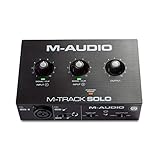
- Podcast, Record, Live Stream, This Portable Audio Interface Covers it All - USB sound card for Mac or PC delivers 48kHz audio resolution for pristine recording every time
- Be ready for anything with this versatile M-AUDIO interface - Record guitar, vocals or line input signals with one combo XLR / Line Input with phantom power and one Line / Instrument input
- Everything you Demand from an Audio Interface for Fuss-Free Monitoring - 1/8" headphone output and stereo RCA outputs for total monitoring flexibility; USB/Direct switch for zero latency monitoring
- Get the best out of your Microphones - M-Track Solo’s transparent Crystal Preamp guarantees optimal sound from all your microphones including condenser mics
- The MPC Production Experience - Includes MPC Beats Software complete with the essential production tools from Akai Professional
Nothing is audible while monitoring
Audacity offers audible input monitoring, but it must be enabled in your setup. If you use a headphone output from the keyboard, the built-in speakers may mute, depending on the instrument, so check the keyboard’s controls if you hear nothing.
Quick Recap
Best Value

- FEATURES / POWER SPECS : Extra Long 6 Feet USB 2.0 Type-A Male to Type-B Male Connection Cable / High-Speed Transfer Rates up to 480Mbps 28AWG/2C+26AWG/2C with Error-Free Performance
- COMPATIBILITY: Ideal for connecting your Yamaha Digital Piano, Roland Music Workstation, Donner DEP 10 20 45 DDP-80 88 Key Digital Pianos, Alesis, Korg, Casio Keyboard, AKAI Professional, Arturia KeyLab MiniLab, Midiplus, Nektar Impact, Novation, M-Audio MIDI Controller, Native Drum Controller, Pioneer, Hercules DJControl Inpulse, Numark DJ Mixer, Behringer U-Phoria, PreSonus AudioBox Audio Interface, Microphone, Studio Equipment to a Laptop, Computer (Mac PC) and other devices with a USB-B port
- Also is a good USB Type B replacement cord for devices like Printer, Scanner, Fax, Hard Drive Disk, Server, Keyboard, DAC, Development board, UPS, Digital Camera, Arduino, Silhouette Cameo Cutting Tool Machine, Blue, Brother, Canon i-SENSYS PIXMA SELPHY, CyberPower, Dell, Epson Artisan Expression Home Premium Stylus WorkForce, Fujitsu, HP Deskjet ENVY LaserJet OfficeJet PhotoSmart, IOGEAR, Lexmark, Panasonic, Snowball mic
- SAFETY: Pwr+ cables manufactured with the highest quality materials. CE/FCC/RoHS certified.
- WARRANTY: 30 Days Refund - 24 Months Exchange. PWR+ is WA, USA based company. We are friendly Customer Support Experts
The Bottom Line
“”
Product prices and availability are accurate as of the date/time indicated and are subject to change. Any price and availability information displayed on Amazon at the time of purchase will apply.

