
Free tools Windows power users keep installed
One-click scans. No signup required.
iTechGuides is reader-supported. When you buy through links on our site, we may earn an affiliate commission. As an Amazon Associate I earn from qualifying purchases. Learn more
To understand what an insurance policy may pay for, start with its declarations or information page, then read the coverage grant, definitions, exclusions, limits, endorsements, and post-loss conditions. The declarations page summarizes key details; the full contract determines how coverage applies. Because wording and legal requirements vary by policy, insurer, and state, check your own documents and ask the insurer or a licensed agent or broker about anything unclear.
1. Check the declarations or information page
This summary identifies the policy and its main coverage details. Compare it with what you intended to buy, and ask for corrections if something is inaccurate.

- Named insured and, where relevant, covered drivers or other insured people
- Insured property, vehicle, address, or other identifying details
- Policy number and effective and expiration dates
- Coverage types, limits, and deductibles
- Listed endorsements, lienholders, or other parties with an interest in the insured property
What appears on the page varies by policy type. For example, auto policyholders should check the listed drivers, vehicles, limits, and deductibles. Keep a written record of any correction request.
Recommended Free Tools
2. Find what the policy covers—and how it defines it
Read the coverage grant
The insuring agreement, sometimes called the coverage grant, describes the loss or event the insurer agrees to cover, subject to the rest of the policy. Identify the specific coverage that might apply to the situation you care about. A general statement of coverage is not the whole answer: definitions, exclusions, limits, and conditions can narrow or shape it.
#1 Best Overall
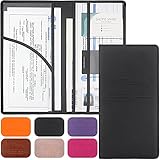
- 💼 CAR ORGANIZER PRACTICALITY: Car registration and insurance holder has multi-function clear compartments which can organize various items very well. The car document holder large pocket for insurance documents and 2 pockets for vehicle registration, 3 small pockets for driver's license, ID cards, AAA cards, business cards, receipt, key contact information cards, etc. It can fully meet your needs
- 👁EASY TO ACCESS AND READ: Car registration and insurance holder keeps your documents organized and keep them tidy and secured, which is stress-free to identify the documents in the folder and quickly reach the document when asked
- 🧲MAGNETIC CLOSURE DESIGN: The car insurance card holder is built with inner magnetic closure, which will keep your vehicle paperwork organizer closed to secure your vehicle documents from humidity and wear and tear. The car insurance holder is your first choice for protecting important car documents and certificates
- ✨PREMIUM MATERIAL: Car registration and insurance holder are made of high-quality PU leather and vinyl PVC. The beautiful cover of 3d embossing provides a comfortable soft touch feeling and professional look. This material is durable, Tolerant, and looks very naturally beautiful
- 💖SECURED & ASSURED: If you have any product problem when you use our car registration and insurance holder. Please feel free to contact us by email, we will do our best to offer a satisfactory solution for you within 24 hours
Check defined terms
Look for words the policy defines, often in a dedicated definitions section. A defined term may have a narrower or different meaning than it has in ordinary conversation, and that contractual meaning can affect whether a provision applies.
Homeowners and renters policies may use different approaches to describing covered causes of loss, including listed perils or broader coverage subject to exclusions. The policy wording—not a general description of the policy type—controls.
3. Read exclusions in context
An exclusion is a provision that denies or restricts coverage for specified causes of loss, people, property, or locations. Read the full clause, not just its heading. Check its definitions, exceptions, and any other provisions it references, then read it alongside the coverage grant.
Rank #2

- 👁️Quick Accessible: Inside the car insurance and registration card holder, the clear inner material makes you easy to find documents when you open it up, you can see exactly what they are and quickly show them when asked, even no need to take the stuff out.
- 💼Document Well Organized: The car document holder keeps your car documents organized and keep them tidy and secured, which make it easy to quickly identify and reach paper or cards in the folder. The glove box organizer for car has 6 compartments to keep all your car essential auto car essentials organized.
- 🧲Hidden Magnetic Closure: The glove box document holder are built with hidden magnetic closure, which will keep your car paperwork organizer neat and tidy and ensure the certifications stay closely and and completely protective within the registration pouch.
- 💖Premium Material: The car manual holder is made from high-quality ECO-friendly PU leather material. The car insurance holders with the best sewing and crafted is durable, wear-resistant, and has a luxurious look. This material of the registration holders is durable, wear resistant and waterproof. The insurance card holder for car has a clear window so you can easily see all the documents when you open it up.
- 🌷Compact Size: With the perfect size dimensions of 5.0in x 9.4in x 0.4in, this vehicle license and registration holder for car will fit into glove compartments, sun visors, door holders, consoles, etc. The glove box organizer is precisely designed to fit all of your car documents.
Flood and earthquake are commonly excluded in homeowners or renters coverage, but that is not universal. Separate policies or endorsements may change what applies. Confirm the terms in your own contract rather than assuming that a loss is either covered or excluded based on its label.
4. Understand limits, sublimits, and deductibles
Limits and sublimits
A limit is the maximum amount the insurer agrees to pay under the applicable coverage, subject to the policy’s terms. Some policies also set lower limits for particular categories of property, events, or claims. Find the limit that applies to the specific type of loss rather than relying on the largest figure on the declarations page.
A dwelling limit is not necessarily the home’s market value, nor does it automatically guarantee that every rebuilding cost will be covered. Check the contract’s valuation and replacement-cost language. Building-code upgrade coverage and provisions that may allow payment above a stated limit are specific terms to verify; they are not universal features.
Deductibles
A deductible is the amount or share the policyholder is responsible for under the contract. Check how it applies to the coverage and loss in question, including whether a separate deductible is specified. Do not assume that one deductible applies to every claim.
The Tool Desk
Outbyte Driver Updater FREEFix the driver behind crashes, sound loss and screen glitchesFind Drivers →Outbyte PC Repair FREEClear out junk files and repair common Windows errorsFree Scan →5. Compare endorsements with the base policy
An endorsement, sometimes called a rider, is a written change to the policy. It may add coverage, remove or restrict it, change a limit, or otherwise modify the base wording. Find the endorsements listed for your policy, obtain and read their actual text, and check their effective dates. The endorsement’s name or a short summary may not explain all of its effects.
6. Find claim duties and deadlines before you need them
Look in the policy’s conditions or duties-after-loss section for what you must do after an incident. Depending on the contract, requirements may include notifying the insurer, providing proof or other documentation, supplying complete and correct information, and cooperating with the claim process.
Rank #4

- 【Very Practical】The leather car document holder has multi-function clear compartments which can organize various items very well. Clear and easy to read both documents when you open the card holder. 1 large pocket for insurance documents and 2 pockets for vehicle registration, 3 small pockets for driver's license, ID cards, AAA cards, business cards, receipt, key contact information cards, etc. In short, this new car accessories can fully meet your needs.
- 【Premium PU Leather】 The Auto Document Wallet is made from high quality PU leather, case holder passed Euro REACH Quality Standard, US EN71 and US CA Prop 65 Test. The material of card organizer is durable, wear-resistant and naturally beautiful, and looks very decent.
- 【Perfect Size 】 This car document holder is a moderate size. The closure size, 5.3in x 9.5in x 0.35in, the expansion size: 10.7inch * 9.5inch. whether men or women will not feel too big or too bulky when holding car paperwork organizer. And it can be fit for any glovebox or console well.
- 【Exquisite Workmanship】 Every this Car Insurance Registration Holder is handmade by skilled workers. This glove box organizers is a great way to keep all of your important documents. Beautiful cover of 3D embossing, exquisite workmanship, uniform and beautiful seam, sturdy and durable.
- 【Perfect Gift】Beautiful cover of embossing recognition, this car insurance holder is a good gift for yourself, lovers, friends, family or someone, for an anniversary, Christmas, Valentine's Day.
There is no single deadline or document checklist that applies to every policy. Read the current contract and contact the insurer promptly after a loss to confirm the steps and timing that apply. If you are unsure what to submit, ask the insurer rather than guessing.
Independent reader supportYour contribution helps us test, update, and keep practical guides available for everyone.7. Ask questions that point to the contract
If an explanation is unclear, ask the insurer, agent, or broker to identify the specific policy section, definition, exclusion, limit, or endorsement behind the answer. For a claim decision you dispute, request the reason and the policy wording the insurer relied on, and retain the correspondence. Getting clarification in writing can help you keep an accurate record.
Quick wins for a faster PC:
Fix the driver behind crashes, sound loss and screen glitchesFind Drivers →Clear out junk files and repair common Windows errorsFree Scan →Scan for outdated or missing drivers - takes under a minuteDriver Scan →For questions about applicable state requirements, consult your state insurance department. A general guide cannot determine whether a particular loss is covered; that depends on the contract, applicable law, and the facts of the claim.
Best Value

- 【HIGH QUALITY】: made of premium PU leather and durable vinyl PVC, strong and firm enough for your long-term use.
- 【SAFE PROTECTION】: this registration and insurance card holder keeps your document free from tearing, bending or being ruined by moisture.
- 【TIME SAVER】: clear inner pouches design helps you identify the correct document quickly with one glance.
- 【WIDE RANGE OF USES】: can store your bills, insurance cards, vehicle registration and other essential paperwork.
- 【SPECIAL GIFT】: beautiful sleek and trim design. This car document holder is a good gift for yourself, your lover, friends and family.
How the documents differ by insurance type
Homeowners and renters
Review the declarations, coverage grant, exclusions, and general conditions. A renters policy generally covers the renter’s contents rather than the building structure, but check the actual coverage and any separate policies or endorsements. Verify flood and earthquake terms in the contract rather than treating common exclusions as a rule for every policy.
Auto
Confirm the covered drivers and vehicles, coverage types, limits, deductibles, and any excluded drivers. The declarations page can help you spot a mismatch between the listed details and the coverage you expected.
Health
Health plans use different documents and terminology from property and auto policies. In California, the Evidence of Coverage (EOC) describes covered and excluded care, costs, and cost-sharing. An Explanation of Benefits (EOB) describes a processed claim, including payment and, where applicable, reasons for a full or partial denial. An EOB is an explanation of a claim outcome, not a replacement for the plan’s coverage terms.
How to compare two policies
Premium alone does not show which contract offers more useful protection. Compare the terms that matter for the risks you want to address:
- Covered causes of loss and exclusions
- Limits and sublimits for relevant property, events, or claims
- Deductibles and how they apply
- Valuation or settlement terms
- Notice, proof, and other claim duties
- Endorsements and any gaps that remain
For a home policy, also check whether replacement-cost terms and building-code coverage are included. State rules, policy wording, and endorsements can affect a comparison, so compare the actual documents rather than relying only on summaries.
Quick Recap
Product prices and availability are accurate as of the date/time indicated and are subject to change. Any price and availability information displayed on Amazon at the time of purchase will apply.

