
iTechGuides is reader-supported. When you buy through links on our site, we may earn an affiliate commission. As an Amazon Associate I earn from qualifying purchases. Learn more
A Geiger–Mueller (GM) tube needs a high-voltage bias supply, but its correct operating voltage depends on the exact tube model. For a portable counter, a boost converter feeding a voltage-multiplier ladder can provide that bias with low idle power; the design must also handle event pulses, current limiting, regulation, and high-voltage safety.
Choose the tube’s voltage before choosing the supply
GM tubes operate at high voltage, but generic ranges are context—not settings. Analog Devices’ design note gives a broad range of 350 V to 900 V, depending on tube construction and gas mixture, while its CN-0536 reference design describes commonly used tubes biased from 250 V to 500 V. Use the exact tube datasheet and operating curve to select the bias, ideally near the middle of the stated plateau where the manufacturer recommends operation.
The model-specific ZP1221/01 specification hosted by the UK gives a 400 V plateau threshold, a 100 V plateau length, and a recommended supply voltage of 450 V. Those values describe that tube, not a universal GM-tube setting. A supply with a nominal 400 V output is not automatically compatible with another model.
How the low-power supply works
Boost converter and multiplier ladder
The low-power circuit in Analog Devices’ design note uses a boost converter to feed a seven-stage voltage-multiplying ladder. The ladder raises the converter voltage to the tube’s required bias. Because the tube draws very little current between radiation events, minimizing the supply’s own idle consumption is central to battery life.
#1 Best Overall

- 3 in 1 Testing: Comes with 0.005‑5cGy/h wide measuring range of , the Geiger counter can detect hard β, γ and X rays.
- Better Display: Designed to have and high sensitivity, the tube tester supports clear display on the test result, easy to read.
- Flexible Using: Can be widely used in detecting domestic nuclear radiation, industrial nuclear radiation, treatment nuclear radiation and more.
- Good Materials: Adopting premium glass and stainless steel materials, the Geiger counter tube is not easy to malfunction and also very .
- Simple Carrying: Light in weight and compact in size as well, the Geiger Miller tube is very convenient to carry for both indoor and outdoor use.
Sense an early multiplier stage
Instead of measuring the full high-voltage output through a very high-value resistor divider, the design takes feedback from the lowest multiplier stage. This permits more ordinary feedback-divider resistor values and reduces current wasted in a divider across the full output. The trade-off is that the sensed point is not the final output itself, so load regulation must be considered.
The design note reports 80 µA input current in its no-load condition with no radiation events. This is a result for the illustrated circuit and test condition, not a general supply specification. Each detected event removes a small amount of charge from the tube’s supply, so average demand also depends on event frequency and charge per event.
Rank #2

- This popular tube is used in many DIY Geiger Counter projects.
- Sensitive to beta and gamma radiation.
- Each tube is tested and carefully packaged.
Layout and output behavior matter
Switching-converter layout, filtering, decoupling, and shielding where needed require care. High-value resistor availability and board leakage can also complicate conventional high-voltage divider sensing. The note cautions that switching converters require careful board layout; poor layout can undermine stable, low-noise operation.
Quick wins for a faster PC:
Scan for outdated or missing drivers - takes under a minuteDriver Scan →Repair Windows errors before they cause bigger problemsFix Now →Reference designs and hardware paths
| Option | Published details | Best fit and trade-offs |
|---|---|---|
| Build the low-power converter | Boost converter plus seven-stage multiplier in the Analog Devices design note; reported 80 µA input current at no load with no radiation events. | Useful when low idle consumption and a tube-specific design are priorities. You must design for the tube’s voltage, pulse extraction, current limit, layout, and regulation. |
| Analog Devices CN-0536 | Adjustable bias described from 280 V to 500 V; 400 V nominal output maintained between 390 V and 410 V; 33 µA average current consumption for the described operating behavior. | An Arduino-shield-form-factor reference design with pulse conditioning and an Arduino-style interface. Its GM tube is not included, and the actual tube must fit its voltage range. |
| MICOD/Shmytov GM EVM | Manufacturer’s July 2026 datasheet describes selectable 400 V or 500 V output, pulse shaping, and a typical 10 MΩ tube current-limiting resistor. | A module-oriented option when one of the selectable voltages suits the tube. Verify the exact module, output option, input requirements, pulse output, and availability with the vendor. |
| ORTEC 556/556H laboratory supply | ORTEC lists support for GM tubes and other detector classes; its published range is broader than this portable, low-power application. | More appropriate to a laboratory or NIM-format setup than a compact battery-powered counter. Compare its voltage and current capabilities, regulation, size, and cost with the actual use case. |
CN-0536 uses a fixed-frequency boost stage, a Cockcroft–Walton multiplier, and hysteretic voltage-mode control. Its feedback comes from the first multiplier stage to reduce divider losses, with some load-regulation trade-off. The voltage and current figures in the table belong to CN-0536; they are not specifications for the earlier seven-stage design note.
Rank #3

- This kit is compatible with Arduino
- Made of premium quality materials it will not rust and is durable
- Supports most of the Geiger tube: M4011 STS-5 SBM20 J305 etc (the 330600V operating voltage of the Geiger tube can be supported)
- Support the computer (PC) data acquisition Matlab analysis and processing
- Good kit for MCU software developers that just want to drive Geiger Tube for their own software
ADI’s CN-0536 page lists EVAL-CN0536-ARDZ at $147.40 in the page content reviewed, but pricing can change; check the current listing before purchase. The page also says the GM tube is not included. PASCO marks its SN-7927A educational product discontinued and points to the PS-3238 Wireless Geiger Counter as an alternative.
What to verify before building or connecting a module
- Operating point: Match the supply to the exact tube’s recommended voltage and plateau, rather than selecting from a generic GM-tube range.
- Output under load: Check regulation and ripple as event pulses draw charge from the supply. An early-stage feedback method reduces divider loss, but may permit more variation at the output.
- Current limiting and pulse extraction: Ensure the design limits tube current appropriately and provides a usable pulse signal for the counter electronics.
- Input and idle power: Confirm the supply’s input voltage and quiescent consumption suit the portable system; event rate also affects average demand.
- Measurement: Use appropriately rated high-voltage measurement equipment. No particular meter or probe model is established here.
High-voltage safety and measurement limits
These supplies produce hazardous high voltage. The MICOD/Shmytov EVM manufacturer warns that the board can retain charge after its input is removed and requires adequate electrical clearance to prevent arcing. The EVM datasheet also says to ensure the output is discharged before touching the board or attached equipment. Treat the output and multiplier capacitors as energized until discharge has been verified with suitable equipment.
Rank #4
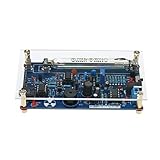
- This kit is compatible with Arduino.
- Made of premium quality materials, it will not rust and is durable.
- Supports most of the Geiger tube: M4011, STS-5, SBM20, J305, etc. (the 330~600V operating voltage of the Geiger tube can be supported).
- Support the computer (PC) data acquisition, Matlab analysis and processing.
- Good kit for MCU software developers that just want to drive Geiger Tube for their own software.
A GM tube can detect events and provide a rough indication of a radiation field, but it cannot distinguish radiation type. The Analog Devices design note cautions that dose-rate calibration accuracy is poor. A bias supply and pulse-counting circuit alone therefore should not be presented as a calibrated radiation dosimeter.
What’s actually slowing this PC down?
Pick the symptom - the matching free tool is one click away.
Quick Recap
Best Value

- SUPPORT MOST GEIGER TUBES: M4011 can be installed directly, other can not be installed on the board, but the flying leads can also be used (digital multimeter measures the positive pole of the Geiger tube to the negative pole of the power supply, adjust the blue potentiometer until the multimeter displays DC 170volt)
- INTERRUPT OUTPUT Can be monitored by an external screen or a pointer meter. The output is interrupt output, the waveform is the falling of the pulse, and the low level is valid
- LOW FAILURE RATE: The circuit structure of DIY geiger counter parts kit is stable and the failure rate is extremely low
- VARIOUS DETECTIONS: Can detect X rays, gamma rays, beta rays, and can perform radioactive dose detection on marbles fordecoration, antiques, jades, overseas shopping products, 131, and various unknown minerals
- EXCELLENT RESIN MATERIAL: Adopt good quality resin material, possess impact , scratch , , heat , low temperature , possess excellent electrical properties
Sources
- Analog Devices: “A High-Voltage Bias Supply for a Geiger-Mueller Tube”
- Analog Devices CN-0536 reference design
- UK government-hosted ZP1221/01 specification
- ORTEC 556/556H product information
- PASCO SN-7927A product page
- MICOD/Shmytov GM EVM manufacturer datasheet, July 2026.
Product prices and availability are accurate as of the date/time indicated and are subject to change. Any price and availability information displayed on Amazon at the time of purchase will apply.

