
Windows Errors? Fix Them Before They Spread
Repair common Windows errors and clear accumulated junk for a smoother, more stable PC - no reinstall needed.Free scan · no reinstallCrashes, No Sound, or Screen Glitches?
Random freezes, missing sound and display glitches usually trace back to one bad driver. Find and replace yours safely.Free scan · under a minuteIf you mean a home-theater or home-audio subwoofer, start by testing its placement from your usual listening seat, then check phase, crossover, and level using the subwoofer and receiver manuals. A corner may increase perceived output, but it can also make bass uneven or boomy. If you mean a bass-guitar cabinet or PA speaker, do not assume these subwoofer steps apply; use the exact model’s manual.
First identify what kind of bass speaker you have
“Bass speaker” can mean a powered home subwoofer, a passive subwoofer with a separate amplifier, a soundbar subwoofer, or an instrument or PA cabinet. Their connections and controls are not interchangeable. The steps below concern home subwoofer setup; check your equipment’s manual before changing connections, gain, or controls.
Before adjusting anything, note the current connections and settings. A control labeled “bass boost,” “level,” or “crossover” can behave differently across products, so use the definitions and limits for your particular model.
Move the subwoofer and listen from your normal seat
Placement changes how bass interacts with the room, so the loudest spot beside the subwoofer is not necessarily where it will sound best. Klipsch says, “Putting a subwoofer in a corner of the room may cause the sub to sound louder.” That is a possibility, not a guarantee: reflections and room resonances can make bass uneven or boomy.
#1 Best Overall

- 10" front-firing spun-copper IMG woofer
- All-digital amplifier with 300 watts peak power
- Volume low pass crossover and phase control
- Line level LFE RCA inputs for maximum receiver compatibility
- Dimensions 14 5" x 12 5" x 16 4"
- Play familiar material with steady bass at a moderate level and sit in your normal listening position.
- Try a corner, then other practical locations, moving the subwoofer in small increments.
- Keep the port opening unobstructed. Klipsch recommends leaving wall clearance based on the port diameter; follow your model’s placement guidance.
- Choose the location that gives useful, even bass at the seat where you listen, rather than the position that sounds most impressive elsewhere in the room.
Klipsch recommends experimenting with placement, and PreSonus cautions that proximity to reflective boundaries can exaggerate bass. Teufel’s setup guidance also addresses room modes, which can make bass stronger in some positions and weaker in others.
Compare phase settings from the listening position
If the subwoofer offers a 0°/180° switch or other phase control, compare the available settings while seated in your usual spot and playing familiar bass-heavy content. Keep the setting that gives stronger bass there while blending naturally with the main speakers. HARMAN/JBL says 0° is typical for most applications; phase adjustment is an integration check, not a guaranteed loudness boost. See HARMAN/JBL’s subwoofer phase guidance.
Rank #2

- Seventour 10 inch Ultra Slim Under Seat Active Powered Car/Truck Subwoofer with Built-In Amplifier, Enclosure made of cast aluminum for excellent heat dissipation and reliable performance.
- This is a car subwoofer audio that features a personalized spider speaker protector as well as a speaker LED ambient light ring design. When the car is started, the subwoofer lights up with blue LED lights. Make your car look more cool and dynamic.
- This car subwoofer includes wired bass volume remote control. With gain, bass boost and crossover controls, peak power: 800 watts, giving you a stunning bass experience.
- The Car Sub supports low level RCA inputs. It is also compatible with high level inputs, adjustable input sensitivity, thermal protection circuitry, short circuit protection circuitry, overload protection circuitry, green power/red protection LED.
- Low Pass Filter: 50Hz - 150Hz, Bass Boost: 0 - 12dB @ 45Hz, Built-in Sub-Acoustic Filter Load @ 20Hz, Total Harmonic Distortion (THD): < 0.4%, Rated Fuse: 25A, Peak Power: 800 Watts, RMS Power Handling: 220 Watts, Impedance: 4 Ohms Frequency Response 20Hz - 500Hz, Signal to Noise Ratio: >90dB , Low Level: 300mV, Input Sensitivity, High Level: 0.9V, Dimensions (inches): 13.5"(L) x 10.2"(W).Thickness: 3.1"
Set crossover and level for your system
Crossover determines how the system divides bass between the main speakers and subwoofer; level controls the subwoofer’s contribution. Neither has a universal setting that makes every system louder or sound better. Use the receiver’s calibration procedure and the subwoofer’s manual as your starting point. If bass sounds boomy or poorly blended, reassess the level, crossover, and placement rather than raising everything indiscriminately. Klipsch and Teufel both describe setup in the context of the system and room.
For model-specific setup details, consult Klipsch’s subwoofer guidance or Teufel’s subwoofer setup instructions, as applicable to your equipment.
Rank #3
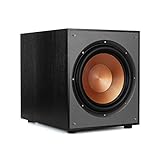
- 12" high excursion spun-copper Imp woofer
- 29 hertz – 120 hertz plus /- 3 dB
- 400 watt
- Max acoustic output 116dB
- Bass-reflex via rear firing port. Amplifier power (control/peak): 200 watts/400 watts
Stop increasing gain if the sound distorts
Turning up amplifier gain cannot produce unlimited clean output. When a signal exceeds an amplifier’s available headroom, clipping can cause distortion and may damage a speaker. Rockford Fosgate explains this risk in its C.L.E.A.N. gain-setting tutorial. Follow the manufacturer’s gain-setting procedure; if you hear distortion, reduce the level and check the signal chain and equipment matching instead of continuing to turn controls up.
Independent reader supportYour contribution helps us test, update, and keep practical guides available for everyone.When a different or additional subwoofer may help
If careful placement and setup still do not deliver the low-frequency output you want, a compatible subwoofer may be appropriate. Compatibility depends on the system, not just the word “subwoofer.” Before buying, check:
Rank #4
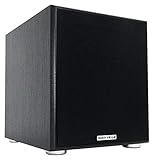
- POWERFUL BASS: 10" woofer with 600W peak/300W RMS output delivers tight, thumpy low end for movies, music, and gaming
- CLASS-D AMPLIFIER: Built-in amplifier precisely matched to the woofer and enclosure for clean, distortion-free sound
- ADJUSTABLE SETTINGS: Volume, crossover frequency, and phase controls allow you to customize your audio experience
- FLEXIBLE CONNECTIVITY: Features RCA line inputs/outputs and high-level speaker inputs/outputs to suit any setup
- DURABLE BUILD: MDF enclosure with high-grade vinyl finish and detachable foam grill for lasting performance and style
- Whether your receiver or system has a suitable subwoofer output and connection type.
- Whether the subwoofer is powered or needs a separate amplifier.
- Its manufacturer-stated frequency response and output capability, including the conditions behind those specifications.
- Available space, port clearance, and the listening area you want to cover.
A second subwoofer can improve bass coverage in some rooms, but it is not a guaranteed loudness upgrade for every setup. No particular model can be recommended without knowing your equipment, room, and budget.
Quick Recap
Best Value
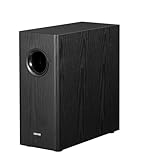
- [ Deep & Powerful 8-Inch Bass ]: Experience 35Hz deep bass with the T5s powered subwoofer, which features an 8-inch long-throw woofer and a powerful 70W RMS output (driven by Class-D amplifier). Perfect for home audio and home theater.
- [ Precision Control, Seamless Integration ]: Adjust the low-pass filter (30Hz–160Hz) and phase selector (0°/180°) to match any home stereo or active speaker setup.
- [ Slim Design, Low Distortion ]: This space-saving compact subwoofer fits into any spaces. The 18mm MDF cabinet with a front-firing driver and right-firing acoustic port minimizes resonance for clean, tight bass. Its wood grain finish and low-profile grille blend seamlessly with home decor.
- [ Smart & Energy-Efficient ]: Auto-standby saves power after 15 minutes of inactivity. The built-in amplifier ensures plug-and-play operation – no external receiver needed! Includes 3.5mm-to-RCA and RCA cables for instant setup.
- [ Two Connections ]: ① Sub out-equipped speakers/amps: RCA to T5s’ Signal In; main speaker connects directly to audio source. ② No sub out: Connect T5s in series (audio source → T5s’ Signal In → T5s’ Signal Out → main speaker). Note: For ②, main speaker requires LINE IN (Bluetooth/USB/optical/non-wired not supported).
Product prices and availability are accurate as of the date/time indicated and are subject to change. Any price and availability information displayed on Amazon at the time of purchase will apply.
Quick wins for a faster PC:
Scan for outdated or missing drivers - takes under a minuteDriver Scan →Clear out junk files and repair common Windows errorsFree Scan →Fix the driver behind crashes, sound loss and screen glitchesFind Drivers →
