
iTechGuides is reader-supported. When you buy through links on our site, we may earn an affiliate commission. As an Amazon Associate I earn from qualifying purchases. Learn more
To keep a YouTube channel showing live video around the clock, an encoder has to send one continuous feed to YouTube and keep sending it. Scheduling a stream in YouTube Studio creates the event page that viewers see, and it can promote the event in advance, but it does not supply any video. The feed has to come from something that stays switched on: your computer, a server you rent, or a cloud service such as StreamNeo.
This guide covers the setup for YouTube’s own tools first, then the settings that decide whether a 24-hour feed stays stable, and then the trade-offs you take on if the feed runs from a home machine.
Stream and broadcast: the two objects you will work with
YouTube’s live tools use two related objects. A stream is the audio-video feed your encoder sends to YouTube. A broadcast is the live event that viewers watch. A stream carries the signal, and a broadcast is the page that presents it. Google’s Live Streaming API documentation describes a channel with a 24/7 live feed, and a separate interview broadcast that uses content from that same feed, which shows that one feed can back more than one watchable event. The non-developer workflow below uses only YouTube Studio and an encoder, so you do not need to write code.
What’s actually slowing this PC down?
Pick the symptom - the matching free tool is one click away.
What you need before you start
- A YouTube channel with live streaming enabled. YouTube says first-time enablement can take up to 24 hours, so turn it on at least a day before you plan to start.
- A video file or a set of clips in the same resolution and frame rate, which will play as the looped content.
- A computer, server or hardware encoder that can run for days without interruption. Software encoders and standalone hardware encoders are both supported by YouTube.
- Upload bandwidth that is clearly higher than the bitrate you plan to send. A common margin is to keep the stream bitrate at no more than about 60 to 70 percent of your steady upload speed, so brief dips do not stall the feed. This is a practical margin, not a YouTube requirement.
- A stream key, which you will paste into the encoder. Treat it as a password (see the steps below).
Step by step: schedule the event and send the feed
- Confirm live streaming is enabled. In YouTube Studio, check that the channel is allowed to go live. If the feature was just enabled, wait for it to take effect before you schedule anything.
- Create the scheduled event. Open Live Control Room, use the Manage tab, and schedule a stream. Give it a title, description and start time. Scheduling gives you a page to promote, and viewers may receive reminders from it.
- Copy the server URL and stream key. Put the YouTube server URL and stream key from the event’s stream settings into the encoder’s server and stream-key fields. Paste the key only into the encoder you control.
- Configure the encoder. Set the resolution, frame rate, bitrate, keyframe interval and audio format listed in the table in the next section.
- Start the encoder at least 15 minutes early. YouTube recommends this so that the feed reaches YouTube and the preview is ready before the event time.
- Check the preview and click Go live. In Live Control Room, confirm the picture and sound in the preview. Then click Go live. Scheduling does not start the event by itself; the feed and this action do.
- End the event deliberately. Click End Stream in Live Control Room, then stop the encoder. If you stop the encoder first, the event may remain in a state you have to clean up.
Because the event stays live only while the feed arrives, the encoder must keep running from the moment you click Go live until you click End Stream. Repeatedly scheduling short events does not create a gapless 24/7 channel by itself; the continuous behaviour comes from one feed that keeps running.
#1 Best Overall

- Compact but Powerful Design: ZowieBox is smaller than a phone, featuring a tally light and LCD screen for streaming status. Capture console gameplay in up to 4K with zero-lag HDMI passthrough, while the built-in video encoder converts video for IP streaming. The IP stream can also be decoded back to a 4K HDMI signal.
- Standalone Game Streaming: Just plug and play—ZowieBox enables PC-free live gaming without affecting gameplay. As an RTMP hardware encoder and HDMI streamer, it delivers stable streaming directly from your source, making it ideal for gaming, live events, and professional broadcasting.
- NDI|HX3 Converter Technology: ZowieBox converts HDMI signals to NDI|HX3/HX2/HX, functioning as an NDI video encoder, or NDI Video Decoder for flexible IP workflows. Certified NDI technology enables low-latency gameplay streaming through OBS/vMix. Note: Encoder and decoder modes cannot run simultaneously; full NDI signals are not supported.
- UVC to HDMI Conversion: Supporting up to 4K@30fps and 1080p@60fps decoding, ZowieBox enables flexible conversion for webcam and video workflows. As a video decoder and HDMI to IP converter, it expands connectivity options for professional video devices. Note: USB capture card functionality is not currently supported.
- All-around Configuration Options: Control ZowieBox through its web UI on a PC, phone, or tablet. Manage connected PTZ cameras, tally light, video/audio, OSD, work mode, streams, network, and system settings. Support for VISCA over IP encoder workflows enables flexible PTZ control, while the dashboard provides video preview and system status.
Encoder settings that matter
The values below are the ranges YouTube publishes in its encoder settings guidance at the time of writing. Check the current figures in YouTube Help before you go live, because these recommendations change.
| Output | Video bitrate (YouTube’s published range) | Keyframe interval | Audio |
|---|---|---|---|
| 720p at 30 fps | 1,500 to 4,000 Kbps | 2 seconds | AAC, 128 Kbps stereo, 44.1 kHz |
| 1080p at 30 fps | 3,000 to 6,000 Kbps | 2 seconds | AAC, 128 Kbps stereo, 44.1 kHz |
| 1080p at 60 fps | 4,500 to 9,000 Kbps | 2 seconds | AAC, 128 Kbps stereo, 44.1 kHz |
- Resolution and frame rate should match your source file. Re-encoding a 1080p file to 720p discards detail, and upscaling does not add any.
- Bitrate is the main lever for stability. Pick a value inside the range that your upload speed can carry with margin. A bitrate that is too high for the connection causes buffering for viewers and frame drops at your end.
- Keyframe interval of 2 seconds means the encoder inserts a full reference frame every 2 seconds. Viewers’ players depend on that rhythm, so a longer interval can cause longer load times and stalls.
- Audio should be AAC at 44.1 kHz. A mismatched sample rate is a common cause of audio drift over long sessions.
Stream settings in YouTube Studio
The event’s stream settings include latency, DVR and automatic start and stop controls. These are choices rather than blanket recommendations. Lower latency reduces the delay between your feed and the viewer’s screen, but it can mean more buffering in the viewer’s player. DVR lets viewers pause and rewind inside the live stream. Automatic start and stop means the event goes live when YouTube receives the feed and ends when the feed stops. For an unattended 24/7 channel, automatic start is useful; automatic stop means a dropped feed will end the event, so check the labels in your own Studio before you rely on either setting.
Loop a video so the feed never runs out
A looped feed needs an encoder that repeats the source file. The two common ways are a command-line encoder and a scene editor. Either way, the content you loop must be content you have the rights to stream.
Rank #2

- 【Hardware H.265/H.264 Encoding at 1080P60】Dedicated hardware encoder delivers broadcast-quality 1080P60 streams with H.265/H.264 compression. Reduces bandwidth usage by up to 50% compared to legacy H.264-only solutions, while maintaining crisp, crystal-clear video output.
- 【Broad Protocol Support for IP Distribution】 Supports SRT, RTMP(S), RTSP, UDP, HTTP, HLS, WebRTC, TRTC, Icecast and SHOUTcast — integrate seamlessly with CDNs, surveillance NVRs, IPTV systems and browser-based monitoring dashboards. One device replaces multiple single-purpose streaming boxes.
- 【Browser-Based Setup in Minutes】 Set up in minutes through any browser — no software, drivers or OS compatibility issues. DHCP is enabled by default to prevent IP address conflicts on your network. Note: basic networking knowledge (IP address, RTSP/RTMP configuration) is recommended for advanced streaming setups.
- 【Compact Design with Flexible Deployment】Palm-sized form factor (approx. 90×54×29mm) fits easily behind monitors, on shelves, or in equipment racks. Low power consumption ensures reliable 24/7 operation for live events, remote monitoring, and digital signage.
- 【Professional Audio & OSD Overlay + 1-Year Warranty】 Supports HDMI embedded audio plus external 3.5mm input. Built-in OSD generator adds scrolling text, logos, or timestamps directly to the video stream — ideal for branding, event info, or security labeling. Backed by a 1-year warranty and 24/7 online technical support.
Option 1: ffmpeg on a computer or VPS
ffmpeg can read a file, loop it indefinitely, and send it to YouTube over RTMP. Replace the file name and the stream key. The primary YouTube ingest address has been rtmp://a.rtmp.youtube.com/live2, but copy the exact server URL that Studio shows you.
ffmpeg -re -stream_loop -1 -i loop-video.mp4 -c:v libx264 -preset veryfast -b:v 4500k -maxrate 4500k -bufsize 9000k -pix_fmt yuv420p -r 30 -g 60 -keyint_min 60 -sc_threshold 0 -c:a aac -b:a 128k -ar 44100 -f flv rtmp://a.rtmp.youtube.com/live2/YOUR_STREAM_KEY-stream_loop -1repeats the input forever.-rereads it at real-time speed, which keeps the feed from running ahead of the clock.-g 60with-r 30produces a keyframe every 2 seconds. For 60 fps, use-r 60 -g 120and a bitrate in the 1080p60 range.- For a playlist, list the clips in a text file as
file 'clip1.mp4'per line, then runffmpeg -re -stream_loop -1 -f concat -safe 0 -i list.txtwith the same output options. All clips must share resolution and frame rate, or the output will be inconsistent.
Option 2: OBS Studio
In OBS, add a Media Source to the scene, select your file, and tick Loop. Under Settings, open Stream, choose YouTube as the service, and paste the server and stream key from Studio. Under Settings, open Output and set the keyframe interval to 2 seconds. Then click Start Streaming and check the preview in Live Control Room.
Scheduled broadcasts on top of a continuous feed
For creators who want a 24/7 feed and also want a separate timed event, such as a live interview, Google’s Live Streaming API describes the pattern. A single live stream can back a long-running broadcast, and a second broadcast can be bound to that same stream and made live while the first continues. This is an advanced route: it means creating stream and broadcast resources through the API, binding them, and transitioning each broadcast to testing or live. If you are not writing code, treat the event as a separate planned item and keep the main feed running in Studio.
Rank #3

- 【Innovative Product with Leading Technology】- Equipped with an advanced H.265 /H.264 dual encoding chip, supports 4K UHD (3840x2160) video input and output, with a maximum frame rate of 30fps at 4K resolution and up to 120fps at 2K and lower resolutions, delivering a smooth and detailed visual experience. It also supports HDCP 1.4 decryption, easily decoding various HDMI ultra HD video sources, delivering a cinematic visual experience for both professional live streaming and 4K ultra HD content transmission.
- 【Multi-protocol and Multi-platform Compatibility】- Fully compatible with streaming protocols such as HTTP, RTSP, RTMP(S), SRT, HLS(M3U8), MP4, Multicast(UDP, RTP, PTL), FLV, WebRTC, TRTC, ICECAST, it can simultaneously output 4 video streams with different protocols and push them to live streaming platforms such as YouTube, Facebook, Twitch, and Vimeo with one click. Simultaneous live streaming across multiple platforms can be achieved without additional equipment.
- 【Highly Customizable Settings to Meet Individual Needs】- It supports adding static text, scrolling captions, brand logos, and timestamps. Users can freely adjust core parameters such as video resolution, frame rate, and bitrate, and also perform personalized editing functions such as video cropping, rotation, flipping, and mirroring. It supports dual input of HDMI embedded audio and line-in audio, with adjustable sound quality, making your live stream content more distinctive and allowing you to create a unique brand live stream style.
- 【Stable and Efficient Transmission, Easy Operation】- Employing HDMI to Ethernet core connection technology, it ensures stable and reliable network transmission with low latency and no lag, adapting to various network environments. Equipped with an intuitive user interface and detailed instruction manual, no professional technical background is required; setup can be completed quickly after connecting the device. It is also compatible with multiple terminals such as computers and mobile phones for management, and the video stream status can be viewed in real time via a URL.
- 【Lifetime Free Warranty and Technical Supports】- All URayCoder video codecs come with a lifetime free warranty and technical supports, supporting secondary development and feature customization to meet enterprise-level personalized needs. Meanwhile, we providing many kinds of customization services such as shell pattern printing, logo addition, hardware and function development, ensuring reliable quality and worry-free after-sales service.
What YouTube archives, and what you must keep yourself
YouTube’s encoder setup guidance states that streams under 12 hours are automatically archived. A continuous 24-hour feed is longer than that threshold, so do not count on one complete automatic archive of the whole session. If a durable recording matters, record the output locally as well. Check the file size growing during setup, so you know the recording is working before the first long run.
Do these 3 things before closing this tab:
1Fix the driver behind crashes, sound loss and screen glitches2Repair Windows errors before they cause bigger problems3Scan for outdated or missing drivers - takes under a minuteKeep the feed up: power, network and failover
Power and sleep
A home computer must not sleep, hibernate or restart for updates during the run. Disable sleep in the operating system’s power settings, schedule updates for a different time, and use a UPS if power cuts are common where you live. A UPS only covers short outages; it does not cover a router that goes down for hours.
Network
Wired Ethernet is more stable than Wi-Fi for a long upload. Keep the encoder machine off the same bandwidth-heavy tasks, such as large downloads or cloud backups, because a saturated upload is the most frequent cause of a dropped feed.
Rank #4

- ⭐【Innovative Product with Leading Technology】- Equipped with an advanced H.265/H.264 dual encoding chip, supports 1920x1080 resolution input and output, achieving 60fps high-definition presentation with realistic and delicate color reproduction and lossless detail. It also supports HDCP 1.4 decryption, easily decoding various HDMI high-definition video sources, delivering a cinematic visual experience for both professional live streaming and high-definition content transmission.
- ⭐【Multi-protocol and Multi-platform Compatibility】- Fully compatible with streaming protocols such as HTTP, RTSP, RTMP(S), SRT, HLS(M3U8), MP4, Multicast(UDP, RTP, PTL), ONVIF, FLV, it can simultaneously output 4 video streams with different protocols and push them to live streaming platforms such as YouTube, Facebook, Twitch, and Vimeo with one click. Simultaneous live streaming across multiple platforms can be achieved without additional equipment.
- ⭐【Highly Customizable Settings to Meet Individual Needs】- It supports adding static text, scrolling captions, brand logos, and timestamps. Users can freely adjust core parameters such as video resolution, frame rate, and bitrate, and also perform personalized editing functions such as video cropping, rotation, flipping, and mirroring. It supports dual input of HDMI embedded audio and line-in audio, with adjustable sound quality, making your live stream content more distinctive and allowing you to create a unique brand live stream style.
- ⭐【Stable and Efficient Transmission, Easy Operation】- Employing HDMI to Ethernet core connection technology, it ensures stable and reliable network transmission with low latency and no lag, adapting to various network environments. Equipped with an intuitive user interface and detailed instruction manual, no professional technical background is required; setup can be completed quickly after connecting the device. It is also compatible with multiple terminals such as computers and mobile phones for management, and the video stream status can be viewed in real time via a URL.
- ⭐【Lifetime Free Warranty and Technical Supports】- All URayCoder video codecs come with a lifetime free warranty and technical supports, supporting secondary development and feature customization to meet enterprise-level personalized needs. Meanwhile, we providing many kinds of customization services such as shell pattern printing, logo addition, hardware and function development, ensuring reliable quality and worry-free after-sales service.
Backup encoder and failover test
YouTube recommends testing a backup encoder before you rely on one. Run the primary and backup encoders, then stop the primary or unplug its Ethernet cable and check that playback moves to the backup. Treat this as a test of your setup, not a promise of seamless recovery.
Copyright and reused content
YouTube’s policies apply to live streams in the same way they apply to uploads. A looped feed is still content you must have rights to: music, footage and images need licences or permission. Repeating earlier material can also trigger reused-content restrictions. Check each clip before it goes into a loop. The free copyright safety checklist from StreamNeo walks through the same questions. YouTube’s current policy pages are the authority, and they change.
Troubleshooting
| Problem | Likely cause | Fix |
|---|---|---|
| Preview stays blank or Go live is not available | Encoder not sending, wrong server URL or key, or encoder not started | Re-paste the URL and key into the correct fields, start the encoder, and wait for the preview. |
| Live streaming cannot be used yet | First-time enablement still in progress | Wait up to 24 hours after enabling, then try again. |
| Feed stops after a few hours | Computer sleep, a power cut, an encoder crash, or bitrate above upload speed | Disable sleep, add a UPS, lower the bitrate, and watch the encoder log. |
| Viewers see buffering | Bitrate too high for upload, or keyframe interval not 2 seconds | Lower the bitrate and set the keyframe interval to 2 seconds. |
| Audio slowly falls out of sync | Sample rate mismatch | Set audio to AAC at 44.1 kHz and restart the encoder. |
| Stream key may be exposed | Key pasted into a shared or public place | Reset the key in Live Control Room and update the encoder. |
| No archive after a 24-hour run | Streams under 12 hours are archived automatically; longer feeds are not guaranteed to be | Record locally, and check the file during setup. |
Cost notes
- Home computer: the cost is electricity for a machine that runs 24 hours a day, plus the upload bandwidth it uses. Your own electricity tariff and upload plan decide the total.
- Rented server (VPS): the monthly fee depends on the provider and the specification you choose. Add the cost of the bandwidth it uses. Check the provider’s own pricing before you compare it with anything else.
- Hardware encoder: a standalone device adds a one-time purchase cost and still needs the same network and power. YouTube’s list of verified encoders includes AWS Elemental MediaLive, a broadcast-grade cloud service that suits larger productions. Assess its cost against your use case.
To compare the monthly cost of a home machine with a cloud service using your own figures, use the cloud vs PC cost calculator.
Best Value
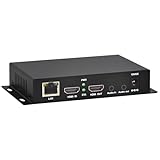
- 【Local Recording & Video Cropping – EH1211 Exclusive Features】 This mini HDMI video encoder supports local recording to USB drive or TF card – it can record both RTSP streaming video and direct HDMI input to external storage. The built-in video cropping function lets you customize the encoding region, making it easy to adapt input to needed displays or focus on specific areas. With its space-saving design, EH1211 is ideal for classrooms, conference rooms, and digital signage installations.
- 【ORIVISION Advantage& Ultra Mini Model】- This ORIVISION ultra mini video encoder has high integration with low cost. Ultra mini size(125x72x25mm) and light weight (200g) of H.265 encoder is perfect for live broadcasting applications with frequent move or tiny device installation space. IP encoder has 1 X HDMI Input and loop-out, 1 X 3.5mm audio input,1 X 3.5mm audio output(new), 1X USB2.0 port(new), 1X TF card port(new). IPTV encoder support audio encoding without video input.
- 【1080P@30HZ Input/Output Resolution & 2 Channel Output】- HDMI encoder supports max 1080P@30 resolution HD input and output. The video encoder for live broadcasting can output 2 channels feeds at the same time. While only 1 channel can reach 1080p output. The H.265/ H.264 encoder supports multiple different protocol feeds output at the same time, but does not support simultaneous output 1080P30.
- 【Multi-Protocols & Software & Platform & Flip Supporting】- Hardware encoder supports protocols including HTTP/HTTPS/RTSP/RTMP/RTMPS/SRT/UDP/RTP/FLS/FLV,is compatible with Onvif protocol. Multicast UDP/RTP. HDMI video encoder supports software like Flashplayer, OBS, VLC player, Vmix..etc. Fit for Youtube, Facebook, Ustream, Livestream, Twitch, Vimeo, Streamspot, Dacast, Tikilive, Netrmedi, etc. This video encoder also supports new function of image rotation and mirror flip. More convenient for live broadcasting.
- 【Powerful OSD Setting】- OSD setting function of the live broadcasting encoder makes it easy for you to add any self-defined text, time and image overlay on your video when output displayed. You may add any text/logo at any position to announce your copyrights with this hevc video encoder.
Or let it run in the cloud
If you would rather not keep a computer or home connection running for days, StreamNeo keeps a YouTube channel live 24/7 from uploaded videos. It is YouTube only, it plays uploaded videos rather than going live from a camera, and it runs from the cloud, so your computer can be off.
- Upload. Upload a recording or build a playlist in StreamNeo.
- Add your stream key. Paste your YouTube stream key once.
- Go live. Start the slot and StreamNeo loops the content to your YouTube channel from the cloud.
- Nothing has to stay on at home. No computer, OBS or home connection needs to run for the stream to continue.
- Any quality up to 4K 60fps at one price. Content streams as uploaded, with no re-encode and no quality tiers, for one flat price per slot.
- Automatic recovery if YouTube drops the stream.
- The first day is free with no card, one free day per account.
- Storage: 10 GB per slot, pooled across your active slots.
Plans run for a day, a week, a month, 6 months or a year, and you can cancel any time. The Monthly plan is $9.99 per month. Start with the free day at app.streamneo.com/register and see whether a cloud feed fits your channel.
Quick Recap
Product prices and availability are accurate as of the date/time indicated and are subject to change. Any price and availability information displayed on Amazon at the time of purchase will apply.

