
iTechGuides is reader-supported. When you buy through links on our site, we may earn an affiliate commission. As an Amazon Associate I earn from qualifying purchases. Learn more
Investigate an incident by preserving the live record, building a timestamped timeline, and testing explanations against evidence—not by treating a confident recollection as fact. During an active response, reduce user impact first; reconstruct causes and agree on improvements once the situation is controlled.
Why hindsight can distort an incident account
After an incident, the eventual explanation can make earlier clues seem obvious. But responders made decisions with the information available at the time, and a later narrative can blur what was observed, when it was observed, and what was only inferred. Google SRE recommends examining contributing conditions without indicting an individual or team, and assuming people acted with good intentions and the information they had then (Google SRE: Postmortem Culture).


A useful investigation keeps three things distinct: recorded observations, actions and decisions, and hypotheses about causes. A correlation—such as an error increase after a deployment—is a lead to test, not by itself proof that the deployment caused the incident.
The Tool Desk
Outbyte Driver Updater FREEScan for outdated or missing drivers - takes under a minuteDriver Scan →Outbyte PC Repair FREEClear out junk files and repair common Windows errorsFree Scan →During the incident, preserve evidence and mitigate
Maintain a working incident document while responders investigate. Record observations and their sources as they occur: monitoring alerts, user reports, relevant logs, deployments or configuration changes, decisions, escalations, and mitigation steps. Include timestamps and clarify what each time represents. A live record reduces reliance on memory and gives the later timeline a factual starting point (Google SRE Workbook: Incident Response; Google SRE: Anatomy of an Incident).
#1 Best Overall
- Record what was seen, where it came from, and when it was seen.
- Log decisions and actions, including who took them and when, where that information is available.
- Separate a measured or reported fact from an interpretation. Label explanations as hypotheses until supported.
- Keep incident coordination clear, with defined roles and a clear line of command.
Do not delay mitigation while trying to establish a complete root-cause account. Google’s response guidance prioritizes assessing impact and mitigating it; detailed root-cause analysis and post-incident fixes follow once the incident is under control (Google SRE Workbook: Incident Response).
Reconstruct a timeline that distinguishes events
After immediate impact is controlled, arrange the record in sequence. Do not collapse the start of a problem into the time it was detected: these are different events, and the gap between them may matter. Include the impact and the evidence behind each entry. If the time of an event cannot be established, mark it unknown rather than presenting an estimate as a recorded fact. Google’s incident guidance identifies a timeline as a core part of an incident record (Anatomy of an Incident).
| Timeline entry | What to record |
|---|---|
| Incident start | When the issue began, if the record supports that time |
| Detection | When a monitor, user, or responder first identified the issue |
| Escalation | When the incident was raised or additional responders were engaged |
| Mitigation | What action reduced impact and when it was taken |
| Resolution | When the incident ended or service returned to the relevant condition |
For each timestamp, identify its meaning and source—for example, an alert time is not necessarily the time the underlying fault began. Read the sequence for gaps and test competing explanations against the recorded evidence. If the available record does not answer a question, say so rather than filling the gap with a plausible story.
Analyze causes without assigning blame
A postmortem should explain the incident’s impact, what responders did, what conditions contributed, and what will change. Focus on the system and circumstances: what information was visible, what safeguards or signals existed, and how those conditions shaped the event. Avoid judging an action as obviously wrong only because the eventual explanation is now known. Google SRE’s guidance is to identify contributing causes without indicting individuals or teams (Postmortem Culture: Learning from Failure).
Teams can agree in advance which events require a postmortem. Google SRE gives examples including user-visible downtime or degradation, data loss, on-call intervention, unusually long resolution, and monitoring failure (Google SRE).
Turn findings into owned improvements
Capture follow-up actions that address the contributing conditions, not just the most visible symptom. Depending on what the incident revealed, improvements may concern prevention, detection, mitigation, coordination, or communication. Each action needs a named owner and a deadline, and progress should be tracked through completion. Google Cloud describes postmortem work as a sequence of creating the record, capturing facts, analyzing causes, planning improvements, and executing that plan (Google Cloud Architecture Center: Conduct thorough postmortems).
Rank #4
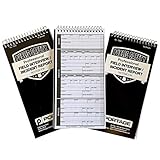
- THE IDEAL SIZE - The field interview and incident report notebook is a slim 3.75” x 6” pocket sized police notebook that fits easily and comfortably in a uniform pocket
- TAKE NOTES ON THE GO - This professional reporter’s notebook makes it easy taking notes in the field. we use a .75mm thick cover, twice as rigid as most competitors. The extra stability provides a sturdy writing surface, so you are always prepared
- FORM KEEPS YOU ORGANIZED - This notebook includes a simple, yet comprehensive form for recording key notes, ensuring you don’t miss important details. Each report has individual sections for case numbers, time, date, location, etc
- DURABLE CONSTRUCTION - Our appointment planners are made with extra thick covers, bound with coated spiral bindings, and rounded page corners, that make for a professional and durable notebook that stands the test of time. Portage is built to last
- TRIED AND TESTED DESIGN - Our Notepads have been tested and perfected by the professionals that use them daily. This notebook has been designed to keep all cases and information organized and accessible
A recommendation without an owner or a way to track it is not yet a completed improvement. Tie each action to a finding so the team can see what risk or response weakness it is meant to address.
Recommended Free Tools
For cybersecurity incidents, use current response guidance
For cybersecurity response, NIST’s SP 800-61 Revision 3 was finalized in April 2025 and superseded Revision 2. NIST frames incident response as part of cybersecurity risk management; consult the current project page for the publication and related materials (NIST Incident Response project). The timeline and evidence practices above support investigation, but they do not replace applicable organizational procedures or cybersecurity-specific requirements.
Quick Recap
Product prices and availability are accurate as of the date/time indicated and are subject to change. Any price and availability information displayed on Amazon at the time of purchase will apply.

