
Free tools Windows power users keep installed
One-click scans. No signup required.
iTechGuides is reader-supported. When you buy through links on our site, we may earn an affiliate commission. As an Amazon Associate I earn from qualifying purchases. Learn more
In the United States, a building’s age can signal possible lead paint, but it cannot tell you whether a particular home has lead or whether it currently poses a hazard. The reliable route is to match the question to the right test: a certified inspector locates lead-based paint, while a certified risk assessor evaluates hazards in paint, dust, and soil and recommends what to do. Soil near older buildings can also matter, especially where children play or people garden.
What makes an older building or its soil a lead concern?
Federal guidance uses 1978 as the key screening cutoff for U.S. housing: homes built before then may contain lead-based paint. EPA estimates that about three-quarters of U.S. homes built before 1978 still contain some. The likelihood varies by construction period:
| Home construction period | Estimated share likely to contain lead-based paint |
|---|---|
| Before 1940 | 87% |
| 1940–1959 | 69% |
| 1960–1977 | 24% |
These EPA estimates describe groups of homes, not the condition of an individual property; the cited EPA page does not state the figures’ publication year. Age is a reason to investigate, not a diagnosis. State and local rules may use different requirements or apply additional protections.
What’s actually slowing this PC down?
Pick the symptom - the matching free tool is one click away.
Paint condition and wear
Peeling, chipping, cracking, or chalking paint can release contaminated chips and dust. Paint on surfaces that rub together or receive frequent use—such as windows and doors—may create dust through friction even when damage is not obvious. Intact lead paint is generally less likely to pose a hazard than deteriorating or disturbed paint, but it still warrants monitoring.
#1 Best Overall

- 2-in-1 LEAD DETECTION: Safe Home provides the only LEAD COMBO-KIT on the market which includes 10 DIY surface swabs that issue results in 30-seconds to a detection of 5 ppm AND a sample-submission kit for optional in-depth Lead testing at our EPA-certified lab to a detection of 0.006 ppm. All of this…in ONE KIT!
- DIY LEAD SCREENING: Safe Home provides the only Do-It-Yourself Lead screening kit that uses ultra-sensitive ACS (American Chemical Society) Grade Reagents, in our test swabs. This minimizes background interferences and issues more reliable results, than competitive brands. Safe Home costs a bit more, but you can trust the quality of our products.
- OPTIONAL LEAD TESTING AT OUR CERTIFIED LAB: Contractors and discerning homeowners can also use our Lead Sample Submission Kit, for optional testing at our EPA-certified lab. Testing at our laboratory meets EPA, NLLAP, RRP, and PPE guidelines. Our lab results can also be used for disposing of remediated materials to hazardous vs. non-hazardous landfills. NOTE: Lab fees are required for optional testing at our EPA-certified laboratory.
- MULTI-PURPOSE APPLICATIONS: Test for Lead in paint, dust, soil, wood, toys, furniture, metal, plastic, and more. Includes simple instructions for DIY screening and for sample collection and submission to our EPA-certified lab, for testing. MADE in the USA with domestic and international components. *Please Note: If testing surfaces that are sealed like ceramics, only the outer surface will be tested.
- EXPERIENCED CUSTOMER SUPPORT: Before, during, and after DIY screening or LAB testing for Lead, Safe Home provides qualified personnel with 40+ years of experience in testing Lead, to guide you. Reach out any time. We are happy to assist!
Soil around the building
Soil near the foundation and roof dripline can collect particles from exterior lead paint. Roadside soil may also be affected by historical leaded gasoline, while industrial activity or hazardous-waste sites are other possible sources. Contaminated soil can be swallowed directly or tracked indoors on shoes, clothing, pets, and objects, adding to household dust. EPA’s guidance on lead in soil explains potential sources and testing.
How to tell whether a property may need assessment
Use these observations to decide whether to arrange testing; none can confirm or rule out lead by itself:
Rank #2

- SLGi Home Test Kits includes sampling tools, a prepaid return shipping label, instructions, and analysis.
- We perform Lead FLAA analysis by EPA Method 7000B for (1) paint, dust, or soil sample.
- Your results will be ready within (5) business days of your kit arriving at our lab.
- Your sample takes 1–5 business days to reach our lab.
- Check the building’s age and jurisdiction. Find the construction date if possible. For U.S. federal screening, pre-1978 housing is the relevant context, but requirements can vary by state, territory, Tribal jurisdiction, and local program.
- Look for damaged or high-wear paint. Note peeling or chalking areas and painted windows, doors, porches, fences, or other surfaces that may rub, chip, or shed.
- Consider past and planned work. Sanding, scraping, demolition, renovation, and repeated friction can create dust, including when paint was previously covered.
- Include outdoor use. Consider bare soil near the building, roads, or known industrial or waste sites, and whether children play there or people grow food in it.
- Choose a test based on the question. A paint inspection identifies lead paint; a risk assessment looks for current hazards and recommended controls. EPA says, “The only way to know for certain whether a building has lead-based paint or lead hazards is to have it tested.” See EPA’s overview of lead abatement, inspection, and risk assessment.
Which test answers your question?
| Option | What it evaluates | Best fit |
|---|---|---|
| Lead-based paint inspection | Whether and where lead-based paint is present | You need to identify painted surfaces containing lead, for example before planning work |
| Lead risk assessment | Whether current hazards exist in paint, dust, or soil, and what actions are recommended | You need to understand present exposure risks and appropriate controls |
| Soil laboratory analysis | Lead concentration in the submitted soil sample | You want soil tested; EPA identifies qualified laboratory analysis as the preferred approach |
An inspection does not, by itself, establish that there is a current hazard; a risk assessment addresses that broader question. EPA recommends using certified professionals. For soil, use a qualified laboratory, including an EPA-recognized National Lead Laboratory Accreditation Program (NLLAP) lab where appropriate. Local extension offices and some health departments may also offer testing. An online mail-in kit may simply be a way to submit a sample to a laboratory; check the lab’s credentials, the soil sample it accepts, and whether the report gives a concentration. A consumer soil test does not replace a certified risk assessor’s evaluation of the property.
Windows Errors? Fix Them Before They Spread
Repair common Windows errors and clear accumulated junk for a smoother, more stable PC - no reinstall needed.Free scan · no reinstallOutdated Drivers Are Slowing You Down
One free scan finds every outdated or missing driver and matches the right update for your exact hardware.Free scan · exact hardware matchDo not interpret a soil result in isolation as proof that a home is safe. Meaning depends on the sample, testing method, land use, and applicable standards. EPA’s current hazard standards and clearance-level guidance distinguishes reportable levels from action levels. Its October 2024 final rule changed the reportable dust standard to any level measurable by an EPA-recognized laboratory; do not rely on older floor or window-sill figures as the current standard. For reportable dust levels below action levels, EPA describes HEPA vacuuming of furnishings and regular damp cleaning as best practices. Consult the current EPA guidance for how standards apply to a specific case.
Rank #3

- Kit tests for the presence of lead in soil
- 0, 100, 200, 300, and 400ppm (mg/L) detection levels
- 1 to 10 minute test time
- Includes test strips, reagent, and sample container for five tests
How to avoid creating a hazard during renovation
Do not sand, scrape, or otherwise disturb suspect paint just to check it. In covered renovation, repair, or painting work that disturbs lead paint in pre-1978 housing or child-occupied facilities, EPA’s Renovation, Repair and Painting (RRP) program requires lead-safe certified contractors. The EPA pamphlet Steps to Lead Safe Renovation, Repair and Painting was updated in March 2026. Which rules apply can depend on the work, property, and jurisdiction; state, Tribal, territorial, and housing-assistance programs may impose or administer requirements.
Before hiring, ask whether the contractor is certified under the applicable EPA or authorized state program, what containment and cleanup plan applies, and whether independent clearance testing is appropriate for the project. A visual check or general consumer swab is not a clearance decision. Arrange professional assessment and suitable post-work testing as required for the job and location.
Rank #4
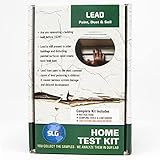
- Lab fee and mailing fee included.
- This kit test for lead in paint, dust, or soil, and is sent to Schneider labs for accurate testing. All tests are done with EPA certified methods.
- This SLGI Home Test Kit is designed for the sample collection of multiple samples (Packs), either paint, dust, and/or soil, and analysis turn around time (Days) starts the moment the kit arrives at our lab.
- Results are sent out based on the turn around time purchased (Days), and by 6:00pm EST.
What to do if a person may have been exposed
A building inspection or soil test measures the property, not a person’s exposure. If a child may have been exposed, discuss blood lead testing with a health care provider. Lead exposure can occur through swallowing or breathing contaminated material; the EPA guide to reducing lead exposure at home covers common household pathways and precautions.
Quick Recap
Best Value
- SLGi Home Test Kits includes sampling tools, a prepaid return shipping label, instructions, and analysis.
- We perform Lead FLAA analysis by EPA Method 7000B for (10) paint, dust, and/or soil samples.
- Your results will be ready within (5) business days of your kit arriving at our lab.
- Your samples take 1–5 business days to reach our lab.
- Your samples must all be submitted together.
Product prices and availability are accurate as of the date/time indicated and are subject to change. Any price and availability information displayed on Amazon at the time of purchase will apply.

