
Free tools Windows power users keep installed
One-click scans. No signup required.
iTechGuides is reader-supported. When you buy through links on our site, we may earn an affiliate commission. As an Amazon Associate I earn from qualifying purchases. Learn more
You may be able to borrow before your startup makes sales, but “startup use is allowed” does not mean a lender will approve you. In the United States, start by matching the amount and use of funds to a loan program, then show a lender how the business can repay. SBA 7(a) loans and Microloans are two routes to investigate; both still involve lender review of your business and borrower profile.
Can you get a business loan before you make sales?
Possibly. A pre-revenue business can seek financing, but it must make a credible case for repayment without an established sales record. The U.S. Small Business Administration (SBA) says 7(a) borrowers must be operating, for-profit U.S. small businesses that meet size and activity rules, are creditworthy, and have a reasonable ability to repay. A startup’s projections and assumptions therefore matter, and the participating lender—not the SBA—makes the credit decision. See the SBA 7(a) loan requirements.
An SBA guarantee supports the lender under program rules; it is not a guarantee that a particular borrower will receive a loan. The SBA does not publish an approval rate for pre-revenue startups in the cited program information, so there is no sound basis for predicting your odds from the fact that a business is new.
Which startup loan path fits your need?
| Financing path | Potential fit | Limits and points to check |
|---|---|---|
| SBA 7(a) | Broader eligible business needs, including working capital, equipment, supplies, and starting a business. | Most 7(a) loans have a $5 million maximum. The business must meet SBA eligibility rules, including operating-business, creditworthiness, and repayment-capacity requirements. Apply through a participating lender; rates and terms are negotiated subject to SBA limits. SBA 7(a) details. |
| SBA Microloan | Smaller startup or expansion needs, such as working capital, inventory, supplies, furniture, fixtures, machinery, or equipment. | Loans are made through approved nonprofit intermediaries and are capped at $50,000. The SBA reports an average loan of about $13,000 on its Microloans page, accessed October 4, 2026; that is a program average, not a promised amount. Proceeds cannot pay existing debt or buy real estate. Intermediaries decide credit and set terms. SBA Microloan details. |
| SBA 504 | A project focused on qualifying capital assets. | The SBA describes 504 as long-term, fixed-rate financing for capital assets, not general working capital. Ask a Certified Development Company whether the asset and borrower qualify. SBA 504 details. |
| SBIC investment capital | A business willing to consider investment rather than conventional debt. | This is investment capital, not a loan, and may involve different investor selection and ownership economics. The SBA information does not establish that a particular pre-revenue venture will qualify. SBA investment-capital information. |
| Limited SBA grant opportunities | Some research, community entrepreneurship-promotion, or exporting activities that match a grant program. | The SBA says its small-business grants are limited and tied to particular areas; they are not general startup cash. SBA grant information. |
For a smaller request, an SBA Microloan intermediary may be a practical starting point. For a larger or broader eligible need, investigate 7(a) lenders. If the funds are specifically for a qualifying capital asset, check 504 instead of treating it as a working-capital product.
#1 Best Overall

- Profitability calculations; cash flow function Calculates NPV and IRR for uneven cash flows
- Time-value-of-money and Amortization keys solve problems including: pension calculations, loans, mortgages, etc.
- Ideal calculator for students, managers and statisticians
- Built-in functionality : List-based one- and two-variable statistics with four regression options: linear, logarithmic, exponential and power
- The BA II Plus calculator is approved for use on the following professional exams: Chartered Financial Analyst exam. GARP Financial Risk Manager (FRM) exam. Certified Management Accountants exam
How to find lenders and approach them
- Define the request. Write down the amount, when you need it, and an itemized use of proceeds—such as inventory, equipment, or initial working capital. A specific request helps a lender assess whether the product and repayment structure fit.
- Build the repayment case. Explain how the business moves from launch to revenue and cash available for payments. Include a timeline, the assumptions behind projected sales and costs, and a downside case. Do not present projections as established results.
- Prepare a business plan and records. Describe the customer, product or service, launch plan, costs, and route to revenue. The SBA says most lenders expect a business plan for startup funding. Have ownership, formation, credit, cost, and collateral information ready as applicable; exact document requests vary by lender, loan size, and processing method.
- Use SBA Lender Match to start conversations. The tool asks about your business and funding need and can connect you with interested lenders. It is not a loan application; if matched, apply directly to the lender. Visit SBA Lender Match.
- Contact a Microloan intermediary if the amount and use fit. Find an SBA-approved intermediary in your area and ask about its application steps, terms, and any technical assistance it offers. Intermediaries make their own credit decisions.
- Compare written offers before accepting. Ask each lender the same questions about rate basis or APR, fees, payment schedule, total repayment, maturity, collateral, owner guarantees, required equity contribution, prepayment rules, and restrictions on use. Confirm the actual terms in the written offer.
What lenders may want to see
- A concise business plan covering the customer, product or service, launch milestones, costs, and path to revenue.
- The exact loan amount, a line-item budget for how it will be used, and the timing of each expense.
- Cash-flow projections with explicit assumptions, break-even expectations, and a clear source of repayment.
- Owner and business credit information, ownership details, and business-formation records requested by the lender.
- Quotes, purchase plans, or other support for proposed equipment and inventory costs.
- Information about available collateral, if requested. Collateral and guarantee requirements depend on the lender and applicable program rules.
There is no universal document list or collateral rule in the cited SBA guidance. Ask each lender what applies to your request rather than assuming a standard requirement.
How much can a new business borrow?
The program ceilings are not the same as an individual borrower’s likely loan amount. SBA 7(a) loans have a maximum of $5 million in most cases, while SBA Microloans are capped at $50,000. The Microloan program’s reported average of about $13,000 is descriptive, not a commitment to lend that amount. Your actual offer depends on the lender’s assessment of eligibility, creditworthiness, use of funds, and repayment capacity.
Rank #2

- PROFESSIONAL FINANCIAL CALCULATOR : Built-in TVM, IRR, NPV. Engineered for business analysts, real estate investors, accountants, and finance students.
- ADVANCED CASH FLOW & AMORTIZATION : Execute time value of money, break-even analysis, depreciation schedules, and bond pricing. Trusted for professional exam prep", MBA coursework, and banking certifications.
- CATIGA CF-300 : Flip-open hard case with a snap-close design for a secure fit. Compact and portable: designed for daily professional use in office, classroom, or on-site.
- ALL-IN-ONE FOR PROFESSIONALS : From NPV/IRR for real estate analysis to statistical calculations for business analysts. Handles probability, linear regression, and complex financial formulas.
- MORTGAGE, LOAN & INVESTMENT CALCULATOR : Covers bond pricing, loan amortization, investment analysis, and exam-level computations. Your go-to accounting calculator, business calculator, and real estate calculator in one device.
The SBA Office of Advocacy reported that total small-business loan balances were $1.3 trillion in 2023, including $657 billion in business loans outstanding for loans of $1 million or less and another $653 billion in finance-company credit. Those figures describe broad U.S. small-business credit—not startup borrowing or pre-revenue approval prospects. SBA Office of Advocacy, 2024.
Recommended Free Tools
If a lender declines the request
Ask what specifically weakened the application and whether the issue was eligibility, credit, repayment projections, loan size, collateral, or use of proceeds. Use that feedback to revise the amount, timing, or plan, or investigate a more appropriate path such as a Microloan for a smaller eligible need. Do not assume that switching to an SBA-backed product bypasses lender underwriting.
Quick Recap
Best Value
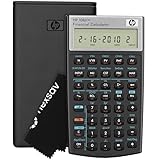
- HP 10BII+ FOR STUDENTS & PROFESSIONALS – This HP calculator is built for business, finance, accounting, and statistics courses. Perfect for learners and professionals who need to solve common financial problems quickly without memorizing formulas or relying on spreadsheets.
- 100+ FUNCTIONS FOR REAL WORLD MATH – Quickly solve time value of money, interest rates, loan payments, NPV, IRR, cash flows, and more. The 10bII+ also includes probability distributions for statistics courses—a feature not often found in financial calculators.
- ALGORITHMIC INPUT WITH DEDICATED KEYS – This high-school/college calculator uses algebraic and chain logic with minimal keystrokes. Layout appears the same as standard calculators for easy learning. Dedicated keys give quick access to commonly used financial and statistical functions
- APPROVED FOR MAJOR EXAMS – The HP 10bII+ algebra calculator is permitted for use on SAT, PSAT/NMSQT, and AP tests. An ideal statistics calculator and business calculator for school finance and accounting students preparing for class, coursework, or standardized exams.
- INCLUDES TRAVEL CASE, CLEANING CLOTH & BATTERIES– Slim, durable, and easy to keep on hand or store in a backpack or locker. Includes a protective case, cleaning cloth, and batteries so it’s ready out of the box. Large screen with clear contrast (non-backlit) is easy to read during exams or lectures.
Rank #4
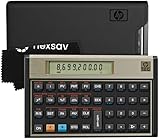
- HP 12C: INDUSTRY STANDARD SINCE 1981 – Trusted by professionals in real estate, banking, and finance for over 40 years. The HP 12C finance calculator remains the go-to tool for fast and accurate calculations in high-stakes business environments.
- 120+ FUNCTIONS FOR FINANCIAL ANALYSIS – Calculate loan amortization, bond pricing, mortgage payments, NPV, IRR, depreciation, and more with this large calculator. Built-in business and statistical functions allow you to perform complex calculations in just a few keystrokes.
- RPN ENTRY FOR FASTER WORKFLOWS – Reverse Polish Notation (RPN) allows for efficient data entry with fewer keystrokes and no formulas. This RPN calculator is perfect for a mortgage payment calculator, accounting calculator, business calculator, or real estate calculator for desktop.
- PROGRAMMABLE FOR REPEAT TASKS – The HP12C desk calculator stores custom keystroke sequences for repeated use. This large calculator supports up to 20 cash flows for IRR/NPV analysis, modeling investment scenarios, projecting returns, and automating routine calculations.
- INCLUDES CLEANING CLOTH, CASE & BATTERIES – Compact design fits easily on a desk or crowded table area. Includes a protective carrying case, cleaning cloth, and comes with pre-installed batteries so it's ready to use out of the box. A great choice for home finances, business professionals, and accountants.
Rank #3

- Extra large 12-digit angled display.
- Loan Wizard.
- Automatic Tax Keys.
- Selectable decimal setting.
- Input any three loan variables to compute the fourth.
Product prices and availability are accurate as of the date/time indicated and are subject to change. Any price and availability information displayed on Amazon at the time of purchase will apply.

