
Quick wins for a faster PC:
Clear out junk files and repair common Windows errorsFree Scan →Scan for outdated or missing drivers - takes under a minuteDriver Scan →iTechGuides is reader-supported. When you buy through links on our site, we may earn an affiliate commission. As an Amazon Associate I earn from qualifying purchases. Learn more
Estimate a thermoelectric generator’s electrical output from the temperature difference across the module’s hot and cold faces, its electrical properties, and the connected load. A useful first estimate treats the module as a voltage source with internal resistance. The temperature difference between a heat source and the surrounding air is not enough: use the temperatures at the module faces.
What you need for an estimate
- Hot-face temperature (Th) and cold-face temperature (Tc) under the intended operating conditions.
- The module’s Seebeck coefficient (S) and internal electrical resistance (Rinternal) from its datasheet, with the datasheet’s test conditions.
- The connected load resistance (Rload), or the electrical configuration of the equipment the module will power.
These values can vary with operating temperature. Ferrotec’s thermoelectric power-generation reference notes that the Seebeck coefficient, resistance, and thermal conductance depend on temperature; its reference calculation uses values at the average module temperature, (Th + Tc)/2.
Calculate voltage and power step by step
- Find the temperature difference across the module: ΔT = Th − Tc. Use temperatures measured at the module faces. Thermal interfaces, heat sinks, mounting, and heat flow can make the face temperatures different from the heat-source and ambient-air temperatures. The 2022 AIMS Energy review of thermoelectric generators defines the relevant temperature difference at the generator’s hot and cold sides.
- Get the electrical properties: find S and Rinternal for the relevant operating temperature and conditions in the module datasheet. If the manufacturer gives values at a particular temperature or test setup, use those qualifications rather than treating the values as universal.
- Estimate open-circuit voltage: Voc ≈ S × ΔT in the simple average, constant-property model. This is the voltage with no load connected; it is not the voltage or power available while operating a load.
- Include the load: estimate current as I = Voc / (Rinternal + Rload), then loaded voltage as Vload = I × Rload. Estimate load power with Pload = I² × Rload, or equivalently Pload = Voc² × Rload / (Rinternal + Rload)². The module’s internal resistance reduces the voltage available at its terminals when a load is connected.
Use the matched-load result as a benchmark
For the simple electrical model with fixed module-face temperatures and constant properties, a resistive load receives maximum power when Rload = Rinternal. At that matched point, Pmax = Voc² / (4 × Rinternal). This is a model benchmark, not a guarantee that a real thermal assembly will maintain the assumed face temperatures while delivering that power. Ferrotec and the AIMS Energy review discuss resistance matching in the context of generator output and load configuration.
PC Slower Than It Used to Be?
A free scan shows the junk files, broken settings and background clutter dragging Windows down - then fixes them in one click.Free scan · Windows 10 & 11Crashes, No Sound, or Screen Glitches?
Random freezes, missing sound and display glitches usually trace back to one bad driver. Find and replace yours safely.Free scan · under a minuteWorked example: a conditional manufacturer specification
Wellentech lists its TEG-07-4006 at 11.7 W with a 200°C hot side, a 27°C cold side, and a matched load; the page gives no publication year. It also lists 16 V open circuit, 5.5 Ω matched-load resistance, and 8.0 V at 1.46 A under matched load. The figures are internally consistent to rounding: 8.0 V × 1.46 A is approximately 11.7 W. These are product specifications under the stated conditions, not a typical output or a prediction for another module or setup. See the Wellentech TEG-07-4006 specification.
#1 Best Overall

- Please identify the "diymore" store.
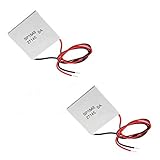
- Model: TEC1-12706.
- Size: 40mm x 40mm x 3.6mm.
- Refrigeration power: Qcmax 50-60W.
- Operation Temperature: -30°C-70°C(-86℉-158℉)
Account for the real thermal and electrical setup
Module-face temperatures
The useful gradient is the temperature difference across the module, not simply the difference between a burner, exhaust, or other heat source and room air. Measure both faces in the intended assembly; the interfaces and heat flow affect their temperatures.
Load and module resistance
A load much lower or higher than the module’s internal resistance changes current, terminal voltage, and delivered power. Use the actual load or estimate its resistance in the operating configuration rather than relying on open-circuit voltage alone.
Heat supply and heat rejection
A calculation that assumes fixed face temperatures can overestimate output if the assembly cannot supply heat to the hot side or remove heat from the cold side while holding those temperatures. The amount of change depends on the specific thermal setup; quantify it with measurements or a system-specific thermal model.
Do these 3 things before closing this tab:
1Scan for outdated or missing drivers - takes under a minute2Repair Windows errors before they cause bigger problems3Fix the driver behind crashes, sound loss and screen glitchesSeries and parallel arrays
For multiple modules, determine the array’s equivalent voltage and resistance before calculating load power. Identical modules in series raise voltage and resistance; in parallel they increase current capability and lower total resistance. Match the load to the equivalent resistance of the complete array, not to one module in isolation.
Rank #3

- Peltier Module Model: 5 PCS TEC1-12706
- Size: 40mm x 40mm x 3.6mm
- Working Current: 4.3-4.6 A (rated 12 v), Imax: 4.5A
- Rated voltage: DC12V (Vmax: 15 v starting current 5.8 A)
- Refrigeration Power: Qcmax 50-60W
How to compare module output claims
Output figures are comparable only when their boundary conditions and electrical arrangement are compatible. For a useful comparison, check the following in each datasheet:
- Hot- and cold-face temperatures, and how they were measured.
- Whether the listed voltage is open-circuit or measured under load.
- The load or matched-load condition and the module’s internal resistance.
- Seebeck coefficient and the temperature at which electrical properties are specified.
- Maximum temperature limits, module size, and mounting or thermal conditions.
A multimeter and contact temperature probes can help establish loaded voltage, current, and face temperatures in the intended setup. Compare measured conditions with the module datasheet; accessory choices such as heat sinks, interface material, and mounting hardware depend on the application.
Quick Recap
Best Value

- HIGH HEAT TOLERANCE: Features graphite thermal transfer layer, withstands up to 227°C/440°F. Ideal for fireplace applications with efficient heat transfer. Maintains structural integrity through extended use with consistent performance
- REPAIR SOLUTION: Specifically engineered for fireplace fan repair, extends equipment lifespan. Simple replacement process requiring basic tools. Compatible with numerous fireplace fan types, offering versatile application. Addresses common generator wear issues
- UNIVERSAL CONNECTION: Standardized power generator interface ensures secure mounting. Stable electrical link maintains consistent current dance. Secure connection minimizes loosening risks while simplifying maintenance procedures for professionals
- EFFICIENT THERMAL TRANSFER: Graphite construction delivers superior heat conduction. Promotes even temperature distribution, preventing hot spots. Enhances thermoelectric generator output while maintaining safe operating temperatures.
- FUNCTIONAL RESTORATION: Revives fireplace fan's temperature difference generator capability. Restores equipment's power generation function. Essential for residential fireplace maintenance and technician repairs, solving frequent failure issues
Rank #4

- 【Easy to install】An excellent DIY kit for electronic enthusiasts in semiconductor refrigeration applications,Completely assembled,you have no need to use your hands,save time. Positive red and negative black,Easy To install.
- 【High quality and Durable】The complete sealing structure isolates the moisture in the air,Using high-quality aluminum + TEC1-12706 semiconductor cooling plate(The gravity of the upgraded heat sink is increased by 20%, which makes the heat dissipation stronger and smaller.)durable.
- 【High cooling efficiency】 equipped with cool fan, The upgraded version of S-type thickened heat dissipation is faster,easily cooling down within a few minutes. no noise, no vibration, no refrigerant required.Power Supply: DC 12V.Max Power:72W.
- 【 Best assistant for small space cooling】Suitable for computer heatsink ,small splace cooling. Also used for pet bed cooling,plate cooling,test bench,cardboard box, Pantry,wine cellar,ect
- 【Mini and Portable】Easy to install,Save space, can be installed anywhere,compact size (100 * 95 * 95mm / 3.93 * 3.74 * 3.74inch) DIY Peltier Kit include TEC1-12706 semiconductor cooler and other accessories.
Product prices and availability are accurate as of the date/time indicated and are subject to change. Any price and availability information displayed on Amazon at the time of purchase will apply.

