
Outdated Drivers Are Slowing You Down
One free scan finds every outdated or missing driver and matches the right update for your exact hardware.Free scan · exact hardware matchPC Slower Than It Used to Be?
A free scan shows the junk files, broken settings and background clutter dragging Windows down - then fixes them in one click.Free scan · Windows 10 & 11iTechGuides is reader-supported. When you buy through links on our site, we may earn an affiliate commission. As an Amazon Associate I earn from qualifying purchases. Learn more
High DPC or interrupt activity can delay Windows audio processing and cause clicks, pops, or dropouts, but it is only one possible cause of audio and video trouble. A slow disk or network source, an overloaded decoder, or a saturated GPU can also interrupt playback. The best way to narrow the cause is to reproduce the problem, inspect a trace around the glitch, and distinguish driver scheduling delays from audio-path latency and media-source bottlenecks.
First, identify which kind of latency or playback failure you have
“Latency” can refer to different delays in a Windows media pipeline. The distinction matters: a high DPC measurement does not directly tell you how long sound takes to travel from a microphone through an application and back to speakers.
| Term | What it describes |
|---|---|
| DPC latency | Time spent handling deferred kernel work that can delay other processing, including the audio engine. |
| Render latency | Delay between an application submitting an audio buffer and the resulting sound being heard. |
| Capture latency | Delay between microphone capture and the audio becoming available to the application. |
| Roundtrip audio latency | Delay from microphone capture, through application processing, to speaker output; Microsoft describes it as roughly render latency plus capture latency. |
| Media glitch | A click, pop, dropout, or stutter that may result from driver scheduling, source starvation, decoding, graphics, or other workload problems. |
Microsoft’s Low Latency Audio documentation describes the render, capture, and roundtrip paths. Its Streaming Media Performance Assessment results documentation addresses playback glitches and related trace evidence.
What DPC and ISR measurements can—and cannot—tell you
Interrupt Service Routines (ISRs) and Deferred Procedure Calls (DPCs) let drivers handle hardware-related work. If they run too long or occur too frequently, they can occupy processor time needed by time-sensitive audio work. Microsoft’s assessment guidance says DPCs should not run longer than 100 microseconds and ISRs no longer than 25 microseconds. It also identifies durations in the 1–3 millisecond range as potentially affecting media performance, and flags errors above 3 milliseconds.
#1 Best Overall

- Pro performance with great pre-amps - Achieve a brighter recording thanks to the high performing mic pre-amps of the Scarlett 3rd Gen. A switchable Air mode will add extra clarity to your acoustic instruments when recording with your Solo 3rd Gen
- Get the perfect guitar and vocal take with - With two high-headroom instrument inputs to plug in your guitar or bass so that they shine through. Capture your voice and instruments without any unwanted clipping or distortion thanks to our Gain Halos
- Studio quality recording for your music & podcasts - Achieve pro sounding recordings with Scarlett 3rd Gen’s high-performance converters enabling you to record and mix at up to 24-bit/192kHz. Your recordings will retain all of their sonic qualities
- Low-noise for crystal clear listening - 2 low-noise balanced outputs provide clean audio playback with 3rd Gen. Hear all the nuances of your tracks or music from Spotify, Apple & Amazon Music. Plug-in headphones for private listening in high-fidelity
- Everything in the box: Includes Pro Tools Intro+, Ableton Live Lite, Cubase LE, and Hitmaker Expansion: a suite of essential effects, powerful software instruments, and easy-to-use mastering tools
These are Microsoft assessment thresholds and guidance, not a universal point at which every computer will glitch. A measured event is most useful when correlated with the time of a reproducible audio or video problem. The same Microsoft documentation says ISR and DPC problems are often found in network, storage, and graphics drivers. That makes those drivers useful places to investigate, but a network-related symptom alone does not prove the internet connection or a particular adapter is responsible.
Trace a reproducible glitch in Windows
Microsoft’s Streaming Media Performance Assessment runs three 60-second timing iterations and one 60-second diagnostic iteration by default. Timing iterations calculate metrics; the diagnostic iteration helps identify common media issues. Use the assessment results and trace to examine activity around the reported glitch rather than treating one peak measurement as a complete diagnosis.
Rank #2

- The new generation of the songwriter's interface: Plug in your mic and guitar and let Scarlett Solo 4th Gen bring big studio sound to wherever you make music
- Studio-quality sound: With a huge 120dB dynamic range, the newest generation of Scarlett uses the same converters as Focusrite’s flagship interfaces, found in the world's biggest studios
- Find your signature sound: Scarlett 4th Gen's improved Air mode lifts vocals and guitars to the front of the mix, adding musical presence and rich harmonic drive to your recordings
- All you need to record, mix and master your music: Includes industry-leading recording software and a full collection of record-making plugins
- Everything in the box: Includes Pro Tools Intro+, Ableton Live Lite, Cubase LE, and Hitmaker Expansion: a suite of essential effects, powerful software instruments, and easy-to-use mastering tools
- Reproduce the problem. Run the assessment or capture a trace while performing the same activity that produces the glitch. Note the approximate time and whether the content is local or streamed.
- Open the assessment details. Review the issue details and use the in-depth analysis link to open the trace in Windows Performance Analyzer (WPA) with an appropriate analysis profile.
- Correlate events with the glitch. Use the streaming-media analysis view to compare activity intervals with the problem time. Inspect ISR/DPC duration and frequency, kernel worker threads running at dispatch level, and concurrent disk or network activity.
- Check the implicated driver path. Determine whether network, storage, or graphics driver activity coincides with the glitch. Look at both event duration and frequency; do not assume that an isolated event caused a symptom unless their timing supports that conclusion.
- For additional graphics-trace analysis, consider GPUView. WPA and GPUView can help inspect trace data, but GPUView analysis is an additional manual step rather than a required first test.
- Change one variable at a time. If testing a driver, device, or setting change, repeat the same workload and compare the result. Keeping other conditions stable makes it easier to see whether the change mattered.
Separate network or storage starvation from driver scheduling
A media source can fail to supply data quickly enough for real-time decoding and rendering. Microsoft calls this source starvation when the source cannot read from disk or network fast enough. The resulting playback interruption may resemble a driver-related glitch, so inspect source activity as well as ISR/DPC events.
Quick wins for a faster PC:
Fix the driver behind crashes, sound loss and screen glitchesFind Drivers →Clear out junk files and repair common Windows errorsFree Scan →Scan for outdated or missing drivers - takes under a minuteDriver Scan →Compare streamed playback with a local file
Play a local file and compare it with the streamed content that triggers the problem. If only streamed playback fails, the source or network path becomes a more relevant lead; if both fail, investigate broader system, driver, decoder, or graphics causes too. This comparison narrows the possibilities but does not prove a root cause by itself.
Rank #3
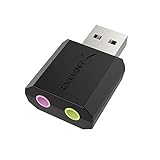
- PLUG IN AND HEAR SOUND IN SECONDS - USB Type-A connector with a 3.5mm stereo headphone output and a separate 3.5mm mono microphone input. No drivers, no software, no external power - the adapter is USB bus-powered and is recognized as a standard USB audio device.
- WORKS ON WINDOWS, MAC AND LINUX - Driverless on Windows 98SE/ME/2000/XP/Server 2003/Vista/7/8, Linux and Mac OSX, and compliant with the USB Audio Device Class 1.0 specification, so any system that supports class-compliant USB audio will see it. Select it as the sound output and input device after plugging it in.
- TWO JACKS, TWO JOBS - The green jack is stereo OUT for headphones or powered speakers; the pink jack is mono microphone IN for a 3.5mm mic. It does NOT support 4-pole headsets on a single combo plug, it does NOT power passive speakers, and it does NOT add surround sound - it is a stereo 2-channel adapter.
- FOR LAPTOPS AND DESKTOPS THAT NEED AN AUDIO PORT BACK - Adds a headphone and mic port to a laptop, desktop, or mini PC whose onboard jack has failed or was never there. Managed and work-issued computers can block new USB audio devices by policy - check with your IT department before ordering for a company machine.
- SABRENT SUPPORT AND WARRANTY - What is in the box: one USB audio sound adapter. Backed by a 1-year limited warranty, extended to 2 years when you register within 90 days on the manufacturer's website.
Look for source and workload evidence
In the trace, check disk and network activity near the interruption, including concurrent load. A network symptom may reflect driver scheduling, delayed source delivery, or another interaction; the symptom is evidence to investigate, not a diagnosis of the internet connection.
Diagnose video stutter beyond DPC latency
Video playback depends on a sequence of stages. If one stage cannot keep up, the visible result can be stutter even when DPC activity is not the cause.
Rank #4

- Podcast, Record, Live Stream, This Portable Audio Interface Covers it All - USB sound card for Mac or PC delivers 48kHz audio resolution for pristine recording every time
- Be ready for anything with this versatile M-AUDIO interface - Record guitar, vocals or line input signals with two combo XLR / Line / Instrument Inputs with phantom power
- Everything you Demand from an Audio Interface for Fuss-Free Monitoring - 1/4" headphone output and stereo 1/4" outputs for total monitoring flexibility; USB/Direct switch for zero latency monitoring
- Get the best out of your Microphones - M-Track Duo’s transparent Crystal Preamps guarantee optimal sound from all your microphones including condenser mics
- The MPC Production Experience - Includes MPC Beats Software complete with the essential production tools from Akai Professional
- Check whether the source is starved. Inspect whether disk or network delivery keeps pace with playback.
- Check decoder load. A saturated decoder can fall behind real-time playback.
- Check graphics capacity and transfers. GPU saturation or slow memory transfers can also interrupt rendering.
Use WPA trace views to correlate these activities with the stutter. GPUView can provide additional manual trace inspection where needed.
Free tools Windows power users keep installed
One-click scans. No signup required.
Measure audio roundtrip latency when that is the actual problem
If the question is how long microphone input takes to reach speaker output through an application, use a pulse-playback and microphone-capture measurement rather than relying on DPC latency alone. Microsoft’s low-latency audio guidance describes measuring the path through render and capture APIs.
Best Value

- The new generation of the artist's interface: Connect your mic to Scarlett's 4th Gen mic pres. Plug in your guitar. Fire up the included software. Start making your first big hit
- Studio-quality sound: With a huge 120dB dynamic range, the newest generation of Scarlett uses the same converters as Focusrite’s flagship interfaces, found in the world's biggest studios
- Never lose a great take: Scarlett 4th Gen's Auto Gain sets the perfect level for your mic or guitar, and Clip Safe prevents clipping, so you can focus on the music
- Find your signature sound: Air mode lifts vocals and guitars to the front of the mix, adding musical presence and rich harmonic drive to your recordings
- With Scarlett 4th Gen, you have all you need to record, mix and master your music: Includes industry-leading recording software and a full collection of record-making plugins
Windows audio latency depends on the application, audio APIs, effects, buffers, and driver support. Microsoft says the Windows audio engine latency was reduced to 1.3 ms for all applications in Windows 10 and later; that figure describes the documented audio-engine path, not guaranteed end-to-end latency for a particular PC, device, application, or stream. The driver defines buffer size, and applications must request supported small-buffer behavior through relevant AudioGraph settings or WASAPI interfaces. Updated drivers are required for small-buffer support. Audio processing objects (APOs) can add latency depending on their signal processing, and low-latency operation can increase power use because the CPU wakes more frequently.
Quick Recap
Use the result to choose the next investigation
- Glitch aligns with long or frequent ISR/DPC activity: investigate the implicated driver category and test changes one at a time.
- Stream fails but a local file does not: examine source delivery and network-path activity, while treating the comparison as a clue rather than proof.
- Video stutters with decoder or GPU saturation: focus on the overloaded pipeline stage instead of assuming DPC latency explains the symptom.
- Audio sounds clean but response is delayed: measure render/capture or roundtrip latency and check buffer, API, effect, and driver support.
Product prices and availability are accurate as of the date/time indicated and are subject to change. Any price and availability information displayed on Amazon at the time of purchase will apply.

