
Do these 3 things before closing this tab:
1Clear out junk files and repair common Windows errors2Scan for outdated or missing drivers - takes under a minute3Repair Windows errors before they cause bigger problemsiTechGuides is reader-supported. When you buy through links on our site, we may earn an affiliate commission. As an Amazon Associate I earn from qualifying purchases. Learn more
A liquid-level system measures how much liquid is in a vessel, compares that measurement with a target, and uses a controller to change inflow or outflow—typically through a pump or valve. That basic loop can support an industrial tank process, but it does not by itself define a safe medical delivery device: patient-connected systems have additional device-safety and lifecycle considerations. Because the liquid, vessel, required delivery, environment, and consequences of failure are unspecified here, no particular sensor, pump, alarm threshold, or control setting can be responsibly prescribed.
What the system controls—and what it does not
A liquid-level control system manages a process variable: the level of liquid in a vessel. A representative arrangement is:
Vessel or process → level sensor and transmitter → controller → pump or control valve → vessel or process
The controller compares the measured level with a setpoint and adjusts a manipulated input, such as inlet or outlet flow. A display, alarms, independent protective functions, power supplies, and communications may also be needed, depending on the use and the risks.
#1 Best Overall

- The CQRobot non-contact liquid level sensor realizes non-contact detection of the liquid level in a closed container. It adopts advanced signal processing technology and high-speed signal processing chip, breaking through the influence of container wall thickness. It is simple to install and easy to use, and can detect the level of various toxic substances, strong acids, strong alkalis and various liquids in high-pressure airtight containers.
- The principle is to use the inductive capacitance of water to detect whether there is liquid. When there is no liquid close to the sensor, the sensor has a certain static capacitance to the ground due to the existence of distributed capacitance on the sensor. When the liquid level slowly rises and approaches In the case of an inductor, the parasitic capacitance of the liquid will be coupled to this static capacitance, making the final capacitance value of the inductor larger.
- The changed capacitance signal is then input to the control IC for signal conversion, which converts the changed capacitance into a change of a certain electrical signal, and then a certain algorithm is used to detect and judge the degree of this change. When the change exceeds a certain amount It is considered that the liquid level has reached the sensing point when the threshold is reached.
- High stability, high sensitivity, strong interference ability, no external electromagnetic interference, special treatment for power frequency interference and common mode interference, strong compatibility, penetration of various non-metallic containers, such as plastic, glass, For ceramics and other containers, the sensing distance can reach more than 12mm; liquid, powder, and particulate matter can be detected.
- The sensor comes with 2 DIP switches, the right DIP switch controls the output voltage (high level) of the signal terminal (green line); when the DIP switch is dialed up, the high level is 5V; when the DIP switch is facing When dialing down, the high level is 3.3V. Compatible with Arduino, Raspberry Pi and Other Motherboards.
Level regulation is not the same as dose or flow delivery. A level sensor indicates vessel inventory or height; it does not, on its own, establish the volume delivered to a patient or process recipient. If the requirement is to deliver a specified flow or dose, define that delivery variable and provide a suitable way to measure and control it.
Define the application before choosing components
The title alone does not specify a buildable design. Start by describing what moves, where it starts and ends, whether the system regulates vessel inventory or meters delivery, and what can happen if the level is too high, too low, or changing flow stops.
Turn the use case into requirements
Document measurable requirements before selecting hardware or tuning a controller. The actual values must come from the application; no target values are established for this unspecified system.
Quick wins for a faster PC:
Repair Windows errors before they cause bigger problemsFix Now →Fix the driver behind crashes, sound loss and screen glitchesFind Drivers →Rank #2

- The non-contact liquid level sensor adopts advanced signal processing technology and high-speed signal processing chips, breaking through the influence of container wall thickness and achieving true non-contact detection.
- The non-contact liquid level sensor has strong compatibility and can penetrate various non-metallic containers, such as plastic, glass, ceramic, etc., with a sensing thickness of up to 20MM.
- Suitable for liquid-level detection of various curved, curved, and cylindrical containers.
- The liquid level sensor (probe) is installed above and below the outer wall of the measured container (high and low levels of the liquid level), non-metallic containers do not need to be perforated and are easy to install.
- The tested liquid is required to conduct electricity, and the contact surface is non-metallic, which can be widely used.
- Liquid identity and properties, including any wetted-material, cleaning, or sterility constraints.
- Vessel geometry, operating level range, mounting locations, obstructions, and access for service.
- Normal setpoint, allowable deviation, required measurement range, and measurement uncertainty.
- Inlet and outlet flow requirements, including whether the system must regulate level, deliver a flow, or deliver a dose.
- Required response time and behavior at operating boundaries.
- Pressure, temperature, environmental conditions, power, controller platform, and communications needs.
- Maintenance interval, calibration approach, and how drift, fouling, implausible readings, or loss of signal will be recognized.
- Failure consequences and acceptable behavior on loss of power, sensor signal, or actuator function.
- Applicable jurisdiction, intended use, and any regulatory or standards obligations.
How to choose a level-sensing method
Industrial level measurement can use direct or inferential approaches. ISA educational material covers hydrostatic head, capacitance, ultrasonic measurement, and measurement by weight. An ISA-hosted fundamentals chapter also describes direct methods such as visual gauges, floats, probes, and sonic reflection, and inferential methods such as buoyant force and hydrostatic pressure. These options are not a universal ranking: suitability depends on the fluid, vessel, installation, required performance, and maintenance conditions.
| Method or approach | What it represents | What to establish for selection |
|---|---|---|
| Visual gauge, float, probe, or sonic reflection | Examples of direct level-measurement approaches described in the ISA-hosted fundamentals chapter. | Confirm whether the method suits the fluid, vessel geometry, installation, operating range, and required measurement performance. The cited material does not establish a best choice for this unspecified application. |
| Hydrostatic pressure or buoyant force | Inferential approaches identified in the ISA-hosted fundamentals chapter; ISA educational material also covers hydrostatic-head measurement. | Establish the actual fluid and process conditions and verify the required range, accuracy, installation, and calibration needs. No specific performance is established here. |
| Capacitance or ultrasonic measurement | Methods identified in ISA educational material for industrial level measurement. | Check compatibility with the liquid and vessel, mounting and obstructions, signal integration, and behavior across the required operating range. |
| Measurement by weight | A method identified in ISA educational material. If used to infer liquid level, the design must establish how the measured weight relates to level for the actual vessel and contents. | Define the vessel and operating conditions, the required measurement performance, installation constraints, calibration, and maintenance approach. |
For any candidate method, check process compatibility, vessel and installation constraints, range and repeatability, response, controller signal compatibility, calibration, diagnostics, and failure behavior. These are selection questions—not evidence that any named technology meets a particular requirement.
Design the control and delivery loop
In a basic feedback loop, the controller compares measured level with the setpoint and adjusts a flow that affects that level. For example, a controller may reduce inlet flow or increase outlet flow when the measured level rises above target. Which action is appropriate depends on the process and its safety design; one direction of action is not universally safe.
Rank #3
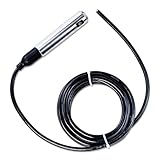
- 【Practical Tool】This Liquid Level Sensor Cable has multi layer IP68 waterproof , ensuring and long lasting use. Its 45 degree oblique angle anti impact and probe detachable anti blocking design make it even more and rugged
- 【Stable Performance】Full digital conditioning circuit, 4-20mA output ensure more stable performance. Input level transmitter and highprecision diffusion of silicon for more accurate monitoring of water level
- 【High-quality material】The 4-20mA input type liquid level sensor (with a range of 5 meters and a 5-meter cable) is made of durable stainless steel material, ensuring its reliability and long-lasting performance. This liquid level sensor adopts of anti-corrosion material, excellent anti-corrosion performance and durable.Anti blocking design, easy to clean
- 【Wide Temperature Range】The Liquid Level Sensor Cable can operate within a temperature range of -40-80℃, providing greater flexibility across various applications. Its temperature compensation feature ensures accurate and data, even in varying environmental conditions
- 【Versatile compatibility】The measured medium is water, do not test liquids that will corrode stainless steel. It can be used with digital display, PLC, inverter, recorder and other instruments. Remember except water, it is not recommended to measure other liquids
Specify the actuator and failure response together
Define whether the manipulated input is an inlet or outlet pump or valve, how its command affects flow, and what response is intended if power or signal is lost. Normally open or normally closed positions, controller action, output limits, and protective actions must follow the process intent and hazard analysis rather than being assumed from the word “level.”
For a straightforward tank, a single feedback loop may be sufficient. ISA materials also discuss continuous, batch, and discrete control, controller tuning, and PLC, DCS, and single-loop architectures. More elaborate control is application-specific: an ISA-hosted loop-checking chapter uses a boiler-drum example with level feedback, feedwater-flow control, cascade, and feedforward. That example is not a default architecture for every tank.
Industrial process systems: document and verify the loop
Industrial design should make the instrument functions and their relationships understandable to engineers and operators. ISA5.1 establishes a uniform means of designating instruments and instrumentation systems through symbols and identification codes, for use in industries including chemical, petroleum, and power generation. Use consistent tags and process diagrams for the sensing, control, and final-element functions.
Rank #4

- Package Content : 5 x Water Level Sensor ; Color :White and yellow
- Model No. : DP3500; Max Contact Rating : 10W
- Max Switching Current : 0.5A;Max Breakdown Voltage : 220V DC;Max Carry Current : 1.0A;Max Contact Resistance : 100m ohm
- Temperature Rating : -10 / +85 Celsuis;Float Ball Material : P.P;Float Body Material : P.P
- Cable Length : 38cm / 15";Switch Body Size : 45 x 17mm / 1.8" x0.7" Thread Dia(Approx) : 13mm / 0.5"
Verification is part of the design, not an activity to leave implicit. ISA-105 describes practices for factory acceptance testing (FAT), site acceptance testing (SAT), site integration testing (SIT), loop checks, and calibration programs. Its material notes that FAT and SAT do not cover loop checks or commissioning, so define those activities and their acceptance criteria separately. ISA84 covers design, operation, and maintenance lifecycle activities for instrumented systems used to achieve functional safety in process industries; a required safety integrity level cannot be inferred from a generic liquid-level application.
Plan a verification sequence
This is a planning checklist for qualified engineering and site procedures, not a substitute for applicable standards or local requirements.
- Review the approved requirements, instrument identification, process diagrams, and documented risk controls.
- Check the sensor range and calibration against the intended operating conditions.
- Confirm signal scaling, direction, and controller indication across the expected range.
- Verify controller action, output limits, and the intended pump or valve response.
- Exercise alarms, interlocks, and other protective functions against their documented criteria.
- Check actuator operation across expected operating states.
- Test loss-of-power and loss-of-signal behavior against the documented risk controls.
Medical delivery: treat it as a device-safety problem
Patient-connected liquid delivery is not simply an industrial tank loop with a smaller vessel. FDA describes an infusion pump as “a medical device that delivers fluids, such as nutrients and medications, into a patient’s body in controlled amounts.” A level measurement may indicate source-container inventory, but it does not alone verify what reaches a patient.
Best Value

- √ PORTABLE COMPACT DESIGN: Pocket-sized liquid level indicator ideal for travel, practical pouring aid for partially sighted, blind and elderly users when filling mugs, cups and kettles at home or on the go
- √PREMIUM DURABLE CONSTRUCTION: Made with stainless steel sensor pins and robust ABS base, fitted with high-sensitivity liquid detection, Emits increasingly rapid loud beeps as liquid rises;plus auto zero reset and auto power-off to conserve battery life
- √TWO-STAGE AUDIBLE ALARM SYSTEM: Progressive loud beep alerts warn as liquid rises to avoid spills and scalds, delivering safer, mess-free pouring support for seniors and people with limited vision
- √ UNIVERSAL CLIP FIT: Securely attaches to the rim of nearly all standard mugs, cups and drinking glasses, simple to clip on for instant liquid level monitoring and prevent overfilling
- √ THOUGHTFUL PRACTICAL GIFT: No more scalded fingers or overflowing glasses with limited visibility!Straightforward liquid detector for blind, partially sighted and older adults, a handy daily living aid perfect as a present for parents, grandparents and vulnerable loved ones
FDA’s September 2023 guidance, Technical Considerations for Medical Devices with Physiologic Closed-Loop Control Technology, addresses design considerations, nonclinical testing, animal studies, and labeling for devices within its scope. FDA says relevant design and testing considerations depend on the delivered energy or article, environment of use, automation level, training and patient populations, physiologic sensor properties, control algorithm, and delivery-system properties. Determine intended use and applicability before treating this guidance as relevant: it is not a universal specification for every device that moves liquid.
FDA’s separate infusion-pump guidance, Infusion Pumps Total Product Life Cycle, is a lifecycle resource addressing pump submissions and design features. FDA’s infusion-pump information explains that failures can lead to over- or under-infusion, missed treatments, or delayed therapy; it also notes that many pumps have alarms and alerts. Alarm design and thresholds must be established for the actual device and use rather than guessed from a generic description.
FDA reports approximately 56,000 adverse-event reports associated with infusion-pump use that it received from 2005 through 2009, as described on its infusion-pump information page in a 2010-era report. This is a historical count of reports received—not an incidence rate, a count of confirmed device-caused harms, or evidence of current event frequency.
Free tools Windows power users keep installed
One-click scans. No signup required.
IEC 60601-2-24:2012 is titled Medical electrical equipment — Part 2-24: Particular requirements for the basic safety and essential performance of infusion pumps and controllers. The IEC catalog scope covers infusion pumps and volumetric infusion controllers, including specified types such as enteral, ambulatory, syringe/container, and volumetric pumps or controllers, and describes limits on what it specifies for other administration-set aspects. The catalog lists a stability date of 2026. Confirm the applicable edition, national adoption, recognition, and intended-device scope during regulatory planning.
What a responsible design can—and cannot—specify yet
The system architecture and design questions can be outlined without pretending the application is defined. An exact sensor, pump, material, alarm threshold, control tuning, or performance figure cannot be chosen responsibly until the liquid, vessel dimensions, operating range, delivery needs, accuracy, response time, process conditions, cleaning or sterility needs, environment, failure consequences, jurisdiction, and intended use are known. Component selection and validation must follow those requirements and the consequences of failure.
Quick Recap
Product prices and availability are accurate as of the date/time indicated and are subject to change. Any price and availability information displayed on Amazon at the time of purchase will apply.

