
PC Slower Than It Used to Be?
A free scan shows the junk files, broken settings and background clutter dragging Windows down - then fixes them in one click.Free scan · Windows 10 & 11Crashes, No Sound, or Screen Glitches?
Random freezes, missing sound and display glitches usually trace back to one bad driver. Find and replace yours safely.Free scan · under a minuteiTechGuides is reader-supported. When you buy through links on our site, we may earn an affiliate commission. As an Amazon Associate I earn from qualifying purchases. Learn more
To check a network card’s performance, compare its reported connection rate with repeatable tests on the local network and the internet. A displayed link rate is not the same as sustained data throughput, and an internet speed test measures the whole route—including the router, internet provider, test server, and other traffic—not just the card. These steps focus on Windows; menu names and tools differ on other operating systems.
What can a network performance check tell you?
Use several observations together rather than treating one speed-test result as a verdict on the adapter:
- Adapter status and driver details show whether Windows detects the interface and whether it reports an error.
- Negotiated link rate describes the connection established between the PC and its immediate peer, such as a router or switch. It is not a promise of usable application throughput.
- A gateway ping checks whether the PC can reach its router and measures response timing. It does not measure maximum transfer speed.
- A local transfer or controlled point-to-point test can help assess the network path without relying on internet service.
- An internet speed test measures the wider connection path, so a low result alone does not establish that the network card is at fault.
The achieved rate depends on more than the adapter: the other endpoint, configuration, cable or radio conditions, network traffic, and—in an internet test—the service and test server can all affect results.
The Tool Desk
Outbyte Driver Updater FREEScan for outdated or missing drivers - takes under a minuteDriver Scan →Outbyte PC Repair FREEClear out junk files and repair common Windows errorsFree Scan →How do you check the adapter and establish a baseline in Windows?
- Identify the adapter. Open Device Manager and expand Network adapters. Note the adapter name, driver version and date, and whether the device is enabled or showing an error. If the adapter is missing or Wi-Fi is unavailable, Microsoft recommends checking its visibility and driver state in its Windows Wi-Fi troubleshooting guidance.
- Record the active connection and link-rate information. Check Windows network settings or the adapter’s connection properties for details available for that interface. Record the result as a link condition, not as an expected internet speed. On Ethernet, the rate depends on both connected devices and their negotiation settings; Intel advises confirming gigabit support at both ends and enabling auto-negotiation on both sides (Intel Ethernet troubleshooting).
- Run repeatable tests before changing settings. Keep the test endpoint and conditions as consistent as practical. For Wi-Fi, record results in several locations; Microsoft recommends comparing before-and-after results when troubleshooting placement or signal conditions (Microsoft Wi-Fi and home layout guidance). Note whether other devices are using the network.
- Check the local path. Ping the default gateway—the router address used by the PC—to see whether it responds. A response means the PC can reach the router; it does not show how fast the link can transfer data. If possible, compare a local file transfer or controlled point-to-point test between two computers. Intel suggests a direct file transfer as a way to assess gigabit Ethernet without making the internet connection the deciding factor (Intel Ethernet troubleshooting).
- Compare another device or connection path. Try another device on the same network, or test this PC with a different cable or a wired connection instead of Wi-Fi. Microsoft recommends these comparisons to help separate PC-specific trouble from network-wide problems (Ethernet troubleshooting; Wi-Fi troubleshooting).
Why is gigabit Ethernet showing only 100 Mbps?
A 10/100 Mbps negotiated rate usually calls for checking the physical link and both endpoints before replacing the network card. The port on the router, switch, or other connected device must support gigabit, and both ends need compatible negotiation settings. Intel recommends auto-negotiation and says to confirm gigabit capability on the link partner.
#1 Best Overall
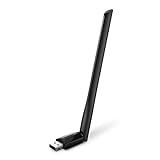
- 𝐋𝐨𝐧𝐠 𝐑𝐚𝐧𝐠𝐞 𝐀𝐝𝐚𝐩𝐭𝐞𝐫 – This compact USB Wi-Fi adapter provides long-range and lag-free connections wherever you are. Upgrade your PCs or laptops to 802.11ac standards which are three times faster than wireless N speeds.
- 𝐒𝐦𝐨𝐨𝐭𝐡 𝐋𝐚𝐠 𝐅𝐫𝐞𝐞 𝐂𝐨𝐧𝐧𝐞𝐜𝐭𝐢𝐨𝐧𝐬 – Get Wi-Fi speeds up to 200 Mbps on the 2.4 GHz band and up to 433 Mbps on the 5 GHz band for upgraded web surfing, gaming, and streaming. Performance varies by conditions, distance to devices, and obstacles such as walls.
- 𝐃𝐮𝐚𝐥-𝐛𝐚𝐧𝐝 𝟐.𝟒 𝐆𝐇𝐳 𝐚𝐧𝐝 𝟓 𝐆𝐇𝐳 𝐁𝐚𝐧𝐝𝐬 – Dual-bands provide flexible connectivity, giving your devices access to the latest routers for faster speeds and extended range. Wireless Security - WEP, WPA/WPA2, WPA-PSK/WPA2-PSK
- 𝟓𝐝𝐁𝐢 𝐇𝐢𝐠𝐡 𝐆𝐚𝐢𝐧 𝐀𝐧𝐭𝐞𝐧𝐧𝐚 – The high gain antenna of the Archer T2U Plus greatly enhances the reception and transmission of WiFi signal strengths.
- 𝐀𝐝𝐣𝐮𝐬𝐭𝐚𝐛𝐥𝐞, 𝐌𝐮𝐥𝐭𝐢-𝐃𝐢𝐫𝐞𝐜𝐭𝐢𝐨𝐧𝐚𝐥 𝐀𝐧𝐭𝐞𝐧𝐧𝐚: Rotate the multi-directional antenna to face your router to improve your experience and performance
Check the cable and ports
- Make sure the cable is fully seated in the intended ports.
- Try a known-good cable. Intel recommends Cat 6 or better for reliable gigabit speed and suggests substituting a cable that is known to work; a cable replacement is a diagnostic step, not a guaranteed speed upgrade.
- Check whether the router or switch port and the other device support gigabit.
- Compare using another port or device if available. A USB-to-Ethernet adapter can help when the computer lacks a built-in Ethernet port or as a comparison, but it adds its own adapter and driver to the test path. Compatibility depends on the computer’s port, operating system, and required link speed (see Microsoft Ethernet troubleshooting).
Check negotiation and drivers
Confirm that auto-negotiation is enabled on both ends rather than forcing a speed setting without a specific reason. Inspect the adapter’s driver details in Windows and check for errors. Intel’s troubleshooting article is written for specific Intel gigabit adapter families and Windows 10 64-bit; its checks are useful diagnostic guidance, but exact steps and applicability depend on your hardware and operating system (Intel Ethernet troubleshooting).
Once the cable, ports, peer capability, negotiation, and driver have been checked, a local file transfer can help determine whether the local wired path behaves differently from an internet speed test.
Rank #2
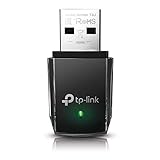
- AC1300 Dual Band Wi-Fi Adapter for PC, Desktop and Laptop. Archer T3U provides 2.4G/5G strong high speed connection throughout your house.
- Archer T3U also provides MU-MIMO, which delivers Beamforming connection for lag-free Wi-Fi experience.
- Usb 3.0 provides 10x faster speed than USB 2.0, along with mini and portable size that allows the user to carry the device everywhere.
- World's 1 provider of consumer Wi-Fi for 7 consecutive years - according to IDC Q2 2018 report
- Supports Windows 11, 10, 8.1, 8, 7, XP/ Mac OS X 10.9-10.14
How do you check whether Wi-Fi is the bottleneck?
Wi-Fi results reflect the radio link and its surroundings as well as the adapter. Signal strength, obstructions, access-point placement, band support, channel conditions, and router capability can all matter. A card’s advertised capability is not the same as the rate it will achieve in a particular room.
Free tools Windows power users keep installed
One-click scans. No signup required.
Compare location, band, and devices
- Record results at several locations and compare them with the PC near the access point. A marked improvement closer to it suggests that distance or obstacles may be contributing.
- Compare another device in the same location. If it also performs poorly there, the environment or access point may be involved; if only this PC does, inspect its adapter, driver, and configuration.
- Where available, compare supported Wi-Fi bands. Microsoft notes that 6 GHz requires a compatible router, Windows device, and network-adapter driver. It also has shorter range and passes through walls less effectively than lower bands (Microsoft Wi-Fi and home layout guidance).
- Reduce obstructions and test with the access point and client positioned for a clearer radio path. Keep the test method and conditions consistent when comparing results.
Separate Wi-Fi from internet trouble
If the gateway responds to a ping but internet access is still unavailable or slow, the problem may be beyond the PC-to-router link—for example, with the modem, internet provider, or another part of the network. If possible, compare the same PC over Ethernet. A wired connection that works normally while Wi-Fi does not narrows the investigation toward the wireless path, though it does not by itself identify a specific faulty component. Microsoft’s Wi-Fi troubleshooting guide includes checking adapter visibility and driver state and disabling Wi-Fi adapter power saving as possible troubleshooting steps.
Rank #3

- AC600 Nano size wireless Dual band USB Wi-Fi adapter for fast and high speed Wi-Fi connection.
- Strong 2.4G/5G connection allows the user to use the Internet with lag-free experience.
- Sleek and miniature sized design allows the user to plug and leave the device in it's place.
- Industry leading support: 2-year and free 24/7 technical support
- This network transceiver supports Windows 11, 10, 8.1, 8, 7, XP/ Mac OS X 10.9-10.14
How should you interpret the results?
| Observation | What it suggests | Next check |
|---|---|---|
| High reported link rate, but low internet speed | The link rate alone does not prove that the adapter is faulty. The router, internet service, test server, network traffic, or another part of the route may limit the result. | Compare another device, test the local path, and check whether wired and wireless results differ. |
| Ethernet negotiates at 10/100 rather than gigabit | A cable, port, peer capability, or negotiation setting may be limiting the link. | Check both endpoints, auto-negotiation, port capability, driver state, and a known-good cable before considering a replacement adapter. |
| Wi-Fi performs better near the access point or on another band | Radio conditions, obstructions, or access-point capability may be affecting the result. | Compare locations and compatible bands rather than assuming the adapter’s stated capability is the achieved speed. |
| Several devices have similar poor results | A shared network or internet-side condition is more plausible than a problem isolated to one PC; this is an inference from device comparisons, not a diagnosis. | Check the router, shared network conditions, modem, and internet service. |
| Only one PC or one interface is affected | The local adapter, driver, cable or antenna, or configuration deserves closer attention. | Check adapter status and driver details, then compare another connection path or known-good cable. |
There is no universal Mbps result that proves a network card is healthy or faulty. In particular, example ping values in troubleshooting instructions are illustrations, not performance targets. Treat repeatable comparisons and local-path tests as evidence about where to investigate, not as an isolated pass-or-fail number.
Independent reader supportYour contribution helps us test, update, and keep practical guides available for everyone.When are advanced Windows wireless logs useful?
For intermittent disconnections or complex failures, Microsoft Learn recommends a symptom-first process and collecting baseline evidence before disruptive resets or driver removal. Windows WLAN event logs and ETW tracing can provide deeper diagnostic detail, but event names and contents vary by Windows version, adapter, and driver model. Most home users can begin with adapter status, repeatable comparisons, and the consumer troubleshooting steps; reserve event tracing for advanced troubleshooting or support work (Microsoft Learn wireless troubleshooting).
Quick Recap
Best Value

- Wifi 6 High-speed Transmission: The WiFi adapter supports the new generation of WiFi6 technology with transmission speeds of up to 600 Mbps on 5 GHz + 287 Mbps on 2.4 GHz, enabling lightning-fast transmission of video at ultra-high speed and low latency
- Dual-band Connection: The AX900 USB WiFi adapter under the AX standard, the 5G band rate can reach 600Mbps, and the 2.4G band can reach 286Mbps. Note: Use WiFi 6 Router to achieve AX900 speed
- Built-in Drivers for Windows 10/11: The WiFi Adapter for Desktop PC just supports Windows 10/11 which CPU architecture is X86/X64, supports CD-free installation, no need to download drivers, saving time and worry. Please note this Adapter doesn't support MacOS/Linux/Win 8, 8.1, 7, XP
- Receive & Transmit Two in One: A desktop computer can connect to the WiFi wireless Internet by connecting it to a wireless network card. A networked computer can connect to the network card to transmit WiFi and share it with other devices
- Stay Safe Online: The wifi dongle supports WPA-PSK, WPA2-PSK, WPA/WPA2 mixed encryption modes. Note: Make sure that the distance between the adapter and router should be within 30ft
Rank #4

- Fast 1300Mbps USB WiFi Adapter - Nineplus wifi adapter provides long-range and stable wifi connections,Upgrade your desktop or laptop wifi Technology with our AC1300Mbps usb wireless Adapter. Whether your desktop pc's wifi usb is malfunctioning or you’re looking to upgrade to faster dual-band 5GHz and 2.4GHz speeds, this pc wifi adapter is the ideal choice. It’s a budget-friendly way to extend your device’s life and experience the benefits of modern WiFi technology
- Dual-band 5.8GHz and 2.4GHz Bands - 5.8Ghz wifi Connection speed up to 867Mbps,2.4GHz 400Mbps,With these upgraded speeds, web surfing, gaming, and streaming online meeting is much more enjoyable without buffering or interruptions,Experience the High Wi-Fi speed of our AC1300Mbps wifi dongle delivers faster internet speeds and stronger, more reliable signal penetration over long distances. It's a high-speed dual-band wifi usb adapter for pc and easy for the modern user.
- Two 5dBi High Gain Wifi Antenna – The high gain antenna of the desktop wifi adapter greatly enhances the reception and transmission of WiFi signal strengths.Equipped with dual high-gain pc wifi antenna, our wifi dongle for desktop pc ensures accurate capture of WiFi signals, providing a stable and strong connection even at greater distances, ideal for overcoming poor signal issues in bedrooms. This computer wifi adapter, wifi card, and usb wifi antenna extend your coverage.
- Super Speed USB 3.0 - wifi adapter for desktop pc Connect speeds Up to 10x faster than USB 2.0 USB, Super USB3.0 delivers faster data transfer, a more reliable network connection, and improved compatibility for wifi adapter for pc. It fully supports the high-speed demands of AC1300 wireless adapter, ensuring peak performance. Plus, it's backward compatible with standard USB 2.0 ports for added flexibility.usb wifi adapter for desktop pc 3.0
- Compatibility Systems: This Wi-Fi usb adapter is compatible with Windows11/10/8.1/8/7/XP,not supports Mac OS or Chromebook or Linux. Most Windows 11/10 systems will automatically detect and install the drivers. If the system does not detect the driver, you will need to download it from our website. For Windows 7, you will need to manually install the driver for this wifi card.or you go to the website online-setup support,we do online-setup for you.
Product prices and availability are accurate as of the date/time indicated and are subject to change. Any price and availability information displayed on Amazon at the time of purchase will apply.

