
Recommended Free Tools
iTechGuides is reader-supported. When you buy through links on our site, we may earn an affiliate commission. As an Amazon Associate I earn from qualifying purchases. Learn more
To change the sound output for the whole PC, open Settings > System > Sound and select the device you want under Output. Windows uses that device as the system default. To send one app somewhere else, use Volume mixer instead. Microsoft’s documented options cover choosing a default and assigning an output per app. They do not describe a setting that switches the output automatically whenever a device connects, so this guide treats “automatic” as a matter of setting the right defaults once, then correcting them when an app or call goes to the wrong place.
What “automatic” can and cannot mean in Windows 11
Windows 11 has three separate audio choices, and most “sound went to the wrong place” problems come from changing one while expecting another to follow:
- The system default output is the device most apps play through.
- An app’s own output device can differ from the system default. Microsoft’s support article Fix app audio not working while system sounds work in Windows states: “Apps can use a different output device than the system default.”
- The default communications device is a separate setting used for calls. It can be a different headset or speaker from the one used for music and videos.
Microsoft’s audio documentation does not describe rules such as “switch to these speakers whenever they connect.” If you want the same device every time, set it as the default once and recheck it after you connect or disconnect hardware. Menu labels can vary slightly between Windows 11 builds, so use the closest matching name if a label differs on your PC.
Free tools Windows power users keep installed
One-click scans. No signup required.
Set the system-wide default output
- Open Start > Settings > System > Sound.
- Under Output, select the speakers, headphones, monitor, or other device you want. Windows applies the change to the system default.
- If the device is missing from the list, or sound still plays elsewhere, open More sound settings (labelled Sound Control Panel in some builds). On the Playback tab, select the device, then choose Set as Default Device.
Expected result: apps that follow the system default start playing through the new device. Apps with their own output selected keep using that output until you change it in Volume mixer.
#1 Best Overall

- [COMPATIBLE WITH USB DEVICES] - Our USB Speakers are compatible with Windows, macOS, ChromeOS, and Linux, making them ideal for PC, laptop, and desktop computer. Incompatible Devices: Monitors TVs and Projector.
- [COMPATIBLE WITH USB-C DEVICES] - Thanks to the built-in USB-C to USB Adapter, our USB-C speakers are now compatible with devices that only have USB-C interface, such as the latest MacBook, Mac mini, iMac, iPad, Android phones, and tablets.
- [INCREDIBLE LOUD SOUND WITH RICH BASS] - Our small computer speaker is equipped with dual ultra-magnetic drivers and dual passive radiators, providing high-quality stereo sound with powerful volume and deep bass for an incredible audio experience.
- [ADAPTIVE-CHANNEL-SWITCHING WITH G-SENSOR] - Ensures the left and right sound channels remain correctly positioned whether the speaker is clamped to the top or bottom of your monitor.
- [CONVENIENT TOUCH CONTROL] - Three intuitive touch buttons on the front allow for easy muting and volume adjustment.
Route one app to a different device
- Open Settings > System > Sound > Volume mixer.
- Find the app under Apps. Keep the app open and playing audio while you do this, because some apps appear in the list only when they are producing sound.
- Open the app’s Output device menu and choose the device you want for that app only.
This is the right method when a game, browser, or media player should use headphones while everything else stays on speakers. It does not change the system default.
Set a separate default for calls
- Open Settings > System > Sound, then select Sound Control Panel (or More sound settings).
- On the Playback tab, select the headset or speaker you use for calls.
- Choose Set Default Communication Device.
Use this when a headset should carry voice chat while music continues through speakers. Whether a particular calling app follows this setting, or uses its own microphone and speaker choice, is controlled within that app; the Microsoft pages reviewed do not list each app’s behavior.
Quick Recap
Best Value

- External computer speaker in Black (set of 2) for amplifying PC or laptop audio
- USB-Powered from USB port of PC or Laptop
- In-line volume control for easy access
- Blue LED lights; metal finish and scratch-free padded base
- Bottom radiator for “springy” bass sound
Rank #4
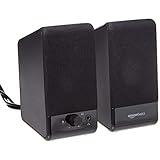
- USB-powered (5V) speakers plug directly into your computer for portable convenience
- Turn the speakers on and adjust the volume using one simple control (located on the front of the speakers); volume control includes On/Standby
- Simple plug-and-play setup (no drivers needed); can be used with headphones via the 3.5mm jack connector
- Frequency range of 103 Hz - 20 KHz; 2.2 watts of total RMS power (1.1 watts per speaker)
- Measures 2.76 by 3.55 by 5.3 inches (LxWxH); weighs approximately 1.4 pounds;
Rank #3
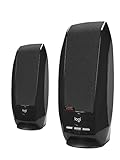
- Balanced audio sound with depth - 2 Watts Peak/ 1.2 Watts RMS power produces immersive and crystal clear sound.
- Simple and quick USB connection. Just plug the speakers into your computer USB-A port. An orange LED stays lit when your speakers are on. Disconnect the USB-A cable to power off.
- Easy controls. You can easily control the volume or mute on the front of the right speaker to get great audio experience.
- They are slim, lightweight and easy to move around so you can accommodate your setup and get perfect sound wherever you are.
- Your long lasting product set with a solid build quality.
Rank #2

- IMPORTANT UPDATE NOTICE -- Based on extensive customer advises, we’ve rolled out two major upgrades to this desktop speaker. First, volume control buttons have been added. Second, we increased the product thickness for a larger sound cavity, bringing moderate improvements in sound quality and volume.
- HIGH-QUALITY SOUND -- This laptop speaker is equipped with Dual 3W High-Excursion Drivers & Passive Radiator, delivering louder sound, wider dynamic range, enhanced bass and reduced distortion.
- ONE CABLE FOR BOTH AUDIO & POWER -- No 3.5mm AUX jack needed. Just one USB cable delivers both audio signal and power for the computer speaker to cut down cable clutter.
- WIDE SYSTEM COMPATIBILITY -- This upgraded PC speaker works with Windows, macOS, Linux and ChromeOS laptops & PCs, compatible with HP, Lenovo, ThinkPad, ASUS, Dell, Samsung, Acer, LG and more. Simply install the latest audio driver for smooth audio playback.
- PLUG-N-PLAY FOR SIMPLE SETUP -- For Windows PCs: Plug the speaker into your computer’s USB port, click the taskbar “Speaker” icon, then select “USB Speakers” as your playback device, and you’re ready.
Which setting controls what
| Setting | Where to change it | What it affects | Basis in Microsoft documentation |
|---|---|---|---|
| System default output | Settings > System > Sound > Output, or Sound Control Panel > Playback > Set as Default Device | Apps that use the system default play through this device | Selecting the playback device sets it as the default |
| App output device | Settings > System > Sound > Volume mixer > app > Output device | Only the selected app; it can differ from the system default | “Apps can use a different output device than the system default” |
| Default communications device | Sound Control Panel > Playback > Set Default Communication Device | Calls, for apps that follow the communications default | Separate communications default documented in Microsoft’s audio guidance; per-app behavior not stated |
When sound still goes to the wrong place or stops
The app or system uses a device you did not choose
- Recheck the system output under Settings > System > Sound, then the app’s output under Volume mixer. An app-level choice overrides the system default for that app, so both places need to match your intent.
- Check whether the default communications device is different from the default output, especially if the sound is a call.
Sound is silent after switching
- Check mute and volume for the output device and the app. Microsoft notes that an external monitor without built-in speakers can be selected as the default output, which leaves the PC with no audible sound. If that is the case, select a device that has speakers or headphones.
- If the device is listed but silent, check the audio enhancements setting for that device, as Microsoft’s no-sound guidance recommends.
- For a Windows 11 PC, Microsoft says the Get Help app includes an automated audio troubleshooter. Open Start, search for Get Help, and run the audio troubleshooter.
The device does not appear in Output
- Confirm the device is connected, powered on, and paired if it is Bluetooth. USB and Bluetooth speakers, headphones, and headsets can appear as output devices once Windows recognizes them.
- Check that the device is enabled and that the correct driver is installed. Microsoft’s broader audio support page lists these as the first checks when an intended output is not detected.
“
Product prices and availability are accurate as of the date/time indicated and are subject to change. Any price and availability information displayed on Amazon at the time of purchase will apply.

