
iTechGuides is reader-supported. When you buy through links on our site, we may earn an affiliate commission. As an Amazon Associate I earn from qualifying purchases. Learn more
You can design useful custom accessories for Steam Frame, but a CAD match is only the starting point. Build from the current Valve reference geometry, keep every camera, tracking path, control, port, and adjustment clear, choose filament for the part’s actual job, and validate the finished print on your own headset. No Steam Frame accessory was physically printed or tested for this guide, so none should be treated as safe, certified, or guaranteed to fit.
What a 3D-printed Steam Frame accessory can—and cannot—be
Readers often ask, “I am wondering if there are already 3D printable accessories for Steam Frame?” The practical answer is that a maker can create brackets, covers, cable guides, comfort parts, stands, and other add-ons, but the existence of a downloadable model does not prove that it fits, tracks correctly, stays attached, or is comfortable. A printed part must be checked on the actual headset and in the user’s normal wearing position.
Valve describes Steam Frame as a wireless VR headset with a modular head strap. The core module can be separated for alternative strap solutions, which creates opportunities for custom hardware. Valve also distinguishes its own Steam Frame-compatible accessories: products carrying the Steam Frame Compatible mark have been tested to work with the headset. A home-printed design has no such endorsement unless Valve has separately authorized it.
Recommended Free Tools
Some specifications may change before availability. Use the current Steam Frame product page and current hardware files when designing, rather than treating an older download or an announcement figure as permanent.
#1 Best Overall
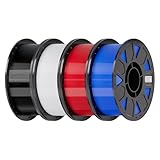
- Ender PETG Filament - combines the advantages of PLA and ABS, offering an eco-friendly, odorless, and user-friendly 3D printing experience. It features enhanced toughness that effectively resists cracking and warping, ensuring smooth and successful prints.
- Excellent Mechanical Properties - This PETG filament boasts high strength, impact resistance, and temperature resistance, with low shrinkage and high elongation at break. Printed models remain sturdy and durable even under repeated bending or stress.
- High Clarity & Glossy Finish - It delivers outstanding transparency and light transmission, making it perfect for visually detailed projects such as lampshades and display cases. The surface finishes with a smooth, glossy appearance.
- Reliable Printing & Compatibility - Dried, vacuum-sealed, and tangle-free, it minimizes clogging, bubbling, and snapping. With a precise diameter of 1.75mm (±0.02mm), it feeds smoothly and is compatible with most FDM printers on the market.
- Safe and Supported - Non-toxic and chemically resistant, Ender-PETG is safe for everyday use. Backed by Creality’s 12-month & 24 hours after-sales service. Note: Please place this product in a dry and ventilated environment, not in an environment of high temperature, sunny or humid conditions.
Start with the current dimensions and reference files
| Published item | Value | How to use it |
|---|---|---|
| Core module plus facial interface | 175 × 95 × 110 mm | Useful envelope information; it is not a complete model of every mating surface or user’s face. |
| Headset with strap | 440 g | Consider added mass and leverage when designing anything mounted away from the core. |
| Core module | 185 g | Relevant when evaluating a strap or balance modification. |
| Target IPD range | 60–70 mm | A printed facial or optical accessory must preserve the headset’s adjustment movement. |
| Maximum eyeglasses width | 140 mm | Do not let a frame, gasket, or cable guide reduce the wearer’s available eyewear clearance. |
These are Valve figures dated 2026. They describe the product, not a tolerance specification for a printed part and not a guarantee that a particular face, prescription frame, or strap arrangement will be comfortable.
What the reported hardware-reference repository contains
A Hackaday report by Donald Papp, published October 10, 2026, says Valve’s Steam Frame hardware-reference repository includes STEP models for the core module, head strap, and controllers, as well as documented controller infrared-tracking LED locations. Papp wrote: “The repository contains STEP format models of the VR core module, head strap, and controllers, so it’s as easy as possible to design things that’ll fit.”
The repository itself was not accessible during preparation of this guide. Its current file revision, precise exclusion geometry, and license therefore remain unverified. Open the live Valve repository yourself, confirm that the files are current, read the license before redistributing or selling derivatives, and do not assume that a model mentioned in a secondary report is still the latest release.
Do not substitute Index geometry for Frame geometry
Valve’s publicly accessible Index CAD documentation can provide general design ideas, such as preserving capacitive surfaces, sensor clearances, and non-reflective surfaces outside a sensor inclusion zone. Those instructions are Index-specific. They are not evidence of Steam Frame dimensions or exclusion zones. For a Frame accessory, use the Frame reference files and confirm every clearance on the real hardware.
Rank #2

- ①【PETG Filament 1.75mm】SUNLU PETG 3D Printer Filament combines the advantages of both PLA and ABS 3D printer filament, making 3D printing more convenient and easy.
- ②【Excellent Layer Adhesion】PETG filament offers excellent layer adhesion, reducing the risks of warping and ensuring smooth, strong prints with great structural integrity.
- ③【Enhanced Toughness】Known for its toughness, PETG outperforms many other filaments in durability, making it ideal for creating sturdy and resilient items that can withstand stress and use.
- ④ 【High Impact & Mechanical Strength】Stronger than standard PLA and easier to print than ABS. Our PETG filament provides excellent layer adhesion and impact resistance, preventing warping or cracking under stress. Perfect for printing functional parts, RC drone frames, or heavy-duty household tools.
- ⑤【Weather-Resistant for Outdoor Use】Engineered with robust UV and moisture resistance, SUNLU PETG maintains its structural integrity and color vibrancy over time. It is the ideal choice for outdoor planters, car accessories, and weatherproof garden fixtures that endure harsh sunlight or rain.
Map the no-touch zones before modeling
Make an exclusion map in your CAD project before drawing the accessory. The official product information identifies four outward-facing monochrome cameras for headset and controller tracking, two interior eye-tracking cameras used for eye tracking and foveated streaming, and a user-accessible front expansion port.
- Outward-facing cameras: leave their complete view unobstructed. A small lip can cast a shadow or hide part of a tracking scene even when it does not visibly cover the lens.
- Interior eye cameras: keep the eye-facing region, lens view, and adjustment travel clear. Avoid parts that can move into the wearer’s field of view or touch eyelashes and skin.
- Controller tracking: do not cover controller infrared LED locations or introduce material and geometry that blocks the headset’s view of them.
- Controls and capacitive areas: preserve buttons, analog inputs, touch-sensitive surfaces, and any hand-contact area needed for normal operation.
- Front expansion: retain access for cables and future expansion hardware; a decorative faceplate that requires removal for every connection is usually a poor trade.
- Strap and adjustment movement: model the full travel, not only the nominal position. A part that fits at one strap setting can bind at another.
- Contact surfaces: keep hard edges, support scars, and fasteners away from skin, lenses, facial interfaces, and pressure points.
Use the Frame-specific CAD to locate these areas exactly. The published product description tells you which functions must remain available, but it is not a substitute for the detailed reference geometry.
A disciplined design-to-print workflow
- Download and identify the current reference. Record the repository date, file name, unit system, orientation, and revision. Import the STEP file into a new project without altering the reference body.
- Check the license before sharing. Confirm whether the reference permits modification, redistribution, commercial use, or inclusion in a downloadable project. If the terms are unclear, publish only your own design instructions and ask the rights holder for clarification.
- Define the mating surface. Select the exact rail, boss, strap section, shell contour, or other feature that will locate the accessory. Do not fit to a screenshot or to the outer envelope alone.
- Build a clearance and exclusion layer. Mark cameras, eye-tracking openings, controller tracking paths, buttons, touch surfaces, ports, lens and facial-interface areas, and all moving adjustments as keep-out geometry.
- Choose the attachment strategy. Prefer reversible clips, straps, or existing mounting features over adhesives or fasteners that could scratch the headset. Design an intentional release path so removal does not require levering against the core module.
- Prototype the interface first. Print a small coupon or a low-cost section containing only the mating features. Check its dimensions and contact pattern before committing to a full shell or bracket.
- Measure and revise. Compare the printed coupon with the CAD and the headset using calipers or another repeatable method. Change dimensions from measured evidence; never force a tight part onto the device.
- Print the complete accessory. Orient the part so critical mating faces have the best dimensional consistency and so layer seams are not placed at a high-stress snap feature. Use the material profile recommended for your specific printer and filament.
- Inspect and finish. Remove supports, brim remnants, strings, and first-layer artifacts that could change the fit. Look for cracks, delamination, voids, warping, elephant-foot distortion, and sharp edges.
- Run the on-headset checks. Test attachment, removal, controls, tracking, comfort, eye relief, strap movement, and stability in the order described below. Stop immediately if the part obstructs a sensor, shifts, causes pain, or requires force.
Choose material for the job, not by a single “strongest” label
There is no universally best filament for Steam Frame accessories. PETG, ASA, TPU/TPE, and PLA solve different problems, and the result depends on the specific blend, printer, nozzle, enclosure, orientation, and profile. Neither Valve nor Prusa certifies these materials for Steam Frame accessories.
Quick wins for a faster PC:
Repair Windows errors before they cause bigger problemsFix Now →Scan for outdated or missing drivers - takes under a minuteDriver Scan →Clear out junk files and repair common Windows errorsFree Scan →| Material | Good candidate for | Useful characteristics | Main drawbacks and checks |
|---|---|---|---|
| PETG | Functional prototypes, holders, clamps, and brackets | Tenacious, good layer adhesion, relatively low warping, and useful toughness with modest temperature resistance. | Stringing, weaker bridges and overhangs, support-removal challenges, and less fine detail than PLA. Verify dimensions on your printer. |
| ASA | Parts exposed to sunlight or higher ambient temperatures | UV resistance and stated temperature resistance up to 93 °C in Prusa’s material guidance. | Significant warping and potentially harmful fumes. Ventilation is needed; larger prints benefit from an enclosure. It is more demanding than PETG for many machines. |
| TPU/TPE | Deliberately flexible bumpers, compliant pads, or selected strap features | Flexible and tenacious, allowing controlled compliance where a rigid part would press or rattle. | Comparatively difficult to print. Confirm that your extruder and motion system support the chosen hardness, and check that the part cannot fold into a camera or control. |
| PLA | Low-load shape prototypes and display or fit-check pieces | Low barrier to entry and generally easy to print for geometry checks. | Do not assume every PLA filament behaves identically or that it is suitable for heat or sustained load. Verify the intended environment and the filament’s data. |
PETG in practical accessory work
Prusa describes PETG as widely used for mechanical parts, including holders and clamps. Its toughness and layer adhesion can suit a clip or bracket, but stringing and overhang behavior can leave residue on a mating face. Plan support removal and inspect every edge that approaches the headset. Temperature recommendations in Prusa’s guides are machine-specific; copy the profile for your printer rather than treating a published value as universal.
Rank #3

- ①【PETG Filament 1.75mm】SUNLU PETG 3D Printer Filament combines the advantages of both PLA and ABS 3D printer filament, making 3D printing more convenient and easy.
- ②【Excellent Layer Adhesion】PETG filament offers excellent layer adhesion, reducing the risks of warping and ensuring smooth, strong prints with great structural integrity.
- ③【Enhanced Toughness】Known for its toughness, PETG outperforms many other filaments in durability, making it ideal for creating sturdy and resilient items that can withstand stress and use.
- ④【High Impact Strength】With its high impact resistance, PETG is perfect for printing parts that need to endure bumps and drops, ensuring long-lasting performance without cracks or breaks.
- ⑤【Robust Durability】PETG prints are robust and maintain their properties over time, making them suitable for both indoor and outdoor applications where weather resistance is a necessity.
When ASA is justified
ASA is a candidate when ultraviolet exposure or higher-temperature resistance matters, such as an accessory left in a bright room or transported in a warm vehicle. Prusa’s stated resistance figure is material-guide information, not a Steam Frame operating limit. Enclose or ventilate the printer appropriately, control warping, and keep the finished part away from the wearer until all fumes and residues are gone.
Use flexible filament only where compliance is intentional
A TPU/TPE bumper can absorb contact or reduce rattling, but flexibility also makes dimensions harder to predict and can allow a part to creep into a sensor view. Define the flexible section, its compressed state, and its failure mode in CAD. If the printer cannot reliably feed the material, choose a rigid design with a separate compliant insert rather than forcing an unsuitable process.
Accessory patterns and the trade-offs they create
Rigid brackets and mounts
Use PETG or another verified rigid material for a bracket that carries a light, cable, or small accessory. Put load paths through existing structural features, spread contact over broad surfaces, and include a deliberate release tab. Avoid a cantilever that presses on the camera housing or transfers a small accessory’s weight into the facial interface.
Do these 3 things before closing this tab:
1Repair Windows errors before they cause bigger problems2Scan for outdated or missing drivers - takes under a minute3Clear out junk files and repair common Windows errorsProtective shells and covers
A cover must protect without becoming a camera hood. Leave openings larger than the visible lens outline when the CAD indicates a wider field of view, and chamfer or round exposed edges. Provide ventilation and cleaning access where appropriate. A cover that traps sweat, dust, or heat can be worse than no cover.
Rank #4

- [Excellent PETG Filament]Our PETG combines the benefits of PLA and ABS to reach Eco-friendly and odorless performance. This PETG Filament is feature in good toughness to avoid cracking and warping, enbale excellent 3D printing.
- [Toughness-enhanced PETG] Our PETG filament choose durable and strong material that delivers excellent clarity, light transmission, and a glossy finish. It is recommended to use a printing temperature of 220-250°C and a base plate temperature of 70-80°C for better printing results.
- [Tangle-Free & Neatly Wound] We ensure that every PETG filament is tightly and neatly wrapped by utilizing full mechanical winding, which effectively minimizes tangles, filament snapping, and line breakage.
- [No Clogging & No Bubbles] Our filaments are thoroughly dried and carefully vacuum sealed to protect them from moisture and dust, which ensures that there will be no issues with clogging or bubbling during printing. Our PETG is designed to be perfectly compatible with the majority of 1.75mm FDM 3D printers, especially suitable for Creality 3D Printers!
- [High Precision & Consistent Performance]Our PETG filament boasts a diameter of 1.75mm, ensuring utmost accuracy with a tolerance of only +/- 0.03mm. With strict quality control and impeccable dimensional precision, our PETG filament guarantees a smooth and steady feeding during printing.
Flexible contact parts
Use a compliant bumper only on a surface where movement is expected and where the material cannot migrate into optics or controls. Design a replaceable insert rather than permanently bonding flexible filament to the headset. Check that the insert stays seated after repeated removal and handling.
Stands and display supports
A stand does not need to touch tracking or facial surfaces, so it is often the lowest-risk first project. Support the headset at stable, padded contact points, keep lenses away from abrasive debris, and make the center of gravity difficult to tip. If a stand includes a charging or data channel, retain direct access to the front expansion area.
Independent reader supportYour contribution helps us test, update, and keep practical guides available for everyone.Print preparation and quality control
Before the final print, inspect the slicer preview for unsupported bridges, thin walls, trapped supports, and seams on visible or mating surfaces. Orient the part so the most important dimensions are formed in the most reliable axes of your machine. The correct orientation depends on your printer and geometry; there is no universal angle or layer height that guarantees a Frame fit.
- Print a flat calibration coupon containing the actual clip, hole, rail, or pad interface.
- Measure the coupon after cooling. Record shrinkage, elephant foot, hole size, and any warping instead of relying on nominal CAD dimensions.
- Use supports only where they can be removed without scarring a mating face. If a support mark is unavoidable, move it to a non-contact area.
- Deburr edges and remove strings. Do not sand a critical surface until you can measure how much material was removed.
- Reject parts with visible cracks, delamination, major voids, warped mounting planes, or sharp defects. A visually poor prototype is not a trustworthy fit test.
Prusa’s material guidance emphasizes that filament properties and print defects affect the finished part. A slicer’s successful completion message does not establish dimensional accuracy or safe headset contact.
Best Value

- High Performance & Strength: PETG filament combines the strengths of PLA and ABS. It offers low shrinkage, high impact resistance, excellent temperature resistance, and high elongation at break, models can bend repeatedly and remain firm and sturdy
- High Transparent & Glossy: PETG has a high degree of transparency. The finished product has a fine surface with exquisite details. This makes PETG material ideal for making transparent parts and models, such as lampshades, display boxes, and more
- Non-toxic Material: Creality CR-PETG 3D printing filament has excellent wether resistance and chemical resistance, no odor, and non-toxic, green environmental protection
- Wide Compatible: CR-PETG filament is wildly used in FDM 3D printers on the market.Compatible with most popular 3D printers such as MK3, Creality Ender series/CR series, ELEGOO, Anycubic, and more
- Creality Support: Creality provides 12-month & 24 hours after-sales service. Note: Please place this product in a dry and ventilated environment, not in an environment of high temperature, sunny or humid conditions
Test the finished print on the actual headset
CAD alignment cannot reveal every real-world problem: filament shrinkage, strap flex, skin pressure, eyewear shape, and small changes in assembly can all alter the result. Perform the following checks with the headset powered off for the initial mechanical inspection, then repeat functional checks powered on.
| Stage | What to check | Pass condition |
|---|---|---|
| Initial contact | Seat the part gently and inspect every contact point. | It reaches its intended stops without force, scraping, or levering against the headset. |
| Attachment and removal | Install and remove it several times using the designed release path. | No cracking, gouging, loosening, or need to twist the core module. |
| Controls and access | Operate buttons, analog inputs, capacitive surfaces, ports, and the strap adjustment. | Every control and connection remains fully usable throughout adjustment travel. |
| Tracking | Check headset and controller tracking with the accessory installed, then after handling it. | No loss, jitter, occlusion, or new blind spot attributable to the part. |
| Eye and facial clearance | Wear the headset in the user’s normal fit, with usual eyewear if applicable. | No contact with eyes, eyelashes, lenses, facial interface, or pressure-sensitive areas; eye relief remains adjustable. |
| Stability | Turn the head normally, adjust the strap, and handle the headset as during ordinary use. | The accessory does not shift, rattle, pinch, or work its way toward a sensor or control. |
| Recheck | Inspect all interfaces after use and after another installation. | No new wear, deformation, whitening of a clip, loose fastener, or surface damage. |
Stop using the part if it obstructs a camera, changes tracking, shifts during movement, causes discomfort, interferes with eyewear, or requires force to attach or remove. These are conservative maker checks, not a Valve-certified test protocol.
Troubleshoot by symptom
| Symptom | Likely cause | Corrective action |
|---|---|---|
| Part will not seat | Warping, first-layer flare, incorrect orientation, or an incorrect reference revision. | Measure the coupon and mating surface, remove only known print artifacts, and revise the interface instead of forcing it. |
| Clip is loose | Material shrinkage, excessive clearance, or a flexible section carrying load. | Measure the assembled gap, adjust the locating feature, and add a positive stop or compliant insert rather than tightening against a sensor housing. |
| Tracking becomes unreliable | A camera view or controller infrared path is partially blocked or shadowed. | Remove the accessory, confirm tracking recovery, then enlarge or relocate the opening using Frame-specific geometry. |
| Controls are hard to reach | The accessory overlaps a button, analog input, capacitive area, or adjustment path. | Redesign the exclusion boundary and test the full movement range, not only the neutral position. |
| Face pressure or eye discomfort | Contact is carrying load, edge geometry is sharp, or the accessory changes eye relief. | Stop use, round or relocate the contact, and retest with the wearer’s normal fit and eyewear. |
| Part cracks during removal | Layer orientation, thin snap feature, brittle material, or an unsuitable release direction. | Increase the feature’s section, change print orientation or material, and provide a clear flex and release path. |
| ASA print curls or smells strongly | Warping, inadequate enclosure control, or insufficient ventilation. | Follow the printer and material safety guidance, improve environmental control, and consider PETG if UV and heat resistance are not required. |
Licensing, compatibility language, and publishing your design
Check the live Valve repository license before uploading modified STEP files, screenshots derived from the models, or a commercial product based on them. The license was not verified here, so do not promise permissions that the repository does not grant.
Describe a part as “designed for Steam Frame” only when that wording accurately explains your target. Do not use the Steam Compatible mark, Valve logos, or language implying that Valve designed, tested, endorsed, or certified a third-party print unless you have written authorization. A personal fit check is not the same as official compatibility.
When publishing files, include the reference-file revision, printer assumptions, material and profile notes, required hardware, installation direction, removal instructions, known exclusions, and a warning to test on the user’s own headset. If a design has only been checked in CAD, say so plainly; do not present it as physically validated.
A practical decision rule
For a first functional prototype, PETG is often the most forgiving starting point when your printer handles it consistently. Choose ASA only when its UV or higher-temperature characteristics justify the extra warping and ventilation work. Use TPU/TPE for a specifically defined flexible feature, and PLA for low-load shape checks or stands in a controlled environment. In every case, the correct choice is the one that preserves sensor and control clearance, produces a stable and clean interface on your machine, and can be removed without stressing the headset.
The reliable workflow is therefore: current Frame CAD, explicit keep-out geometry, a small measured prototype, a material matched to the job, careful print inspection, and a staged test on the actual headset. None of those steps can be replaced by a rendered screenshot or a nominal dimension.
Quick Recap
Product prices and availability are accurate as of the date/time indicated and are subject to change. Any price and availability information displayed on Amazon at the time of purchase will apply.

