
Windows Errors? Fix Them Before They Spread
Repair common Windows errors and clear accumulated junk for a smoother, more stable PC - no reinstall needed.Free scan · no reinstallCrashes, No Sound, or Screen Glitches?
Random freezes, missing sound and display glitches usually trace back to one bad driver. Find and replace yours safely.Free scan · under a minuteiTechGuides is reader-supported. When you buy through links on our site, we may earn an affiliate commission. As an Amazon Associate I earn from qualifying purchases. Learn more
A new indexed label can create a separate time series for every distinct combination of its values with existing labels. That can expand the number of series—and the index state that tracks them—far more than adding samples to series that already exist. The title’s “million more rows” comparison is an illustration, not a universal cost ratio: actual resource use depends on the database, data, workload, and series churn.
What cardinality counts
Cardinality is the number of distinct time series, not the number of samples or rows. A series can contain many timestamped samples. In Prometheus-style systems, a metric name together with its label values identifies a series: changing a label value creates a different series, even when the metric and other labels stay the same. Prometheus documentation on metric and label naming warns that every unique combination of label key-value pairs represents a new time series and can substantially increase stored data.


“Indexed column” is not a universal database concept. Engines differ in which fields they index and how they define a series. In InfluxDB Cloud TSM, for example, measurements, tags, and field keys are indexed, and each unique set of indexed elements forms a series key. The same schema change can therefore have different consequences in another engine.
Free tools Windows power users keep installed
One-click scans. No signup required.
Why a new dimension fans out
Suppose a metric has labels for service and operation. Adding user_id does not necessarily create just one new series. For each existing service-operation combination, each distinct user ID that occurs can identify another series. If the label has many distinct values, the resulting series count can grow sharply. The exact increase depends on which combinations actually occur; it is not always the product of every theoretical value count.
#1 Best Overall
By contrast, more samples with the same metric name and label values add observations to an existing series. This is why a large increase in sample count need not have the same index effect as adding a high-cardinality dimension. It does not mean those samples are free: ingestion, storage, retention, and query costs still matter.
Where the extra cost comes from
Series identity has to be represented and found. Prometheus describes a block index that maps metric names and labels to time-series chunks, with the incoming block held in memory before full persistence. VictoriaMetrics says its index stores data per label for registered time series, and that index size grows with both series count and total label length.
High cardinality can raise memory use, enlarge indexes, slow inserts, and increase query work, but the precise effects depend on the implementation and workload. In VictoriaMetrics, for example, inserts may need slower disk reads when active-series information no longer fits in the in-memory cache. InfluxData describes high series cardinality as a primary memory-use driver for many workloads. These are engine-specific behaviors, not a universal cost per series or per column.
The Tool Desk
Outbyte PC Repair FREEClear out junk files and repair common Windows errorsFree Scan →Outbyte Driver Updater FREEScan for outdated or missing drivers - takes under a minuteDriver Scan →High cardinality versus churn
A large, stable set of active series and high churn are related but distinct concerns. Churn means series are being created frequently. A label based on an ephemeral identifier—such as a changing pod name—can cause new series to appear as old ones disappear, increasing the work of tracking series over time.
Rank #3

- 2 Years of Cellular Service Included – Necto offers the most affordable cellular-enabled sensor with 2 full years of 4G LTE service included—no hidden fees, contracts, or WiFi required. With a built-in multi-network SIM card, you can remotely monitor conditions 24/7 and receive real-time alerts. After 2 years, you can renew the subscription from the app for only $6.99 a month.
- Instant Alert & 24/7 Monitoring - Keep tabs on your Home, RV, Car, or Pets from anywhere with the 3-in-1 temperature, humidity & power outage monitor. Customize the high and low temp/humidity thresholds and add up to 5 contacts for unlimited text and email alerts. Receive real-time alerts if critical changes in temp/humidity or a power loss occurs.
- Rechargeable Internal Battery - The Necto smart RV and pet monitor has a 3 day long-lasting rechargeable battery. Unlike WiFi sensors, Necto provides continuous monitoring in the event of a power outage, via its built-in battery and cellular technology. Receive instant alerts on your phone when battery power is low or if the device disconnects from the network.
- Intuitive Mobile App & Easy Setup - Our user-friendly mobile app gives you remote access to your sensor from anywhere. Use your smartphone or PC to customize alert thresholds, view past readings, and manage device settings with ease. The sensor takes minutes to install and requires no technical expertise. Simply activate the device through the app and plug it into any standard wall outlet.
- Fast Refresh & Free Data Storage - The industrial built-in temperature and humidity sensor takes readings every 10 seconds to make sure the temp/humidity are within the safe range. Every 10 minutes the most recent reading is updated on the online portal. Readings are stored on our servers for 1 year and can be downloaded anytime on a CSV file.
VictoriaMetrics’ capacity guide illustrates the effect with an example: 1,000 time series per service across 100 replicas yields 100,000 active series; a redeployment that changes pod names can create another 100,000 new series. Those are figures in the guide’s example, not a universal deployment estimate. The guide also gives an illustrative example of 1,000 series per Node Exporter instance and approximately 50,000 active series across 50 instances; this is not an independent benchmark.
Which labels are likely to cause trouble?
Look closely at labels whose values are unique per request, user, event, or deployment, or that can grow without a defined bound. Common examples include user IDs, email addresses, query IDs, hashes, UUIDs, URLs, IP addresses, timestamps, and changing pod names. A label is not automatically harmful just because its values vary: the relevant questions are how many distinct combinations it creates, how quickly they appear, and whether queries need that dimension.
Rank #4
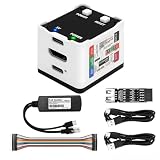
- 【Remote Control Operations Server】Sipeed NanoKVM is an IP-KVM solution based on the LicheeRV Nano RISC-V Linux single-board computer, inheriting the Nano's compact form factor and powerful capabilities. Breaking free from traditional host requirements for network connectivity and system software, NanoKVM functions as an external hardware device directly providing remote control capabilities.
- 【Powerful Interfaces】Sipeed NanoKVM features one HDMI input port that can be recognized by a computer as a display to capture screen content. One USB 2.0 port connects to the computer host, functioning as a HID device (e.g., keyboard, mouse, touchpad). It also utilizes spare TF card storage space, mounting it as a USB flash drive device.
- 【100Mbps Ethernet Support】Sipeed NanoKVM features a 100Mbps Ethernet port for network transmission of video and control signals. The Full version additionally includes an ATX power control interface (USB-C) for remote host power status monitoring and control. The Full version housing also incorporates an OLED display showing the device's IP address and KVM-related status.
- 【Server Management】Sipeed NanoKVM enables real-time monitoring and control of server operations. Supports remote desktop access and host power cycling: NanoKVM overcomes limitations requiring the host to be networked or specific system software, functioning as external hardware to provide direct remote control capabilities.
- 【Supports Remote Installation】Sipeed NanoKVM emulates a USB flash drive device, enabling mounting of installation images for system deployment or access to computer BIOS settings. The NanoKVM Lite features two serial ports for use with IPMI or connection to other development boards via web-based serial terminal interaction. Users may also expand functionality with additional accessories.
How to find and reduce high-cardinality series
- Measure series cardinality. InfluxDB documents
influxdb.cardinality()andSHOW SERIES CARDINALITY, along with ways to count distinct values for a tag. Use the tools available in your engine to identify which measurements and dimensions account for the series. - Inspect value distributions and growth. Check whether values are stable categories or rapidly growing identifiers. Pay particular attention to IDs, hashes, long text, timestamps, URLs, and names that change during redeployment.
- Remove labels that do not serve a query need. If a dimension is not needed for filtering or aggregation, avoid making it part of series identity. Keep high-detail data elsewhere if it must remain available but does not need to be an indexed label.
- Aggregate before ingestion when necessary. If a volatile label cannot be removed but per-value detail is not required, VictoriaMetrics recommends pre-aggregation to reduce the number of resulting series.
- Retest with representative traffic. Test the read and write workload you intend to run, including realistic active series, churn, ingestion, queries, and retention. Active-series count and ingestion rate alone do not reliably determine capacity.
How to compare time-series database options
Do not choose an engine based on a supposed universal cost per label or series. Compare the behavior that matters for your schema and workload:
- Which dimensions define series identity or create index entries?
- How do memory use and index size change as active-series count and label length grow?
- How does the engine handle churn from short-lived or changing identifiers?
- What ingestion rate, query shapes, and retention period must it support?
- What cardinality inspection, label filtering, or pre-aggregation options are available?
- How does it perform on representative tests using your intended data and read/write patterns?
VictoriaMetrics’ capacity guide says compute needs are difficult to predict from active series and ingestion rate alone, and recommends workload-specific testing. The reviewed official sources do not establish that one indexed column always costs more than a million rows, or provide a neutral cost-per-series figure that applies across engines. Treat the comparison as a warning about fanout, then measure your own workload.
Quick Recap
Product prices and availability are accurate as of the date/time indicated and are subject to change. Any price and availability information displayed on Amazon at the time of purchase will apply.

