
iTechGuides is reader-supported. When you buy through links on our site, we may earn an affiliate commission. As an Amazon Associate I earn from qualifying purchases. Learn more
Scientists reconstruct early Earth and Mars by combining dates from minerals, chemical and isotope fingerprints, meteorites, landforms, and models. Each clue answers a different question: a mineral can record when it crystallized, isotopes can reveal something about its source or later interactions, and a valley can show that water once flowed without proving how long the climate stayed warm. The result is a timeline built from evidence with different levels of certainty—not a single complete record.
Why early planetary history has to be reconstructed
No scientist can observe the first chapters of Earth or Mars directly. Instead, researchers test what happened by asking what physical traces should remain and whether independent kinds of evidence fit the same explanation. A radiometric age, an isotope ratio, a mineral assemblage, and a landform are not interchangeable: each records a different part of a planet’s history.
The records are uneven. Earth’s crust has been altered, buried, eroded, and recycled, leaving relatively few surviving samples of its earliest history. Mars preserves extensive ancient terrain, and rocks blasted off its surface by impacts have reached Earth as meteorites. Those meteorites can be studied with laboratory instruments, but they represent particular rocks rather than a complete survey of the planet.
Recommended Free Tools
What the main kinds of evidence can tell scientists
Radiometric clocks date particular mineral events
Some radioactive elements decay into other elements at predictable rates. By measuring the parent and daughter isotopes in a mineral, scientists can estimate when that mineral crystallized or when its isotope system was last reset. The interpretation depends on the mineral and its geological history: a date on one grain is not automatically the age of an entire crust, ocean, or atmosphere.
#1 Best Overall

- Globe Diameter : 24cm / 9.5"
- Item Size : 9.5"D X 14"H X 10"W / D 24cm X H 36cm X W 26cm / Diameter X Height X Width
- Name : Explorer Red Mars Globe, 24cm/9.5"
- Color : Red (Mars surface) / Uses images from NASA
- Base Material : Plastic Dark Brown (ABS)
Uranium–lead (U–Pb) dating of zircon is especially useful because zircon can preserve an old age through later geological events. In a 2018 Nature study, seven zircons from the Martian meteorite NWA 7034 yielded dates from 4,476.3 ± 0.9 to 4,429.7 ± 1.0 million years ago. These measurements date the zircons’ crystallization, not the formation date of all Martian crust.
Isotopes help identify sources and later interactions
Isotopes of an element have different numbers of neutrons. Their proportions can preserve clues about a rock’s source material, the evolution of a planetary reservoir, or contact with water and other materials. Turning a measured isotope ratio into a history usually requires geological context and a model; it is an inference rather than a direct observation of the ancient event.
Rank #2
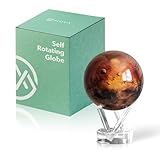
- Mars in Motion – A Realistic Look at the Red Planet - Golden-red surface tones with volcanic ridges and weathered terrain bring Mars to life. An inspiring piece for space lovers and science fans alike.
- Self-Rotating Technology Powered by Light - MOVA’s patented design silently spins the globe using ambient light and the Earth’s magnetic field — no batteries or cords required.
- Premium Build with Seamless Movement - A fluid-suspended inner globe rotates within a clear acrylic outer shell, offering a smooth, almost magical visual experience.
- Perfectly Sized for Personal Spaces - Measuring 4.5 inches in diameter (about softball size), it fits beautifully on desks, shelves, and side tables as a compact cosmic accent.
- Gift-Worthy for Dreamers and Thinkers - A thoughtful present for science enthusiasts, educators, students, and anyone fascinated by space. MOVA Globes spark imagination and lasting conversations.
The NWA 7034 zircon study also used lutetium–hafnium (Lu–Hf) isotope compositions to infer the nature and timing of the zircons’ source reservoir. The authors interpreted the isotope evolution as indicating that primordial Martian crust existed by 4,547 million years ago. That figure is an inferred timing for extraction of an enriched source reservoir, not a direct U–Pb age for the seven zircons.
Free tools Windows power users keep installed
One-click scans. No signup required.
Meteorites provide samples of places scientists cannot visit
Some meteorites found on Earth are fragments of Mars that were thrown into space by impacts and later fell here. NWA 7034 and NWA 7533 are regolith breccias: rocks made of fragments of surface material assembled together. They preserve minerals and chemical signatures that can be examined in detail, including evidence of crustal material and alteration.
Rank #3

- Mars in Motion – A Realistic Look at the Red Planet - Golden-red surface tones with volcanic ridges and weathered terrain bring Mars to life. An inspiring piece for space lovers and science fans alike.
- Self-Rotating Technology Powered by Light - MOVA’s patented design silently spins the globe using ambient light and the Earth’s magnetic field — no batteries or cords required.
- Premium Build with Seamless Movement - A fluid-suspended inner globe rotates within a clear acrylic outer shell, offering a smooth, almost magical visual experience.
- More to Explore - Our larger Mars globe offers richer surface detail and stronger visual presence, ideal for offices and display cabinets.
- Gift-Worthy for Dreamers and Thinkers - A thoughtful present for science enthusiasts, educators, students, and anyone fascinated by space. MOVA Globes spark imagination and lasting conversations.
In NWA 7533, variation in zircon oxygen-isotope compositions has been interpreted as evidence for interaction among Martian regolith, atmosphere, and hydrosphere. A 2014 Nature Geoscience paper proposed that a thick primary Martian atmosphere was lost within the first 120 million years after accretion. This is the authors’ interpretation of the isotope record, not a directly observed atmospheric-loss event.
Landforms and minerals record processes, not always one unique cause
Valley networks, impact craters, hydrous minerals, sulfate deposits, and sedimentary features help researchers identify erosion, water–rock interaction, impacts, and volcanic resurfacing on Mars. The shape and distribution of these features provide clues to what processes occurred and their relative order. They do not, by themselves, establish how long a climate condition lasted or prove that the whole planet shared it.
Rank #4

- Globe Diameter : 24cm / 9.5"
- Item Size : 9.5"D X 14"H X 10"W / D 24cm X H 36cm X W 26cm / Diameter X Height X Width
- Shipping Size : 52cm X 34cm X 26cm / 20.5"L X 13.4"H X 10.2"W / Length X Height X Width
- Explorer Gray Moon/Red Mars 2 Globe Set, 24cm/9.5"
- Color : Moon Globe - Gray / Mars Globe - Red
Researchers estimate the ages of many Martian surfaces by counting impact craters and comparing the counts with models of how crater production changed over time. This gives a chronology that depends on models rather than a direct date for every valley or deposit. The USGS-hosted 2010 account by Carr and Head describes high rates of cratering, erosion, and valley formation during the Noachian, while concluding that conditions suitable for flowing water may have occurred only occasionally.
Numerical models connect scattered clues
Models let researchers test whether measured ages, isotope patterns, rocks, and landforms can be explained by a proposed sequence of events. For example, a model can connect zircon oxygen-isotope values to interactions between shallow crustal magma and water. A model’s conclusion is only as strong as the evidence and assumptions behind it; several different histories may sometimes fit the surviving clues.
Best Value

- MAKE ASTRONOMY EASY TO SEE: Gear-driven movement helps teachers and students show how the Earth moves around the sun and how the moon moves around the Earth. Instead of flat diagrams, the model turns abstract lessons into a clear hands-on demonstration for classrooms, homeschool, and science projects.
- DEMONSTRATE SEASONS AND ECLIPSES: Multiple moving axes make it easier to explain daylight, night, moon phases, seasons, solar eclipses, and lunar eclipses in one tabletop display. Students can rotate the handle, watch the positions change, and connect each movement with real astronomy concepts.
- BUILD A MORE ENGAGING LESSON: The DIY assembly format adds interaction before the lesson even begins. It encourages observation, problem solving, and discussion, making it useful for school labs, STEM activities, homeschool units, science fairs, and parent-led learning at home.
- STAY STEADY DURING DEMOS: Plastic and steel construction sits on a wide base designed for repeated classroom handling. The compact 15.2 × 7.87 × 11.02 in size fits on desks, teaching tables, and display shelves while keeping the sun, Earth, moon, and season plate easy to view.
- REDUCE SETUP CONFUSION: The model includes an operating handle, orbit rods, season plate, moon phase display, and gear-driven parts in one kit. For smooth rotation, gears should be aligned freely and not pressed too tightly, helping users get better motion and a cleaner demonstration.
What the evidence currently says about early Earth
Earth’s earliest surviving rocks and minerals offer a fragmentary record, so scientists compare them with meteorites and use chemical and isotope patterns to test ideas about accretion and planetary differentiation. The absence of a surviving rock is not proof that the event it might have recorded never happened: early crust could have been destroyed or transformed.
One important clue comes from zircons in the Jack Hills of Western Australia. A 2024 Nature Geoscience study interpreted their oxygen-isotope measurements, using modelling, as requiring shallow crustal magmatic systems that interacted with meteoric water at or before 4.0 billion years ago. This supports early water–rock interaction in those systems; it is not a direct observation of a global ocean.
A 2026 review in Nature Reviews Earth & Environment defines the Hadean as 4.567–4.0 billion years ago. It describes a possible initial hydrosphere by 4.4 billion years ago, but places the earliest robust evidence of subaqueous environments at about 3.7 billion years ago. These dates refer to different types and strengths of evidence. They should not be collapsed into a claim that Earth’s oceans began at 3.7 billion years ago.
What the evidence currently says about early Mars
Mars offers both laboratory samples and broad areas of preserved ancient terrain. Meteorites provide detailed mineral ages and isotope chemistry for individual rocks; orbital and surface observations reveal the larger pattern of valleys, craters, minerals, and deposits. Combining the two helps scientists ask whether a laboratory sample fits a process seen across a region, although the meteorites do not represent every Martian setting.
Evidence for water on Mars is not the same as evidence for an enduring warm, wet planet. Valley networks and water-altered minerals point to past water-related processes, but climate interpretations differ by time and region. The USGS account by Carr and Head emphasizes that fluvial conditions may have been occasional; a later synthesis describes multiple climate transitions and intermittent warm conditions. The sources do not support portraying early Mars as uniformly warm and wet, or reducing its climate history to one simple wet-to-dry transition.
Quick Recap
How to read the dates and conclusions
| Evidence or finding | What it supports | What it does not establish by itself |
|---|---|---|
| Seven NWA 7034 zircon U–Pb dates: 4,476.3 ± 0.9 to 4,429.7 ± 1.0 million years ago (2018 Nature study) | Crystallization ages for the measured zircon grains. | The age of all Martian crust, or the date an atmosphere or ocean formed. |
| NWA 7034 Lu–Hf isotope interpretation: primordial Martian crust by 4,547 million years ago (2018 Nature study) | An inferred timing for extraction of the enriched source reservoir of the zircons. | A direct crystallization age for the seven dated zircon grains. |
| Jack Hills zircon oxygen-isotope interpretation: meteoric-water interaction at or before 4.0 billion years ago (2024 Nature Geoscience study) | Modelled interaction between water and shallow crustal magmatic systems. | A direct observation that a global ocean existed at that time. |
| Possible initial hydrosphere by 4.4 billion years ago; earliest robust subaqueous evidence about 3.7 billion years ago (2026 review) | Two distinct stages in the evidence discussed for early Earth’s water. | A single, definitive date for when Earth’s oceans began. |
| Proposed loss of a thick primary Martian atmosphere within 120 million years after accretion (2014 Nature Geoscience paper) | The authors’ interpretation of oxygen-isotope evidence from NWA 7533. | A directly observed event or an independently established date for atmospheric loss. |
A practical way to assess any claim about early planets
- Identify the evidence. Is the claim based on a mineral age, isotope chemistry, a landform, a mineral assemblage, or a model?
- Separate the measured result from the interpretation. A measured age or ratio is not the same thing as the historical explanation attached to it.
- Check what the sample represents. A meteorite is a specific rock; a landform may cover a region but may not have a direct laboratory age.
- Ask how much has been preserved. Earth’s old record is particularly incomplete, while Mars’s preserved surfaces still have gaps in coverage and chronology.
- Distinguish water from climate. Evidence for water–rock interaction or flowing water does not alone demonstrate long-lived, planet-wide warmth.
Product prices and availability are accurate as of the date/time indicated and are subject to change. Any price and availability information displayed on Amazon at the time of purchase will apply.

