
Do these 3 things before closing this tab:
1Fix the driver behind crashes, sound loss and screen glitches2Repair Windows errors before they cause bigger problems3Scan for outdated or missing drivers - takes under a minuteiTechGuides is reader-supported. When you buy through links on our site, we may earn an affiliate commission. As an Amazon Associate I earn from qualifying purchases. Learn more
Satellites need radiation protection because particles and space-weather conditions can disrupt electronics, gradually damage components and solar panels, or trigger charging-related anomalies. The protection is not one magic coating: engineers model the mission’s environment, choose and test components, use spacecraft structure or targeted shielding where it helps, and design systems and operations to manage the risks that remain.
How does space radiation damage satellites?
Radiation can harm a spacecraft in different ways, so “radiation damage” is not a single problem with a single fix. Some effects are immediate; others accumulate over time.
Single-event effects can disrupt operation
An energetic particle can interact with an electronic component and cause a single-event effect. Depending on the event and the affected system, the result may be a memory upset, corrupted data, or a system anomaly. NASA Science quotes Clive Dyer, an electrical engineer at the University of Surrey’s Space Center, describing the basic risk: “Single event effects will mess up your computers, scrambling your data — in binary code — from 1’s to 0’s.” This is an accessible explanation, not a formal definition of every single-event effect.
The Tool Desk
Outbyte PC Repair FREERepair Windows errors before they cause bigger problemsFix Now →Outbyte Driver Updater FREEScan for outdated or missing drivers - takes under a minuteDriver Scan →Cumulative exposure can degrade hardware
Ionizing radiation can build up damage in electronics over a mission, while displacement damage can impair components such as solar cells. Solar panels can also lose efficiency under some space-weather conditions. The consequences depend on the component, exposure, and mission environment; a satellite’s expected lifetime is therefore part of the protection problem.
#1 Best Overall

- HOBBY MODEL KIT – Unassembled model packed in an envelope with easy to follow instructions. Ideal for ages 14 and up.
- NO GLUE OR SOLDER NEEDED – Parts can be easily clipped from the metal sheets. Tweezers are the recommended tool for bending and twisting the connection tabs.
- VOYAGER – 1.5 Sheet Model with a moderate difficulty level. Assembled Size: 1.38 x 1.77 x 6.70 inches.
- FROM STEEL SHEETS TO 3D – Pop out the pieces and connect using tabs and holes. Includes illustrated instructions.
- HIGHLY DETAILED ETCHED MODEL – Display your 3D model once completed - collect and build them all.
Charging is a separate hazard
Surface charging occurs when charge accumulates on the spacecraft’s exterior; internal charging occurs when it builds up within materials or components. Either can contribute to electrical discharges or anomalies. These hazards are distinct from cumulative dose and single-event effects, so reducing one does not automatically solve the others.
What does a satellite radiation shield actually do?
Passive shielding uses material between radiation and sensitive hardware. Some protection comes from mass already present in the spacecraft; engineers can also add localized “spot” or “sector” shielding around critical components rather than shielding every surface equally. Placement matters because the radiation environment and spacecraft geometry are not uniform in every direction.
Rank #2

- Model Kit
- May Require Paints and Glues to Assemble
- Accurate Scale Model
- Detailed Instructions Provided
- Decals/Transfers Included
Shielding can reduce exposure to some radiation and lower some upset risks when it is designed for the mission. NASA describes passive shielding as most effective against lower-energy radiation. It is not a barrier that blocks every particle, prevents every anomaly, or makes a satellite immune to a solar event.
How do engineers choose the right protection?
The design starts with the mission rather than a universal material ranking. Engineers assess the environment the spacecraft is expected to encounter, identify vulnerable components and effects, and weigh protection against mass, volume, performance, and other mission constraints.
Rank #3

- HOBBY MODEL KIT – Unassembled model packed in an envelope with easy to follow instructions. Ideal for ages 14 and up
- NO GLUE OR SOLDER NEEDED – Parts can be easily clipped from the metal sheets. Tweezers are the recommended tool for bending and twisting the connection tabs
- APOLLO CSM – 3.5 Sheet Model with a challenging difficulty level. Assembled Size: 5.07 L x 2.28 W x 3.45 H inches.
- FROM STEEL SHEETS TO 3D – Pop out the pieces and connect using tabs and holes. Includes illustrated instructions
- HIGHLY DETAILED ETCHED MODEL – Display your 3D model once completed - collect and build them all
- Mission environment: Orbit, particle populations, solar-particle exposure, and mission duration shape the expected hazards.
- Effect to mitigate: Cumulative ionizing dose, displacement damage, single-event effects, and charging require different combinations of measures.
- Material and geometry: Composition, thickness, coverage, and component placement influence what reaches a particular part. A material comparison is meaningful only when the particle type, energy, geometry, orbit, and outcome being compared are specified.
- Mass and volume: Added shielding consumes spacecraft resources and can affect the wider design.
- Other controls: Radiation-tolerant component selection, testing, redundancy, monitoring, recovery plans, and operational decisions complement physical shielding.
NASA’s radiation-hardness assurance reference describes protection as an iterative process of assessing hazards, applying mitigations, and managing residual risk. NASA Science quotes Michael Xapsos, a member of the Project Scientist Team for NASA’s Space Environment Testbeds mission: “With more data, engineers can make better trades between risk, cost, and performance in the electronic devices they pick.”
Does more shielding always make a satellite safer?
No. More material adds mass, and energetic particles interacting with shielding can produce secondary particles. Under some conditions, those secondary particles can make the radiation environment inside a spacecraft worse. NASA therefore cautions that additional shielding can be detrimental in some cases.
Rank #4

- HOBBY MODEL KIT – Unassembled model packed in an envelope with easy to follow instructions. Ideal for ages 14 and up.
- NO GLUE OR SOLDER NEEDED – Parts can be easily clipped from the metal sheets. Tweezers are the recommended tool for bending and twisting the connection tabs.
- JAMES WEBB SPACE TELESCOPE - 2.75 Sheet Model with a moderate difficulty level. Assembled Size: 4.13 L x 2.75 W x 2.75 H inches. 1:221 Scale. 62 Pieces
- FROM STEEL SHEETS TO 3D – Pop out the pieces and connect using tabs and holes. Includes illustrated instructions.
- HIGHLY DETAILED ETCHED MODEL – Display your 3D model once completed - collect and build them all.
That trade-off is why “use the thickest shield” is not a sound general rule. Engineers model the mission’s particle environment and compare candidate materials, thicknesses, geometry, and component locations against the specific effect they want to reduce. The best choice for one orbit or component may not be the best choice for another.
What’s actually slowing this PC down?
Pick the symptom - the matching free tool is one click away.
What do NASA’s Shields-1 results show?
Shields-1, launched in December 2018, tested Z-grade shielding in a CubeSat structure. NASA’s SmallSat Institute reports the following results and comparisons; each is specific to the configuration and baseline described, not a general guarantee for other spacecraft:
Best Value
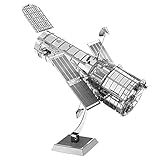
- HOBBY MODEL KIT – Unassembled model packed in an envelope with easy to follow instructions. Ideal for ages 14 and up.
- NO GLUE OR SOLDER NEEDED – Parts can be easily clipped from the metal sheets. Tweezers are the recommended tool for bending and twisting the connection tabs.
- HUBBLE TELESCOPE – 1 Sheet Model with a moderate difficulty level. Assembled Size: 3.00 x 2.00 x 2.50 inches.
- FROM STEEL SHEETS TO 3D – Pop out the pieces and connect using tabs and holes. Includes illustrated instructions.
- HIGHLY DETAILED ETCHED MODEL – Display your 3D model once completed - collect and build them all.
- A 3.02 g/cm² Z-shielding vault produced a total ionizing dose reported as more than 18 times lower than the modeled dose behind 0.20 cm of aluminum shielding.
- A 2.08 g/cm² AlTiTa Z-shielding configuration produced approximately half the dose from a solar particle event compared with a standard 0.2 cm aluminum structure.
The same NASA page describes the average historical cost of adding shielding in space mission analysis and design as below 10% of total spacecraft cost. That is a historical average in the page’s stated context, not a cost estimate for every project. The results illustrate why specific configurations must be evaluated against a defined environment and comparison point.
How do operators use space-weather hazard information?
NOAA’s Spacecraft Environmental Anomalies Expert System—Real Time (SEAESRT) provides hazard levels for geosynchronous satellites in four categories: surface charging, internal charging, single-event upsets, and total-dose effects. Its hazard quotients draw on environmental measurements and historical anomaly statistics or proxies. A quotient of one corresponds to the long-term average likelihood in that framework; it is not a prediction that a particular satellite will fail or remain safe.
NOAA’s public space-weather scales describe possible effects at different levels. For solar radiation storms, stronger levels can be associated with memory problems, imaging noise, star-tracker issues, and reduced solar-panel efficiency. The geomagnetic-storm scale includes possible surface charging and tracking or orientation problems; at G3, it also notes possible increased drag for low-Earth-orbit satellites.
Quick wins for a faster PC:
Repair Windows errors before they cause bigger problemsFix Now →Fix the driver behind crashes, sound loss and screen glitchesFind Drivers →Clear out junk files and repair common Windows errorsFree Scan →The scale page gives average frequencies over an 11-year solar cycle: it lists S3 solar radiation storms at 10 per cycle and S4 at 3 per cycle. Those are NOAA scale-page averages, not the probability that an individual satellite will be damaged. NOAA also says SEAESRT outputs are not currently archived, so its hazard indicators should be treated as operational context rather than a permanent record or a spacecraft-specific reliability verdict.
Quick Recap
Product prices and availability are accurate as of the date/time indicated and are subject to change. Any price and availability information displayed on Amazon at the time of purchase will apply.

