
Do these 3 things before closing this tab:
1Clear out junk files and repair common Windows errors2Scan for outdated or missing drivers - takes under a minute3Repair Windows errors before they cause bigger problemsiTechGuides is reader-supported. When you buy through links on our site, we may earn an affiliate commission. As an Amazon Associate I earn from qualifying purchases. Learn more
In a 2006 experiment, researchers put fluorescent semiconductor quantum dots inside protein shells from brome mosaic virus, a plant virus. A confocal microscope could then follow the labeled particles as they interacted with cells. The method was a research probe for studying virus-entry dynamics—not a clinical test or a way to track human infections.
How did the quantum dots track a virus?
The dots did not make a virus glow. The researchers used CdSe/ZnS semiconductor quantum dots as fluorescent markers and packaged them inside a capsid—the protein shell of brome mosaic virus (BMV). They could observe the labeled particles with a confocal microscope as they moved in relation to cells.
The approach adapted an earlier method for assembling gold nanoparticles inside viral capsids. In the quantum-dot version, attraction between negatively charged nanoparticles and positively charged proteins lining the capsid helped drive assembly. The researchers described this as mimicking the attraction between a virus’s genetic contents and its protein coat.
The Tool Desk
Outbyte Driver Updater FREEFix the driver behind crashes, sound loss and screen glitchesFind Drivers →Outbyte PC Repair FREEClear out junk files and repair common Windows errorsFree Scan →The work was reported by Bea Perks in Chemistry World on August 2, 2006. The primary paper, by Suraj K. Dixit and colleagues, was published online July 27, 2006, in Nano Letters and appeared in volume 6, issue 9, on September 13, 2006: “Quantum Dot Encapsulation in Viral Capsids”.
#1 Best Overall

- Optics Elements for Interference Diffraction Optical Physical Experiment.
- Single Slit/Double Slits Interference Diffraction.
- Suitable for: who are prepared for physics by understanding the interference and diffraction of light in advance.
- This kit is used in class to illustrate the phenomenon of light interference.
- This film is made of PET material, please do not use high power laser to avoid damage to the film.
Why did the coating matter?
Before the dots could be enclosed, their surface chemistry had to work with the capsid proteins. The team tested four coatings and selected polyethylene glycol (PEG) modified with a sulfur group at one end and a carboxylic acid group at the other. The coating supported assembly and helped the dots remain fluorescent under prolonged illumination.
Coating choice was not a cosmetic detail: an unsuitable coating could leave the dots insoluble or change the internal pH enough to prevent capsid assembly. A contemporaneous Nature Nanotechnology research highlight also reported that raising the ratio of quantum dots to viral components reduced empty capsids and resulted in many capsids containing multiple dots.
Rank #2
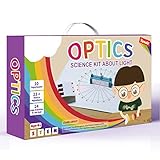
- Explore the Science of Light: Discover the fascinating world of optics with 15+ hands-on light experiments and learn how light travels, reflects, refracts, and forms images through real scientific exploration.
- Create Rainbows & Optical Effects: Use the included prism, lenses, mirrors, and transparent optical blocks to observe amazing optical phenomena such as rainbow formation, color mixing, and light refraction.
- Complete Optical Science Lab Kit: This STEM kit includes more than 25 experimental components, allowing kids to build their own mini physics laboratory and perform a wide variety of optics experiments at home or in school.
- Easy-to-Follow Experiment Guide: The 32-page full-color manual provides clear step-by-step instructions and explanations that help students understand key physics concepts while encouraging curiosity and scientific thinking.
- Perfect STEM Gift for Curious Kids: A fun and educational science kit designed for boys and girls ages 8-16, ideal for STEM learning, science projects, homeschooling, classroom demonstrations, birthdays, and holiday gifts.
What did the experiment show—and what did it not show?
In the 2006 account, the PEG-coated dots produced fluorescence that could be followed for up to 10 minutes. Dots coated with dihydrolipoic acid faded about eight times faster than the PEG-coated dots in the reported comparison. These are results from that experiment, not general performance specifications for quantum dots or microscopes.
The primary paper reports that PEG-functionalized CdSe/ZnS dots could self-assemble into viral particles, with minimal release of photoreaction products and enhanced stability during prolonged irradiation. Those findings concern materials, assembly and fluorescence stability; they do not establish tracking of a human pathogen inside a living person.
Rank #3

- Investigate the building blocks of life and learn the ABC's of DNA!
- Isolate plant DNA in a test tube.
- Learn about biological inheritance.
- Assemble a DNA model to see its elegant double-stranded helical structure.
- A 48-page, full-color manual guides you through 20 experiments and teaches about the basics of genetics and DNA.
Why might researchers want to follow viral particles?
Watching labeled particles move could help researchers investigate how long cell entry takes and which route a virus follows through a cell. Perks’s report presented these as potential uses for studying infection dynamics and, eventually, informing drug development—not as results already demonstrated by the experiment.
The capsid used was from BMV, a plant virus. Perks reported that it was the only virus type used in the technique at the time. David Wright, identified in the report as an associate professor of chemistry at Vanderbilt University, said “it’s really going to be important to make it generalisable.” The comment underscored the need to extend and validate the method across different viruses; it does not show that this later happened.
Rank #4

- This is a multi-functional learning kit,three power generation modes, energy conversion, circuit learning, and understanding of the conversion between sound, light and electricity.
- Solar power generation, using solar panels to convert the solar energy into electrical energy.
- Hand-cranked generator, kinetic energy is converted into electrical energy to light an LED or turn the fan
- The windmill generator,harness wind power and light an LED
- An excellent Family & Kids program,great for Primary and secondary schools projects,With Paper Instructions
Was this a medical test or clinical imaging method?
No. The report describes an experimental imaging approach using quantum dots, a plant-virus protein shell and confocal microscopy. It does not establish a diagnostic test, clinical use, or a method for tracking human infection. Its medical relevance was prospective: the researchers hoped the approach could become applicable to a wider range of viruses.
Free tools Windows power users keep installed
One-click scans. No signup required.
The documented sources describe the original 2006 work and its materials results. They do not establish how extensively the method has since been validated with clinically relevant viruses or whether it has entered clinical practice.
Quick Recap
Best Value

- TOYS THAT TEACH: MindWare’s Zoom, Ooze & Explore Ultimate Science Lab is a Science Academy experiment kit that makes understanding science basics fun, easy and safe. Learn to hypothesize, measure and record your results!
- HANDS-ON SCIENCE: Experience amazing hands-on science! You’ll mix concoctions, send balloon rockets zooming across the room and much more.
- AMAZING CHEMISTRY: This Ultimate MindWare Lab explores chemistry with simple and safe experiments! Each activity, from DIY thermometers to bending water and more, gives hands-on lessons in chemistry and biology.
- GUIDEBOOK AND LAB STATION: The multi-level lab station will keep you organized as you go through the illustrated step-by-step instructions in the guidebook and learn mini lessons about the chemistry behind your experiments.
- INCLUDES: All ingredients and supplies needed for your chemistry experiments! All ingredients are safe and non-toxic. Includes safety goggles and latex-free gloves. (Ages 8 and up)
Product prices and availability are accurate as of the date/time indicated and are subject to change. Any price and availability information displayed on Amazon at the time of purchase will apply.

