
iTechGuides is reader-supported. When you buy through links on our site, we may earn an affiliate commission. As an Amazon Associate I earn from qualifying purchases. Learn more
Metallohelices are synthetic iron-based molecules designed to imitate selected features of cationic antimicrobial peptides, such as positive charge and an amphipathic shape. They are not peptides: they are assembled from non-peptide components around metal ions. Laboratory studies report antibacterial activity and intracellular effects, but metallohelices remain experimental candidates—not approved medicines or treatments for people.
What does it mean for a metallohelix to emulate an antimicrobial peptide?
Cationic antimicrobial peptides (CAMPs) are positively charged molecules that can interact with bacterial surfaces. Many also have amphipathic structures, with both hydrophilic and hydrophobic regions. Researchers design metallohelices to reproduce some of those charge and shape features using a different chemical framework.
Metallohelices are metal-coordinated complexes assembled from non-peptidic organic components around iron ions. The cited studies describe optically pure, water-compatible structures. Calling them peptide-inspired or peptide-mimicking is accurate; calling them synthetic peptides is not. Nor does the analogy mean every metallohelix has the same activity: results depend on the compound’s structure.
What’s actually slowing this PC down?
Pick the symptom - the matching free tool is one click away.
How do antimicrobial metallohelices affect bacteria?
The findings point to more than one possible interaction, and the evidence differs across compounds and studies. In particular, the best-known 2019 result does not support a simple explanation in which the compound kills bacteria by rupturing their membranes.
#1 Best Overall

- FOR BASIC TEACHING TO ADVANCED SCIENCE: 444 pieces molecular model kit, including 136 atoms, 158 bonds and 150 parts for Carbon-60(Fullerene), provides to students from Grade 7 to Graduate level.
- TWO CHEMICAL STRUCTURE MODELS: The ball-and-stick models use spheres to represent atoms and sticks to represent chemical bonds. In the space-filling model, the spheres are drawn to scale and are next to one another as atoms are in real molecules.
- CHEMISTRY EDUCATIONAL MOLECULE MODEL IN 3D: It can display chemical structure, molecular bond, and bond angle in all directions. Demonstrate fundamental molecular geometry, chemical molecular structure, stereochemistry with 3D modeling studies.
- EASY TO LEARN: The universal standard adopted for each atom's color makes it easier for you to use and learn. Atoms and chemical bonds combine tightly and firmly and can be easily disassembled by disconnecting tools.
- If you’re not in love with it for whatever reason, we’ll give you a full replacement or refund—no questions asked. If you have any doubt, please tell us. With nothing to worry about, or even to share with your friends, try it now.
Intracellular effects reported in a 2019 study
Researchers reported that a selected metallohelix entered rapidly dividing Escherichia coli without significant membrane disruption and appeared in distinct foci near the cell poles. The study also reported selective binding to G-quadruplex DNA over double-stranded DNA, in-vitro inhibition of DNA gyrase and topoisomerase I, and plasmid curing in the tested strain.
Additional observations included activation of bacterial two-component and acid-response pathways, along with responses associated with lowering the cell surface’s negative charge. Taken together, these findings suggest several intracellular and cell-response effects. They do not establish that one molecular target accounts for bacterial killing in an infected organism. The 2019 Chemical Science study describes the compound-specific experiments.
Rank #2

- Visualize Molecular: The molecular model kit simplifies complex chemistry concepts into tangible 3D structures improve learning efficiency, suitable for students from Grade 7 to Graduate level.
- 444 Pcs Complete Set: The atom model kit includes with 136 atoms,158 bonds, and 150 fullerene model parts, explore most the molecules structures from simple compounds to complex polymers.
- Effortless Assembly: Embedded component design ensures easy to construct Ball-and-stick and Space-filling models that maximizes focus on exploration without complex assembly.
- Durable & Portable: Built to last, the chemistry set is crafted from high-quality materials. Plus, its portable Snap-Lock design allows you to take your experiments learning anywhere, between the home, classroom and lab.
- Essential Study Tool: Whether you're studying organic chemistry, biochemistry, or molecular biology, molecule building kit is an perfect learning tool for you deeper comprehension of molecular science.
Membrane interactions and uptake depend on design
A 2025 study examined metallohelix enantiomers—that is, different stereochemical forms—with different central hydrophobic-region lengths. It reported differences in activity and selectivity across Gram-positive and Gram-negative microbes and mammalian cells. Uptake varied with compound design and incubation conditions; the authors describe cellular entry as passive diffusion.
The study also found stronger interaction with membrane-mimetic vesicles for more lipophilic compounds, including in charge-neutral mammalian models. This indicates that positive charge alone does not explain which cells interact with a metallohelix. The authors report that phosphatidylethanolamine (POPE) increased binding affinity and propose that a high proportion of conical, non-lamellar lipids may contribute to membrane transport. That is an interpretation of their experiments, not a universal rule for all bacteria or metallohelices. The 2025 RSC Medicinal Chemistry study details the membrane and selectivity findings.
Rank #3

- UNLOCK YOUR CHEMISTRY POTENTIAL: Our comprehensive molecular model kit includes 238 pieces, featuring 84 atoms, 153 bonds and a remover tool. Suitable for chemistry learners from beginners to advanced levels. Manufacturer recommended age: 15 years and up
- ORGANIZED STORAGE AND EASY LOCATING: Experience hassle-free organization with our storage box, complete with divided compartments and labeled sections. Say goodbye to clutter and quickly find the components you need
- EXTRA LEARNING MATERIALS FOR EXCELLENCE: Enhance your studies with our bonus 6-page learning guide and stencils. From grade 9 to college, from organic to inorganic, finish and master your assignments faster and create numerous molecular structures with ease
- IMMERSIVE 3D VISUAL LEARNING: Explore chemistry in a captivating way with our 3D visual learning approach. The universal color-coded Atomic Balls provide a better understanding of molecular structure, boosting your chemistry knowledge. It's also a perfect gift for someone who are going to learn those complex molecule
- EASY-TO-USE DESIGN: Crafted from smooth, burr-free plastic, our molecular science kit ensures easy assembly. With the included remover tool, disassembling is a breeze
What antibacterial activity has been reported?
Two papers report an MIC of 2 μg/mL for different metallohelix compounds against E. coli. MIC, or minimum inhibitory concentration, is an experimental measure of the concentration that inhibits visible microbial growth under specified laboratory conditions. It is not a human dose, and these results should not be read as evidence of clinical effectiveness.
| Study | Compound and result | What the result means |
|---|---|---|
| Royal Society of Chemistry researchers, 2019 | Λ-5b: MIC of 2 μg/mL against E. coli. | The paper compared the result with kanamycin and noted that the metallohelix had about four times the molecular weight. This is a laboratory comparison, not evidence of equal clinical performance. |
| Royal Society of Chemistry researchers, 2021 | Λ-9b: MIC of 2 μg/mL against E. coli; a lethal effect on the TOP10 E. coli strain was observed in under one hour. | Both figures are in-vitro observations tied to the reported compound and strain; they do not establish a treatment effect in people. |
The 2021 paper, “Metallohelices emulate the properties of short cationic α-helical peptides,” reports the Λ-9b result. The 2019 study reports the Λ-5b result and its comparison with kanamycin.
Rank #4
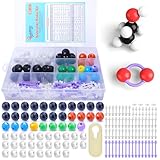
- ADVANCED LEARNING SCIENCE EDUCATION KIT --- Perfect chemistry model kit for modeling simple and small to more advanced and complex chemical structures for schools and college level, students of all ages, researchers and enthusiasts. Fun and interactive early learning molecular set for kids of all years and for use in the classroom.
- HIGH QUALITY --- Made from high quality durable materials designed for easy construction and perfect fit. These Molecular Model Kit pieces are color coded to national standards for easy ID. Organic Chemistry Model Kit includes box for easy storage and transport with your other textbooks, notes, and books. Excellent for the classroom.
- POWERFUL FUNCTIONS --- This Molecular Model Kit has a total of 136 pieces including short link remover tool. Super easy to build models for organic and inorganic chemistry, This model contains C, H, O, N, S and a variety of single and double bonds, Can be put high school, university chemistry in most of the organic or inorganic molecular structure model for the study of experimental operation.
- QUICK AND EASY ASSEMBLY OF COMPLEX STRUCTURES --- Atoms and bonds that are perfectly suited to being connected and disconnected easily without making your fingers hurt. We've also included a link remover to make the task of easy.
- CONVENIENT STORAGE --- The pieces come in a slim plastic box for convenient storage. See the pictures on this listing for a full understanding of what's inside
Why can’t metallohelices be compared by MIC alone?
A single MIC number does not capture how a compound behaves across organisms, cell types, or experimental conditions. The 2025 findings underscore that metallohelix structure and membrane composition can influence both activity and selectivity.
- Scaffold and hydrophobic-region length: structural changes can alter activity and membrane interactions.
- Stereochemical form: enantiomers may show different activity or selectivity profiles.
- Organism and assay: an MIC must remain tied to the organism, strain, and laboratory method tested.
- Cell entry and selectivity: uptake and interactions with bacterial and mammalian membrane models are relevant alongside growth inhibition.
- Test conditions: incubation conditions and the concentrations tested affect how results should be interpreted.
For those reasons, results from different studies should not be ranked by MIC unless the organisms, methods, and conditions are sufficiently comparable.
Best Value

- Visualize Molecular: The molecular model kit simplifies complex chemistry concepts into tangible 3D structures improve learning efficiency, suitable for students from Grade 7 to Graduate level.
- 240 Pcs Complete Set: The atom model kit includes with 86 atoms and 154 bonds, explore most the molecules structures from simple compounds to complex polymers.
- Effortless Assembly: Embedded component design ensures easy to construct Ball-and-stick and Space-filling models that maximizes focus on exploration without complex assembly.
- Durable & Portable: Built to last, the chemistry set is crafted from high-quality materials. Plus, its portable design allows you to take your experiments learning anywhere, between the home, classroom and lab.
- Essential Study Tool: Whether you're studying organic chemistry, biochemistry, or molecular biology, molecule building kit is an perfect learning tool for you deeper comprehension of molecular science.
Are metallohelices a new antibiotic, and could bacteria become resistant?
Metallohelices are experimental antibacterial candidates, not established antibiotics for clinical use. The cited work describes laboratory experiments and does not establish human safety, pharmacokinetics, clinical efficacy, a clinical dose, or regulatory approval.
It is also too early to claim that bacteria cannot develop resistance to them. The 2019 study reports tolerance-related bacterial responses associated with lipopolysaccharide (LPS) synthesis and surface charge. Its discussion of how non-natural scaffolds might pose different evolutionary challenges is a research interpretation, not proof that resistance is impossible.
Quick Recap
Product prices and availability are accurate as of the date/time indicated and are subject to change. Any price and availability information displayed on Amazon at the time of purchase will apply.
The Tool Desk
Outbyte PC Repair FREERepair Windows errors before they cause bigger problemsFix Now →Outbyte Driver Updater FREEScan for outdated or missing drivers - takes under a minuteDriver Scan →
