
Crashes, No Sound, or Screen Glitches?
Random freezes, missing sound and display glitches usually trace back to one bad driver. Find and replace yours safely.Free scan · under a minuteWindows Errors? Fix Them Before They Spread
Repair common Windows errors and clear accumulated junk for a smoother, more stable PC - no reinstall needed.Free scan · no reinstalliTechGuides is reader-supported. When you buy through links on our site, we may earn an affiliate commission. As an Amazon Associate I earn from qualifying purchases. Learn more
IoT and environmental monitoring are changing agriculture by giving farmers more timely information about conditions in fields, crops, and livestock. Sensors can reveal when soil is drying or where conditions vary across a field, helping farmers decide when to irrigate or where inputs may be needed. They do not guarantee higher yields, lower costs, or environmental gains: the value depends on reliable measurements, useful interpretation, connectivity, affordability, and a practical action that follows.
How agricultural IoT turns observations into decisions
A farm monitoring system is a chain, not just a sensor. A device measures or detects a condition; a communications layer sends the reading to a local system or cloud service; software presents the data; and a farmer—or an automated controller—uses it to guide an operation. The Food and Agriculture Organization (FAO) described this kind of connected system in its 2018 report on digital technologies in agriculture.
- Measure: A sensor or other tool observes a relevant condition, such as soil moisture, or gathers information about livestock.
- Transmit and store: Data moves through a network to local servers or a cloud service. The appropriate choice depends on coverage and reliability; cloud connectivity is not essential to every farm design.
- Interpret: A dashboard, app, or decision-support process makes readings available to the people responsible for farm operations.
- Act: A farmer may adjust irrigation or another input, investigate a problem, or use an automated controller where the system supports it.
Popović and co-authors’ 2017 case study describes an IoT platform for precision agriculture and ecological monitoring, with sensor nodes deployed at research and end-user facilities. It illustrates one platform design and evaluation, not a universal blueprint for farms.
What farmers can monitor and change
Soil moisture and irrigation
Soil-moisture readings can help farmers judge when irrigation may be needed. Their usefulness depends on whether probes are placed where they represent the relevant soil and crop conditions, and whether readings are dependable enough to inform a decision.
#1 Best Overall

- Build a Real, Working Smart Farm from Scratch - It’s your gateway to building a fully functional IoT farm. With the ESP32 at its core, you’ll assemble a charming wooden farmhouse, connect 8 sensors and 6 actuators, and bring it to life with code. Monitor real-time data, control devices remotely via WiFi, and see your creation respond to the environment.
- Learn Two Ways to Code - Start with Scratch 3.0 — drag and drop colorful blocks to build logic visually. Then, when you’re ready, dive into Arduino IDE and write real C++ code. Every step comes with clear tutorials and sample code. Whether you’re a complete beginner or ready for a challenge, we’ve got you covered.
- Rich Sensor & Actuator Set for Real Projects - This kit includes 8 sensors (soil moisture, water level, DHT11, PIR motion, light, rain, ultrasonic, button) and 6 actuators (water pump, servo, fan, LED, buzzer, LCD display). You’ll learn how sensors gather data, how actuators take action, and how to connect them all into a smart system.
- Assembly & Coding Made Easy - Worried it might be too hard? Don’t be. We provide step-by-step online tutorials with video guidance and sample code for every single project. The kit comes unassembled (so you get the full building experience), and the code isn’t pre-burned (so you learn to upload it yourself). All you need is 6 AA batteries. No soldering.
- Exquisite Models - You can paint them and customize them to create your very own masterpiece. This is both a craft project and a programming challenge—a truly immersive STEM experience that combines craftsmanship with coding.
A 2024 case study in Chile’s Biobío region describes a low-cost IoT prototype that monitored soil moisture and irrigation status, displayed information in real time, and retained data for later analysis. This is an example of a monitoring workflow; it does not establish a general water-saving or yield result for farms elsewhere.
Variation within a field
Fields are not always uniform. FAO describes precision agriculture as using tools such as global navigation satellite systems (GNSS), variable-rate technology, drones, and remote sensors to measure variation and communicate farm conditions. That information can support applying irrigation water, fertilizer, or pesticides according to the needs of particular locations rather than treating the entire field as identical.
Rank #2

- UNO R4 Minima provides a powerful and versatile platform for building your smart farm applications. With its user-friendly interface and extensive community support, it's perfect for both beginners and experts.
- Rain Drop Sensor: Monitor rainfall levels in real-time to optimize irrigation and ensure your crops receive the perfect amount of water.
- Temperature and Humidity Sensor:Keep track of environmental conditions to maintain ideal growing conditions and prevent heat or moisture-related issues.
- IR Remote Controller and Receiver: Control your smart farm system remotely with ease, allowing for convenient operation and management.
- Basic Electronic Components: LED indicators, buttons, buzzers, and more enable you to create custom alerts, notifications, and feedback mechanisms tailored to your specific needs.
Livestock health and welfare
Monitoring can also extend beyond crops. FAO describes wireless IoT applications that gather information about cattle location, well-being, and health. Such information may help farmers identify animals that appear sick and separate them from the herd. The potential value is in detecting and responding to relevant conditions, not in assuming that a monitoring device by itself improves animal health.
What’s actually slowing this PC down?
Pick the symptom - the matching free tool is one click away.
What the evidence can—and cannot—show
The evidence supports the practical capability to collect and communicate observations. It does not support one universal estimate of how much IoT monitoring improves agriculture as a whole. FAO’s 2018 report says its collection of cases is neither exhaustive nor fully comparable, and it notes that global-level impact studies for agricultural guidance systems were not available in the report.
Rank #3

- Build a 37-Module Sensor Lab: Add motion, distance, light, sound, temperature, touch, display and control functions to compatible UNO, MEGA, Nano, ESP-32 or STM32 projects for prototyping, classroom experiments and maker builds
- Explore Input Sensors and Motion: Experiment with GY-521 motion sensing, PIR detection, ultrasonic ranging, temperature and humidity, DS18B20, flame, Hall, touch, light, sound, tilt, tracking and obstacle-avoidance modules
- Add Displays, Timing and Control: Use the LCD1602, DS1307 real-time clock, joystick, rotary encoder, relay, buzzers, RGB LEDs and infrared modules to build clocks, alarms, counters, status displays and automated projects
- Follow Guided Projects Materials: Use digital tutorial materials, datasheets, wiring diagrams and example code for compatible UNO R3, MEGA 2560 and Nano boards, then adjust thresholds, timing and logic to create custom experiments
- Module-Only Expansion Kit: Controller board, USB cable, breadboard and jumper wires are not included; use 6.5–9 V DC only with the included power module, verify pin requirements before wiring and keep the laser emitter away from eyes
- Monitoring capability: Sources describe systems that observe conditions and make information available to users.
- Results in a particular case: A prototype or farm-specific study can illustrate a design or outcome in its own setting, but should not be treated as a prediction for other farms.
- Effects across agriculture: The reviewed sources do not establish a single general yield, water-use, labor, or profit effect attributable to IoT environmental monitoring.
That distinction matters: more information can support a better-timed or better-targeted decision, but the result also depends on measurement quality, local conditions, the decision made, and whether the farm can carry it out.
What to assess before adopting a monitoring system
Start with the farm decision that needs support, then work backward to the measurement and infrastructure. The following are practical comparison criteria based on the system components and adoption conditions FAO discusses; they are not a validated scoring framework.
Rank #4

- 【About Smart Agriculture Kit】The micro:bit Smart Agriculture Kit has a well-selection of IoT:bit, DS18B20 temperature sensor, soil moisture sensor, water level sensor, PIR sensor, servos and etc., We can use it to build simulated ecological greenhouses, simulated fish pond water level monitoring devices and other cases, from which we can learn the modern agriculture and program and explore more possibilities to apply the information technology in agriculture.
- 【Fun Case】You can use sensors to simulate farmland protection devices to build your own smart farm, and you can also monitor the water temperature and water level of fish ponds. More cases are waiting for you to develop…
- 【Components】For this microbit kit, we selected executed components commonly used at farm as soil moisture sensor, water level sensor, OLED screen, temperature and humidity Sensor , Water-proof Temperature Sensor , PIR sensor, rainbow LED and more.
- 【Graphical Programming Languages】It fits for graphical Makecode programming, students can use easier-to-understand programming method to achieve what they want. It better improves their interest in programming!
- 【TIPS 】(1)WITHOUT micro: bit (2)Wiki Tutorial Get: Pls enter "wiki.elecfreaks.com/en/microbit/wisdom-life/microbit-smart-agriculture-kit/" to learn. (3)Strong Technical Support—Pls click “elecfreaks” amazon store and click “Ask a question” to email us! Looking for your consultation!
- Decision served: Identify whether the priority is irrigation timing, field variability, crop conditions, livestock health, or another defined task.
- Measurement and placement: Check what the sensor measures and whether its location represents the relevant root zone, field zone, greenhouse, or animal.
- Data reliability: Consider calibration, missing or implausible readings, routine maintenance, and what happens if a sensor fails.
- Connectivity and power: Evaluate network coverage, power needs, local versus cloud data handling, and whether the system remains useful during outages.
- Compatibility and action: Determine whether readings can inform existing farm equipment or workflows and what specific action will follow an alert or measurement.
- Whole-farm cost and scale: Account for purchase and operating costs, training, support, and whether likely benefits make sense for the farm’s size and resources.
For example, choosing a soil moisture sensor for agriculture requires more than checking that it measures moisture. Probe placement, calibration, durability, connectivity, and compatibility with the farm’s irrigation setup all affect whether the readings can support a usable decision.
Why access and affordability shape adoption
Digital monitoring depends on more than the equipment. FAO identifies network coverage, internet access, affordability, education, and digital skills as enabling conditions for agricultural digital transformation. Its 2018 report also cautions that capital-intensive precision agriculture can leave smaller farms out. A system that is useful in principle may therefore be difficult to deploy reliably or economically in a particular place.
Best Value
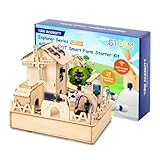
- Build a real IoT smart farm with hands-on STEM projects.The ACEBOTT Smart Farm Kit is a practical STEM kit for kids age 12+, allowing teens to build working farm systems like auto watering, pet feeders, and solar windmills. Compatible with Arduino & Scratch, this coding project set teaches core skills in electronics, automation, and real-world IoT. A great choice among STEM toys for middle schoolers curious about future farming and sustainability.
- 16 step-by-step lessons with dual coding modes.With 16 fun tutorials using Scratch and Arduino IDE, this STEM kit for teens takes learners from basic to advanced coding with ease. Story-driven projects, slides, and clear instructions support both parents and teachers, even without technical background. One of the most classroom-friendly coding toys for ages 12+ and home STEM gifts for future innovators.
- All-in-one smart agriculture system simulation.This interactive science kit for kids age 12+ includes soil moisture sensors, water level alarms, RGB strips, and solar modules. Teens simulate irrigation, power, and animal care systems in one kit, gaining hands-on skills in automation and sustainability. A perfect blend of STEM projects for kids ages 12+ and coding kits for teens preparing them for real-world agri-tech innovation.(Note: Battery required, not included.)
- Safe, solder-free assembly with eco-friendly design.Made from smooth, laser-cut plywood, this building set for boys age 12+ is safe, non-toxic, and easy to assemble. No soldering required. With HD guides, pre-coded programs, and step-by-step videos, this STEM toy for boys age 12+ is ideal for solo builders, families, or classrooms focused on engineering and creativity.
- Perfect STEM gift for home or classroom.Great for birthdays, holidays, or STEM fairs, this DIY farm kit combines STEM kits, art, and sustainability. Teens can paint and personalize their farms, making every build unique. As one of the top STEM gifts for kids 12+, it builds coding confidence, critical thinking, and real-world problem-solving through immersive, hands-on learning.
The practical starting point is a specific management question: what needs to be known, how representative readings will be gathered, how the data will reach the farmer, what action follows, and what it costs to maintain. A suitable arrangement may differ from farm to farm; no single sensor, network, or platform fits every operating context.
Quick Recap
Product prices and availability are accurate as of the date/time indicated and are subject to change. Any price and availability information displayed on Amazon at the time of purchase will apply.

