
iTechGuides is reader-supported. When you buy through links on our site, we may earn an affiliate commission. As an Amazon Associate I earn from qualifying purchases. Learn more
Deep-sea species survive through a mix of sensory, physiological, and feeding strategies—not one universal adaptation. Some detect faint light or use bioluminescence; many rely on smell and touch. Their water-rich bodies are less affected by pressure than gas-filled spaces are, while food scarcity rewards energy-saving strategies. Conditions vary by depth, and hydrothermal vents create important exceptions to the usual cold, dark environment.
What makes the deep sea a different habitat?
“Deep sea” describes a range of environments, not one uniform zone. Light, temperature, pressure, and available food change with depth, so an adaptation useful to one species may not help another in the same way.




- Light: Sunlight fades below the twilight zone, eventually leaving the ocean effectively dark.
- Temperature: NOAA reports that waters below about 200 meters (656 feet) average 4°C (39°F). That is an average, not a reading for every habitat; hydrothermal vents have local temperature gradients. NOAA’s overview of deep-ocean conditions explains these broad patterns.
- Pressure: It increases by about one atmosphere (14 pounds per square inch) for every 10 meters of depth. This is an approximate increase; figures can differ depending on whether a source describes water pressure alone or includes surface atmospheric pressure.
- Food: With little or no photosynthesis at depth, much of the deep ocean depends on organic matter produced nearer the surface, though vents and seeps support food webs fueled by chemical energy.
The deepest ocean reaches roughly 10,994 meters (36,070 feet), according to Smithsonian Ocean. That extreme does not mean every deep-sea species lives near the ocean floor or experiences the same conditions.
Do these 3 things before closing this tab:
1Scan for outdated or missing drivers - takes under a minute2Clear out junk files and repair common Windows errors3Fix the driver behind crashes, sound loss and screen glitchesHow do deep-sea animals sense their surroundings in darkness?
Darkness does not make every deep-sea animal blind. Some animals have large eyes that can detect faint light. Others have reduced or absent vision and depend more on smell or touch. Fishes of the midnight zone, including whalefishes and swallowers, use lateral-line and associated sensory systems to detect movement that may signal prey or predators in the quiet water, as described in NOAA’s midnight-zone fish feature.
#1 Best Overall
Bioluminescence provides light without sunlight
Bioluminescence is light produced by a chemical reaction in an organism. Blue light is common because it travels well through seawater, though the color can vary. In some species, light may help attract prey, find a mate, camouflage the animal, or deter a threat.
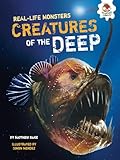
Deep-sea anglerfish offer a well-known example: many females carry a luminous lure, or esca, on a modified dorsal-fin ray. In a single species of anglerfish, bioluminescent bacteria in the lure produce its light. The cookie-cutter shark has a glowing underside that may attract larger prey. These are different uses in different animals, not a single function shared by all glowing species.
NOAA estimates that 80 percent of animals living between 200 and 1,000 meters (656 and 3,280 feet) are bioluminescent; that figure applies to this stated depth range, not every species or depth. The roles and evolutionary history of bioluminescence are not fully settled. NOAA summarizes the uncertainty plainly: “Bioluminescence is a subject with many more questions than answers.” See NOAA’s bioluminescence explainer.
How do deep-sea animals cope with extreme pressure?
Pressure rises steadily with depth: using NOAA’s approximate rule, the increase is about one atmosphere for every 10 meters. At 100 meters, that amounts to roughly 10 atmospheres of added water pressure; a separate NOAA example totals about 11 atmospheres when surface air pressure is included. These are approximate figures using different conventions, not contradictory descriptions of the same measure.
Deep-sea animals are not all protected by hard shells. Many are mostly water and lack gas-filled spaces such as lungs or swim bladders. Because water is difficult to compress, pressure has less mechanical impact on these bodies than on a human or an air-filled cavity. As NOAA puts it, “The impacts of pressure at ocean depth are less for organisms lacking gas-filled spaces like lungs or swim bladders.”
That does not mean pressure has no effect. It can alter chemical reaction rates, and animals adapted to deep conditions can experience metabolic difficulties when brought to the surface. This helps explain why studying deep-sea organisms outside their natural depth can be challenging. More detail is available in NOAA’s explanation of pressure and ocean animals.
How do they manage cold and limited food?
Cold is common in deep water and generally slows metabolic processes, but the precise conditions differ by habitat. The average temperature below about 200 meters is 4°C (39°F), while vents create local thermal gradients. Species are adapted to their particular environments; available evidence here does not establish species-specific cellular mechanisms such as particular enzyme or membrane changes.
Food is often a more immediate constraint. Many deep-sea food webs rely on marine snow—sinking organic particles and remains from the upper ocean. Predators may use strategies that reduce the energy spent searching: an anglerfish’s lure can bring prey close rather than requiring constant pursuit. This is one strategy, not a rule for all deep-sea animals.
Best Value
Some fish and zooplankton make daily vertical migrations, feeding nearer the surface at night and retreating downward during daylight. That movement links the deep ocean to surface food production, but it is a behavior of some organisms, not a universal feeding pattern.
Independent reader supportYour contribution helps us test, update, and keep practical guides available for everyone.Why are hydrothermal vents an exception?
Most deep-ocean food webs ultimately rely on photosynthetic production near the surface. Hydrothermal vents and cold seeps are exceptions: microbes there obtain energy from chemical reactions rather than sunlight, supporting animal communities in the dark.
At vents, Riftia tubeworms host symbiotic microbes. The worms’ blood hemoglobin binds oxygen and hydrogen sulfide, helping isolate sulfide—which is normally poisonous—from the rest of the animal. The tubeworm does not photosynthesize; its partnership with microbes connects it to a chemically fueled food web. Smithsonian describes these ecosystems in its deep-sea overview.
Recommended Free Tools
How do the main survival strategies differ?
| Challenge | Examples of responses | What varies |
|---|---|---|
| Darkness | Faint-light vision; greater reliance on smell, touch, or lateral-line systems; bioluminescence | Whether an animal senses faint light, relies on other senses, or produces light—and what that light may do |
| Pressure | Water-rich bodies without gas-filled spaces are less mechanically affected than air-filled cavities | Species’ body structures and biochemical responses to pressure |
| Cold and scarce food | Energy-saving predation, marine snow, and vertical migration by some fish and zooplankton | Local temperature, diet, depth, and whether an organism migrates |
| No sunlight at the food-web base | Most communities depend on organic matter from surface production; vent and seep microbes use chemical energy | Whether a habitat relies on sinking organic matter or chemosynthesis |
Deep-sea anglerfishes illustrate how varied even one group can be: a 2012 NOAA-hosted feature reported 167 species in 11 families. That is the count given by that dated source, not a verified current taxonomic total. The feature also describes their midnight-zone context: Fishes of the Midnight Zone.
For a classroom-oriented explanation of how light-producing traits can support survival, see NOAA’s bioluminescence adaptation lesson.
Quick Recap
Product prices and availability are accurate as of the date/time indicated and are subject to change. Any price and availability information displayed on Amazon at the time of purchase will apply.

