
Outdated Drivers Are Slowing You Down
One free scan finds every outdated or missing driver and matches the right update for your exact hardware.Free scan · exact hardware matchPC Slower Than It Used to Be?
A free scan shows the junk files, broken settings and background clutter dragging Windows down - then fixes them in one click.Free scan · Windows 10 & 11iTechGuides is reader-supported. When you buy through links on our site, we may earn an affiliate commission. As an Amazon Associate I earn from qualifying purchases. Learn more
A reported photochemical method makes hydrogen radicals using hydrazine, a sulfur-based organocatalyst and violet LED light at about 30°C. The approach avoids supplying hydrogen gas and using pressure equipment, while the research team demonstrated hydrogenation and dehalogenation reactions. The findings are reported by Chemistry World; the primary paper and its detailed experimental protocol were not available for independent verification.
What the technique uses
The method described by Chemistry World combines hydrazine with a sulfur-based organocatalyst and irradiates the mixture with a violet LED at about 30°C. The report says this avoids the need for hydrogen gas, pressure equipment, and precious or toxic metals in generating the hydrogen radicals.
Those conditions are comparatively mild relative to some methods the report mentions, such as white-hot filaments, electrical discharges, mercury lamps or ionising radiation. That comparison describes examples of earlier approaches, not an exhaustive survey of radical-generation techniques. “Mild” refers to the reported reaction conditions; it should not be read as a safety assessment.
Free tools Windows power users keep installed
One-click scans. No signup required.
How light is proposed to release a hydrogen radical
According to the report, hydrazine and the sulfur catalyst first form an intermediate. Ultraviolet irradiation then produces an unusual, unstable neutral Rydberg radical: protonated hydrazine carrying an extra electron. The report says this species rapidly splits into hydrazine and a hydrogen radical.
#1 Best Overall

- Lab Glassware and Labware: there are 5 measuring cups, 4 glass stirring rods, 4 graduated cylinders, 3 glass droppers and 4 lab beakers, a total of 20 pieces of laboratory glassware; This is a complete range of products to meet your laboratory science needs and uses
- Multiple Sizes to Meet Your Various Needs: measuring cups: 50ml, 100ml, 250ml, 500ml, 1000ml, glass stirring rods: 7.87 inches/ 20 cm, graduated cylinders: 100ml, 50ml, 25ml, 10ml, glass droppers: 90mm, 120mm, 200mm, lab beakers: 50ml, 100ml, 150ml, 200ml; Different sizes are suitable for various experiments
- Durable and Reliable Material: the science beakers, lab droppers, lab stirring rods and lab cylinders are made of quality borosilicate glass materials, which are thick and stable, acid and alkali resistant, available for long term use
- Easy to Use: the glass graduated cylinder and other science lab glassware are designed with clear scales for easy to read, and the measuring cups and graduated cylinders have tapered gates for easy to pour liquid
- Wide Range of Applications: these beakers and graduated cylinders are practical gifts for experimenters and science , very suitable for projects, laboratories, science researches and so on
This is the mechanism as described in the news report, rather than an independently checked account of the primary study. The report does not establish the exact catalyst identity, lamp wavelength or intensity, or a complete experimental procedure.
What reactions the team reported
The team used the method in alkene hydrogenation and dehalogenation. Chemistry World reports tests involving compounds structurally related to fluoxetine and menthol, as well as terpenoids and amino acids. In one example, allyl glycine was hydrogenated without stereochemistry scrambling.
Rank #2

- LAB-GRADE GLASS: Made from 3.3 borosilicate glass that resists rapid temperature changes up to 180°C.
- ACCURATE MEASUREMENT: Clear scale markings on each vessel ensure precise reading and liquid handling.
- SAFE HEATING USE: Suitable for controlled heating on lab plates or hot water baths, not open flame.
- FULL SET INCLUDED: Contains 3 beakers, 3 flasks, 3 cylinders, 5 droppers, 2 stir rods, and 2 cleaning brushes.
- FOR SCHOOL AND LAB: Ideal for education, learning projects, and basic scientific analysis.
Alkene hydrogenation
The team reported alkene hydrogenation yields of up to 96% on a gram scale across a broad substrate scope. Chemistry World also says the reactions tolerated aryl chlorides, aryl bromides and carbamates—functional groups that can be affected by conventional palladium-catalysed hydrogenation. This is the report’s comparison, not evidence from an independent head-to-head evaluation. The report does not identify the substrate and exact conditions responsible for the maximum yield.
Do these 3 things before closing this tab:
1Clear out junk files and repair common Windows errors2Scan for outdated or missing drivers - takes under a minute3Repair Windows errors before they cause bigger problemsDehalogenation
Dehalogenation is another reported application, but the news report does not provide a comparable yield or detailed substrate-by-substrate results for it. The 96% figure applies to alkene hydrogenation and should not be generalized to dehalogenation.
Rank #3

- 【32PCS LAB GLASSWARE KIT】Included 1-neck round bottom flask(1000 ml), 2-neck round bottom flask (250 ml/1000 ml), 3-neck round bottom flask(500 ml), separator funnel with PTFE stopcock(250 ml), thermometer, Vigreux distillation column, Liebig condenser, graham condenser, PH paper bags, tube, 4 pcs adapters, glass stopper, plastic clips.
- 【SUPERIOR QUALITY】All glassware is made of upgraded 3.3 borosilicate glass material (GG-17) with good thermal stability, and the glass's thermal expansion coefficient is extremely low, making it suitable for severe temperature changes.
- 【STANDARD SIZE】The laboratory equipment with 24/40 standard joints and frosted for high air-sealed and no air leakage, ensuring distillation purity.
- 【DURABLE & REUSABLE】The glassware set can be heated directly in an open fire and can withstand typical laboratory thermal changes in chemical processes such as heating and cooling, making them durable and reusable for your experiments.
- 【WIDELY USE】The chemistry distillation set includes 32 essential devices that are perfect for distillation, purification, and synthesis, making it an excellent kit for any chemistry experiment. and Also Can DIY the essential oil whatever you like.
Why the result matters—and what remains unknown
Hydrogen radicals are highly reactive, which makes them difficult to generate under practical laboratory conditions. A method that produces them with a violet LED under comparatively mild conditions could give chemists another way to explore radical reactions. Project leader Roopender Kumar of University College London said, “Any chemist could run it.” Maxie Roessler, an Imperial College London expert in radical chemistry and electron paramagnetic resonance who was not involved in the study, called generating hydrogen radicals under mild conditions and simple near-UV light sources “a big breakthrough.”
Those comments reflect the reported promise of the work; they do not establish that the technique is ready for routine or industrial use. The available account is a secondary news report, not a validated laboratory protocol or independent replication. Without the primary paper, the exact operating parameters, safety procedures and reproducibility cannot be assessed. Hydrazine is a hazardous chemical, so the reported temperature and light source are not grounds for attempting the chemistry without the study’s verified safety and handling instructions.
Quick Recap
Rank #4
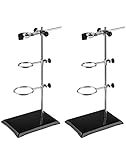
- STABLE BASE DESIGN: Thick cast iron platform keeps the stand balanced and secure during lab use.
- ADJUSTABLE CLAMPS: Includes two ring sizes (2"/2.8") and a burette clamp for different flask or beaker diameters.
- RECOMMENDED LOAD: Supports laboratory containers up to 500 mL or 1 kg for safe everyday experiments.
- EASY ASSEMBLY: Rod connects firmly to the base with a locking screw and is ready to use in minutes.
- PACKAGE CONTENT: 2 sets with base, rod, ring clamps and burette clamp – ideal for teaching or small research setup.
Product prices and availability are accurate as of the date/time indicated and are subject to change. Any price and availability information displayed on Amazon at the time of purchase will apply.
The Tool Desk
Outbyte PC Repair FREERepair Windows errors before they cause bigger problemsFix Now →Outbyte Driver Updater FREEScan for outdated or missing drivers - takes under a minuteDriver Scan →
