
iTechGuides is reader-supported. When you buy through links on our site, we may earn an affiliate commission. As an Amazon Associate I earn from qualifying purchases. Learn more
You can control some chemical reactions with an external input, but there is no universal switch for chemistry. Light may energize a molecule or alter a catalyst; electricity can drive electron transfer at electrodes; and, in a particular circuit-dependent system, opening or closing a circuit can control a galvanic reaction. Which mechanism applies depends on the reaction and its setup.
What “flipping a switch” means in chemistry
It is a metaphor for controlling a reaction with an input. The input might supply energy, change a catalyst into a different state, or alter the reaction environment. Unlike an ordinary electrical device, a chemical reaction does not generally start or stop just because a switch is connected to it.
Light, electricity, mechanical force and flow can all facilitate chemical transformations, but they do so through different mechanisms. A 2019 review in Nature Reviews Chemistry discusses these approaches and their use in synthesis: Synthetic applications of light, electricity, mechanical force and flow.
Recommended Free Tools
How light can control a reaction
Light can supply energy
A molecule that absorbs light may reach an excited state capable of participating in a reaction. In photoredox catalysis, for example, irradiation can produce an active photoexcited state from a catalyst. The light is part of the energy input; it is not necessarily switching the catalyst between two persistent forms.
#1 Best Overall
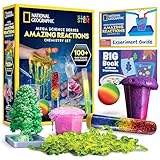
- OVER 100 EXCITING EXPERIMENTS - The science experiments in this kit let kids explore the wonders of hands-on science experiments. They'll make bubbling, color-changing solutions, glowing test tubes, a colorful bouncy ball, glowing worms, and more!
- EVERYTHING KIDS NEED - This kit includes all materials needed to conduct 15 stunning chemistry experiments, including growing a crystal tree, changing the color of liquid with their breath, and more.
- 85 BONUS EXPERIMENTS - Because we know your kids will want to conduct even more science experiments once they get going, we include a bonus experiment guide with 85 additional experiments that can all be done with common household items.
- HANDS-ON STEM - Our science toys are known for being hands-on, and this kids activity kit is no different. Your kids will use real scientific tools, like test tubes, beakers and pipettes, as they explore the fascinating world of chemistry.
- AWARD-WINNING PRODUCTS - Blue Marble, winner of the Toy Association's prestigious Toy of the Year Award, proudly develops products that foster education, imagination, and creativity, with a U.S. support team to ensure a stellar experience!
Light can switch a catalyst’s properties
Photoswitchable catalysis instead uses a reversible light-driven change in the catalyst itself to alter its catalytic properties. This is distinct from simply creating an active excited state by irradiation. A 2022 review of switchable aqueous catalytic systems explains the distinction: Switchable aqueous catalytic systems for organic transformations.
Dithienylethene is one molecular scaffold explored for photoswitchable catalysts. Its light-driven electrocyclization can be rapid and reversible, and the transformation is described as thermally forbidden. Research has examined using light pulses to activate or deactivate catalyst designs; that does not mean every such catalyst is a practical or general-purpose reaction switch. See the 2021 ACS Catalysis perspective, Dithienylethene-Based Photoswitchable Catalysts: State of the Art and Future Perspectives.
Rank #2

- A SCIENCE KIT THAT INSPIRES - Your kids will have hours of fun as they explore the fizzy and bubbly reactions they create, just like a real scientist in a lab!
- A TOTAL OF 45 EXPERIMENTS - Build and erupt a volcano, create a geyser, launch a rocket, and cause some awesome chemical reactions! Each experiment is easy to conduct and a whole lot of fun!
- EASY-TO-FOLLOW INSTRUCTIONS - The experiment guide in this kit has kid-friendly instructions with illustrations for each step, and fascinating insight into the chemical reactions.
- HANDS-ON STEM - Kids will learn the scientific process, important fundamentals of chemistry, and how to safely conduct experiments. This science kit serves as an important stepping-stone in STEM success!
- AMAZON EXCLUSIVE - Blue Marble has developed this product exclusively for Amazon.
How electricity can control a reaction
In electrosynthesis, electrical energy facilitates a transformation through electron transfer at electrodes. Photoredox catalysis and electrochemistry can both provide access to reactive intermediates such as radicals, but the underlying physical chemistry differs. They are related strategies, not interchangeable names for the same process. A critical comparison appears in Chemical Reviews: Photons or Electrons? A Critical Comparison of Electrochemistry and Photoredox Catalysis for Organic Synthesis.
A more literal circuit switch applies in a narrower case. A 2009 U.S. patent application describes a particular hydrogen-generation system in which opening or closing the electrical circuit switches a galvanic reaction: Combined chemistry hydrogen generation system. That example concerns its specific design; it is not evidence that a household switch can control arbitrary chemical reactions.
Rank #3

- ✔ 66 ACTION-PACKED SCIENCE EXPERIMENTS – Includes 26 step-by-step guided activities and 40 bonus DIY ideas using household items. Explore fizzy explosions, color changes, bubbling potions, and more.
- ✔ REAL SCIENCE, SERIOUS FUN – Learn chemistry concepts like acid-base reactions, states of matter, pH indicators, and gas expansion—all through hands-on, kid-friendly experiments.
- ✔ VOLCANOES, GLOW LAVA & SLIME – Make your own volcano with plaster and paint, create glowing potions and blue lava, blow up gas balloons, and mix gooey self-siphoning slime.
- ✔ INCLUDES TOOLS & INGREDIENTS – Comes with test tubes, food coloring, volcano mold, citric acid, slime mix, popping crystals and more to start a home science lab performing exciting experiments.
- ✔ STEM LEARNING FOR AGES 8+ – Perfect for future scientists and curious kids. Encourages critical thinking, creativity, and scientific exploration with clear instructions and adult supervision.
What determines whether a reaction can be switched
For a real system, “switchable” depends on the reaction and apparatus, not just on the presence of a lamp or electrical switch. Useful questions include:
- What is the input? Light, electrical potential or current, mechanical force, or flow each implies a different setup.
- What does the input do? It may supply energy to the reaction, create a reactive excited state, or change a catalyst’s structure or activity.
- Is the change reversible? Some catalyst designs can be switched back with another stimulus; other reactions proceed irreversibly once started.
- Where and when can the process be controlled? Stimuli can offer spatial and temporal control, a broader research area that includes proposed applications such as drug delivery. See Spatial and temporal control of chemical processes.
- What reaction and conditions are involved? The same input can have different effects in different chemical systems.
Why there is no universal chemistry switch
Switching a reaction requires a mechanism that couples the chosen input to that reaction: a light-absorbing reactant or catalyst, an electrochemical pathway, a stimulus-responsive catalyst, or another suitable design. Without that connection, flipping a circuit switch does not by itself start a chemical transformation. Nor does the word “switchable” establish that a method is inherently safer, cleaner, more efficient, or suitable outside the specific system studied.
Quick Recap
Best Value
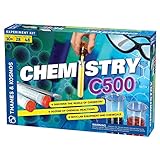
- An introductory tour of chemistry with 28 classic experiments
- Discover the colorful effects of acids and bases
- Make fizzy and foamy reactions and write messages with invisible ink
- Learn about reactions between solids, liquids, and gases
- The 48-page, full-color experiment manual gives simple instructions for setting up and performing each experiment, and then clear explanations of what happened and why
Rank #4
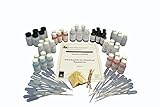
- This kit will introduce two common types of chemical reactions; single replacement and double replacement.
- Students will perform a series of experiments highlighting the differences in these reactions and use what they learn to write balanced chemical reaction equations.
- Kit contains enough materials for 15 groups.
- Teacher’s manual and Student Study Guide copymasters are included.
Product prices and availability are accurate as of the date/time indicated and are subject to change. Any price and availability information displayed on Amazon at the time of purchase will apply.
Do these 3 things before closing this tab:
1Fix the driver behind crashes, sound loss and screen glitches2Clear out junk files and repair common Windows errors3Scan for outdated or missing drivers - takes under a minute
