
iTechGuides is reader-supported. When you buy through links on our site, we may earn an affiliate commission. As an Amazon Associate I earn from qualifying purchases. Learn more
Buck50 is open-source firmware and host-side Python software that gives an STM32F103 Blue Pill several basic test-and-measurement functions, including an 8-channel logic analyzer and a simple two-channel oscilloscope. The project advertises a logic-capture rate of 6+ MHz and an oscilloscope rate of about 1 MHz; these are project specifications, not independently verified measurements or evidence that the board replaces a bench instrument.
What Buck50 can do
Buck50 combines digital capture, basic analog viewing, signal monitoring, and I/O utilities on one Blue Pill. The project describes the following capabilities and figures in its repository documentation and the author’s November 6, 2020 announcement. They are project-reported specifications, not independent test results.

| Function | Project-stated capability |
|---|---|
| Logic analyzer | 8 digital channels, 6+ MHz, and approximately 5K samples of buffer depth. Samples are stored at signal edges to use memory efficiently; the project supports complex triggering through a user-defined state machine. |
| Digital storage oscilloscope | Two channels at approximately 1 MHz, with approximately 5K samples of buffer depth; the project documentation specifies 10K samples in single-channel mode. |
| Signal monitoring | Live monitoring and logging of digital and analog signals, plus USART in synchronous or asynchronous modes, SPI, and I2C. |
| Pulse generation | A three-channel digital pulse-train generator with user-defined frequency, per-channel duty cycle, and polarity. |
| Bridging and conversion | USART/UART, SPI, or I2C can be bridged or converted through USB to a host terminal, UNIX socket, or pseudo-terminal. |
| Parallel I/O | An 8-bit parallel output counter and a utility to send ASCII or binary input from a host terminal to an 8-bit parallel output. |
How to get started
The repository provides source code and ready-to-flash ELF, binary, and Intel hex files. Its documentation says the STM32F103 cannot normally be flashed through its USB port. Use one of the documented programming routes rather than assuming the board’s USB connector is a firmware programmer:
- Choose a flashing route. For SWD, use the Blue Pill’s SWD connection with an ST-Link or Black Magic Probe. Alternatively, flash over USART1, typically using a USB-to-serial converter.
- Follow the project installation instructions. Use the current commands and wiring details in the Buck50 repository; do not infer a pinout or flash command from a partial description.
- Check the pin table for the function you intend to use. The project assigns PB4–PB11 as digital inputs for logic capture and monitoring, and PA0–PA7 as analog inputs for oscilloscope and monitoring functions. Other pins serve output or serial-bus roles.
Pin assignments are multiplexed: a pin’s role can change with the host command, including between input, output, analog, and bidirectional use. Buck50 warns that incorrect GPIO connections can permanently damage the MCU. In particular, do not connect a push-pull output directly to a supply, a ground sink, or another output driven to the opposite level. Consult the full project pin table and the STM32F103 documentation for device electrical limits before wiring.
#1 Best Overall
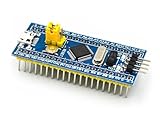
- [PRE-SOLDERED & READY]: This STM32 blue pill comes fully pre-soldered, letting you jump straight into development without extra assembly—perfect for beginners and experienced users working with any STM32 board.
- [FULL I/O ACCESS]: Designed as a versatile STM32 development board, it provides complete access to all I/O pins, offering flexibility for advanced interfacing, prototyping, and embedded system projects using the STM32F103C8T6 MCU.
- [COMPLETE CIRCUITS]: Includes essential circuits such as the crystal oscillator, USB interface, and onboard power management, giving this STM32 module everything needed for stable standalone operation or integration into larger systems.
- [USB POWER & COMMUNICATION]: Uses a standard Micro USB port for both power and communication, making this STM32 board convenient for quick programming, serial communication, and powering through common USB sources.
- [SWD DEBUG INTERFACE]: Features an SWD debugging interface that enables fast uploading and troubleshooting with minimal wiring, compatible with tools used across the STM32 nucleo ecosystem and other STM32 development board workflows.
How to inspect captures and signals
Buck50 can save output in VCD and other formats. The project names PulseView, gnuplot, GTKWave, and Saleae Logic as viewing workflows. These are host-side software options, not additional hardware required by the firmware. Select a viewer based on the output format and whether you need to inspect digital transitions or plot data.
Why the particular Blue Pill MCU matters
A compatibility issue affects some STM32F103 clones or rejected chips. In an issue opened November 18, 2020, Buck50’s maintainer reported that some devices do not generate an interrupt when the firmware writes past the end of RAM. The logic command’s edge-based capture termination can therefore fail on those MCUs.
Rank #2

- 【Micro USB MCU Board】This STM32F103C8T6 development board is made for embedded DIY projects.
- 【ARM Cortex-M3 Core】Great for sensors, displays, motor control, timing, and firmware learning.
- 【Unsoldered Header】Choose your own header style, direct wiring, or low-profile mounting.
- 【For STM32 Projects】Use it for prototypes, control boxes, robots, and smart devices.
- 【Compact Platform】A useful microcontroller development board for students, engineers, and makers.
For an affected board, avoid the logic edges= and logic edges=unlimited termination options; use a duration or stop sampling manually instead. The maintainer cautions that visual inspection may not distinguish genuine MCUs from clones and that the reported chip-ID difference may not reliably identify them. See the project’s STM32F103 clone compatibility issue for the caveat.
Quick wins for a faster PC:
Scan for outdated or missing drivers - takes under a minuteDriver Scan →Clear out junk files and repair common Windows errorsFree Scan →What the specifications do—and do not—tell you
Buck50 is a compact maker project for basic digital and analog work, protocol monitoring, and simple signal generation using an existing development board. Its advertised channel counts, rates, and buffer depths describe the project’s claims, not independently established capture performance. The available project information does not establish a head-to-head comparison with commercial logic analyzers or oscilloscopes, so treat Buck50 as a useful experimental tool rather than a drop-in replacement for bench equipment.
Rank #3
![[initeq] STM32 Blue Pill + Black Pill Development Board Combo with ST-Link V2 Programmer (STM32F103C8T6 + STM32F411CEU6, 2-Pack)](https://m.media-amazon.com/images/I/41skZUgHAiL._SL160_.jpg)
- 32-Bit ARM 100MHz
- 512KB Flash
- 128KB RAM
- MicroUSB and ST-Link Connectors
The repository describes Buck50 as free software under the GNU General Public License, version 3 or (at the user’s option) any later version. That license does not imply proprietary support or a warranty.
Quick Recap
Rank #4

- STM32F103C8T6 Development Board: Based on the ARM Cortex-M3 core, 72MHz main frequency, with 64KB Flash and 20KB SRAM, it can handle complex tasks at high speed and meet the computing and storage needs of multiple applications
- Support peripherals: USART, SPI, I2C communication interface, multiple types of timers and high-performance ADC, DAC
- Compatible with for Arduino STM32 IDE has standard peripheral library and HAL library, and there is abundant online information, which is easy to get started and efficient to develop
- Cost advantage: outstanding cost performance, providing an ideal choice for students, enthusiasts and small and medium-sized enterprises with limited budgets
- Excellent ecology: low power mode energy saving, reliable stability, strong scalability to connect multiple devices
Product prices and availability are accurate as of the date/time indicated and are subject to change. Any price and availability information displayed on Amazon at the time of purchase will apply.

