
Do these 3 things before closing this tab:
1Scan for outdated or missing drivers - takes under a minute2Clear out junk files and repair common Windows errors3Fix the driver behind crashes, sound loss and screen glitchesiTechGuides is reader-supported. When you buy through links on our site, we may earn an affiliate commission. As an Amazon Associate I earn from qualifying purchases. Learn more
Assembly theory tries to describe how complex objects can be built from simpler parts—and whether the repeated appearance of such objects can indicate selection. Its molecular assembly index counts the minimum steps in a construction path; the broader assembly measure also considers how many copies of an object appear in an ensemble. The idea offers a way to investigate life’s origins, but it has not established how life began or settled what counts as a universal molecular signature of life.
What is assembly theory?
Assembly theory treats an object not only as a static arrangement, but also in terms of the possible steps by which it can be constructed. In chemistry, the 2023 Nature paper by Sharma and colleagues treats the formation of bonds as elementary operations. The framework then asks how many steps are needed along a shortest construction path to produce a particular molecule.
The paper presents this approach as a way to reason about selection and the generation of novelty across physical and biological systems. Applied to chemistry, it could help describe how molecular complexity changes and how selection might become relevant in the transition from nonliving chemistry to life. These are aims and claims of the framework, not evidence that it has replaced evolutionary biology or solved abiogenesis.
What is the molecular assembly index?
The molecular assembly index (MA) is the minimum number of steps in a path that produces a molecule under the framework’s construction rules. A larger index means that more steps are required along that minimal path. It is a measure of constructional complexity as defined by those rules—not a direct count of every reaction that occurred in nature.
#1 Best Overall

- FOR BASIC TEACHING TO ADVANCED SCIENCE: 444 pieces molecular model kit, including 136 atoms, 158 bonds and 150 parts for Carbon-60(Fullerene), provides to students from Grade 7 to Graduate level.
- TWO CHEMICAL STRUCTURE MODELS: The ball-and-stick models use spheres to represent atoms and sticks to represent chemical bonds. In the space-filling model, the spheres are drawn to scale and are next to one another as atoms are in real molecules.
- CHEMISTRY EDUCATIONAL MOLECULE MODEL IN 3D: It can display chemical structure, molecular bond, and bond angle in all directions. Demonstrate fundamental molecular geometry, chemical molecular structure, stereochemistry with 3D modeling studies.
- EASY TO LEARN: The universal standard adopted for each atom's color makes it easier for you to use and learn. Atoms and chemical bonds combine tightly and firmly and can be easily disassembled by disconnecting tools.
- If you’re not in love with it for whatever reason, we’ll give you a full replacement or refund—no questions asked. If you have any doubt, please tell us. With nothing to worry about, or even to share with your friends, try it now.
That distinction matters for origin-of-life questions. An index describes a molecule using a construction model; by itself, it does not establish the molecule’s actual history, where it formed, or whether a living organism made it.
How does assembly theory measure selection?
The Nature paper distinguishes the index of an individual object from assembly, denoted A, which describes an ensemble. Its assembly measure uses both the assembly indices of observed objects and their copy numbers. In this framing, repeated instances of a complex object may carry information about selection or causation that an isolated object cannot provide.
Rank #2
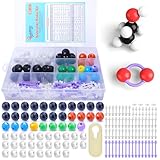
- ADVANCED LEARNING SCIENCE EDUCATION KIT --- Perfect chemistry model kit for modeling simple and small to more advanced and complex chemical structures for schools and college level, students of all ages, researchers and enthusiasts. Fun and interactive early learning molecular set for kids of all years and for use in the classroom.
- HIGH QUALITY --- Made from high quality durable materials designed for easy construction and perfect fit. These Molecular Model Kit pieces are color coded to national standards for easy ID. Organic Chemistry Model Kit includes box for easy storage and transport with your other textbooks, notes, and books. Excellent for the classroom.
- POWERFUL FUNCTIONS --- This Molecular Model Kit has a total of 136 pieces including short link remover tool. Super easy to build models for organic and inorganic chemistry, This model contains C, H, O, N, S and a variety of single and double bonds, Can be put high school, university chemistry in most of the organic or inorganic molecular structure model for the study of experimental operation.
- QUICK AND EASY ASSEMBLY OF COMPLEX STRUCTURES --- Atoms and bonds that are perfectly suited to being connected and disconnected easily without making your fingers hurt. We've also included a link remover to make the task of easy.
- CONVENIENT STORAGE --- The pieces come in a slim plastic box for convenient storage. See the pictures on this listing for a full understanding of what's inside
The distinction is central to the authors’ argument: a high assembly index alone does not show that selection occurred. The number of copies matters to their ensemble measure. The paper proposes that considering complexity together with abundance can help identify objects whose presence is more than an isolated instance.
Free tools Windows power users keep installed
One-click scans. No signup required.
| Quantity | What it describes | What it does not establish by itself |
|---|---|---|
| Molecular assembly index (MA) | The minimum number of construction steps in a path that produces an object. | Whether selection occurred, how the molecule actually formed in nature, or whether it came from life. |
| Assembly (A) | An ensemble-level measure that incorporates object assembly indices and copy numbers. | A settled explanation of life’s origin or a universally validated biosignature test. |
What has been measured experimentally?
A 2024 study by Jirasek and colleagues in ACS Central Science reported measuring molecular assembly indices using three techniques: nuclear magnetic resonance (NMR), tandem mass spectrometry (MS/MS), and infrared (IR) spectroscopy. The use of multiple methods is relevant because it makes molecular assembly index a subject of experimental measurement, rather than only a theoretical description.
Rank #3

- Visualize Molecular: The molecular model kit simplifies complex chemistry concepts into tangible 3D structures improve learning efficiency, suitable for students from Grade 7 to Graduate level.
- 444 Pcs Complete Set: The atom model kit includes with 136 atoms,158 bonds, and 150 fullerene model parts, explore most the molecules structures from simple compounds to complex polymers.
- Effortless Assembly: Embedded component design ensures easy to construct Ball-and-stick and Space-filling models that maximizes focus on exploration without complex assembly.
- Durable & Portable: Built to last, the chemistry set is crafted from high-quality materials. Plus, its portable Snap-Lock design allows you to take your experiments learning anywhere, between the home, classroom and lab.
- Essential Study Tool: Whether you're studying organic chemistry, biochemistry, or molecular biology, molecule building kit is an perfect learning tool for you deeper comprehension of molecular science.
That measurement result does not, on its own, validate every broader interpretation of assembly theory. Measuring an index and showing that it can distinguish life from nonlife, explain the emergence of selection, or resolve how life began are different claims requiring different evidence.
Can molecular complexity show that a molecule came from life?
Assembly theory proposes that sufficiently complex objects occurring in repeated copies could provide evidence of selection. That is a possible route toward chemical-scale biosignature research, but an assembly index is not a stand-alone proof that a molecule was produced by life. The broader inference depends on how the index is measured, how the ensemble is defined, and whether nonliving chemistry can produce comparable results.
Rank #4

- UNLOCK YOUR CHEMISTRY POTENTIAL: Our comprehensive molecular model kit includes 238 pieces, featuring 84 atoms, 153 bonds and a remover tool. Suitable for chemistry learners from beginners to advanced levels. Manufacturer recommended age: 15 years and up
- ORGANIZED STORAGE AND EASY LOCATING: Experience hassle-free organization with our storage box, complete with divided compartments and labeled sections. Say goodbye to clutter and quickly find the components you need
- EXTRA LEARNING MATERIALS FOR EXCELLENCE: Enhance your studies with our bonus 6-page learning guide and stencils. From grade 9 to college, from organic to inorganic, finish and master your assignments faster and create numerous molecular structures with ease
- IMMERSIVE 3D VISUAL LEARNING: Explore chemistry in a captivating way with our 3D visual learning approach. The universal color-coded Atomic Balls provide a better understanding of molecular structure, boosting your chemistry knowledge. It's also a perfect gift for someone who are going to learn those complex molecule
- EASY-TO-USE DESIGN: Crafted from smooth, burr-free plastic, our molecular science kit ensures easy assembly. With the included remover tool, disassembling is a breeze
A threshold around an assembly index of 15 has been discussed in this debate, but it should not be treated as a universally validated boundary between living and nonliving matter. A 2024 paper titled “Experimentally measured assembly indices are required to determine the threshold for life” argues that measured values are needed to assess such a threshold. Its discussion of theoretical inorganic molecules with indices above 15 underscores why the number cannot simply be presented as a settled life test.
The Tool Desk
Outbyte Driver Updater FREEFix the driver behind crashes, sound loss and screen glitchesFind Drivers →Outbyte PC Repair FREEClear out junk files and repair common Windows errorsFree Scan →What are the criticisms and open questions?
The debate concerns both the method and the interpretation of its results. A 2024 review in npj Systems Biology and Applications describes limitations in assembly theory’s methods and its classification of molecular biosignatures. Among its criticisms is the argument that the assembly-pathway method functions as an encoding scheme used by statistical compression algorithms. That is a published critique, not a final resolution of the dispute.
Best Value

- Visualize Molecular: The molecular model kit simplifies complex chemistry concepts into tangible 3D structures improve learning efficiency, suitable for students from Grade 7 to Graduate level.
- 240 Pcs Complete Set: The atom model kit includes with 86 atoms and 154 bonds, explore most the molecules structures from simple compounds to complex polymers.
- Effortless Assembly: Embedded component design ensures easy to construct Ball-and-stick and Space-filling models that maximizes focus on exploration without complex assembly.
- Durable & Portable: Built to last, the chemistry set is crafted from high-quality materials. Plus, its portable design allows you to take your experiments learning anywhere, between the home, classroom and lab.
- Essential Study Tool: Whether you're studying organic chemistry, biochemistry, or molecular biology, molecule building kit is an perfect learning tool for you deeper comprehension of molecular science.
Contemporaneous reactions to the 2023 Nature paper reflected interest alongside caution. In Chemistry World, chemical self-assembly researcher Palli Thordarson said assembly theory had merit for thinking about complex chemical systems, including origin-of-life research and astrobiology, while arguing that it needed stronger experimental confirmation in a prebiotic chemistry context before its deeper fundamental role could be accepted. Lee Cronin of the University of Glasgow, whose group developed the framework, acknowledged that the theory could be wrong and framed its value as a testable possibility rather than certainty.
- Measurement: Can assembly indices be measured reliably across relevant molecules and experimental settings?
- Interpretation: Do observed index and copy-number patterns specifically indicate selection, or could nonliving processes produce them?
- Origin-of-life relevance: Can the framework’s proposed signals be demonstrated in plausible prebiotic chemistry?
- Thresholds: What measured evidence, if any, supports a useful boundary between living and nonliving chemistry?
What assembly theory does—and does not—explain
Assembly theory gives researchers a vocabulary for connecting molecular construction, complexity, and the repetition of objects in an ensemble. Experimental spectroscopy work has reported measurements of molecular assembly index, making the framework open to empirical investigation. Its larger claims about selection and life’s origins remain proposals under debate, and neither those measurements nor a proposed index threshold amount to a demonstrated solution to abiogenesis.
Quick Recap
Product prices and availability are accurate as of the date/time indicated and are subject to change. Any price and availability information displayed on Amazon at the time of purchase will apply.

