
Recommended Free Tools
iTechGuides is reader-supported. When you buy through links on our site, we may earn an affiliate commission. As an Amazon Associate I earn from qualifying purchases. Learn more
A fast AI component can assess a situation, choose an action, and leave user-facing explanation to another part of the system. That can suit predictable, time-sensitive tasks—but it is not a universal definition of “System 1,” and it is not automatically the best design. In an agent, the model may choose an action while surrounding software executes it.
What is a System 1 AI agent?
“System 1” is an analogy used in some AI research for fast processing that relies on experience, rules, or policies. It is not a standardized product category, and it does not mean that an AI literally thinks like a person. Some proposed designs pair a fast component with a slower one that can deliberate when a situation calls for more reasoning.
For clarity, this article uses “Assess, Decide, Do” as a practical description of an agent loop. It is not a named, canonical pipeline used by the papers discussed here.
Quick wins for a faster PC:
Repair Windows errors before they cause bigger problemsFix Now →Fix the driver behind crashes, sound loss and screen glitchesFind Drivers →Assess the available state
The system takes in information relevant to the task: for example, an agent’s current state, a user request, or the result of a previous tool action. What it can assess depends on the inputs and integrations the implementation provides.
#1 Best Overall

- AI-Powered Raspberry Pi Robot Dog — PiDog: Powered by Raspberry Pi (5/4B/3B+/3B/Zero 2W), OpenClaw, and multi-LLMs like ChatGPT, Gemini, Grok, DeepSeek, Qwen & Ollama. With 12 servos, camera, gyroscope, hearing & touch sensors, PiDog can see, listen, talk, move, and interact intelligently. Supports OpenCV, MediaPipe, TTS & STT, app control, FPV & Python. A great STEM robotics gift for students, makers & tech enthusiasts—perfect for birthdays and holidays. (Raspberry Pi not included)
- Realistic Dog-like Movements: PiDog's 12 powerful servos enable 32 dog-like actions, including walking, sitting, standing, shaking its head, wagging its tail, and performing playful tricks, closely mimicking a real dog and providing an engaging experience. This is an AI development robot product designed for engineers, suitable for ages 15 and above
- Rich Sensor Suite for Interactive Experiences: PiDog features ultrasonic, touch, gyroscope, sound, camera, speaker and microphone. These provide it with advanced hearing, vision, and touch, enabling it to see, detect obstacles, respond to touch, and recognize sounds, making interactions highly engaging
- AI-Powered Interactions with OpenClaw & Multi-LLMs. PiDog combines voice, vision, and gesture recognition for immersive AI experiences. Powered by OpenClaw and multi-LLMs like ChatGPT, Gemini, Grok, DeepSeek, Qwen, Doubao, and Ollama (local LLMs), it can understand questions, respond naturally through TTS & STT, recognize math problems, interpret hand gestures, and hold smart conversations. OpenClaw also enables customizable AI behaviors and personalized robotics development, helping users create their own intelligent robotic companion
- Comprehensive Learning Resources and Support: PiDog offers detailed online documentation, video tutorials, prompt technical support, and an active forum community, ensuring beginners can easily complete all projects and enjoy a great experience
Decide what should happen next
A policy, finite-state machine, or reasoning component selects an action. A fast policy can be useful when the available choices and conditions are well defined. Ambiguous goals or unfamiliar situations may call for slower reasoning, additional information, or a human decision.
Do the action—or hand it off
The selected action might be a tool call, a state update, or a request for human review. The model does not necessarily perform the action itself: external software can execute a tool call and return its result to the agent. OpenAI describes this model-and-harness pattern in its agent-loop engineering article.
Rank #2
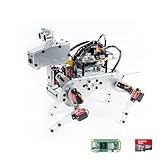
- Raspberry Pi AI Robot: powered by Raspberry Pi (5/4B/3B+/3B/Zero 2W), features 12 servos and sensors for vision, hearing, and touch. Integrated with ChatGPT-4o, it responds to complex queries. With app control and FPV, users can manage and see its view in real-time. It supports Python programming
- Realistic Movements: 12 powerful servos enable 32 actions, including walking, sitting, standing, shaking its head, wagging its tail, and performing playful tricks, closely mimicking a real and providing an engaging experience
- Rich Sensor Suite for Interactive Experiences: features ultrasonic, touch, gyroscope, sound, camera, speaker and microphone. These provide it with advanced hearing, vision, and touch, enabling it to see, detect obstacles, respond to touch, and recognize sounds, making interactions highly engaging
- Engaging Interactions with ChatGPT-4o: with ChatGPT-4o enables voice interactions and visual recognition, making it smarter and more responsive. Users can have natural conversations, solve math problems via the camera, and interpret gestures, creating diverse and fun interactions
- Comprehensive Learning Resources and Support: offers detailed online documentation, video tutorials, prompt technical support, and an active forum community, ensuring beginners can easily complete all projects and enjoy a great experience
Can an AI agent make decisions without talking?
Yes. Choosing an action and composing a conversational response are different functions, so an agent can select or initiate an action without producing a user-facing explanation at that moment. That does not mean the system should always be silent. People may need to know what an agent is doing, especially when an action has significant consequences, is difficult to reverse, or needs approval.
Nor does “doesn’t talk” mean “doesn’t communicate.” A system can communicate through a status display, a structured log, an alert, or a handoff for approval rather than a conversational answer. The appropriate form depends on who needs to monitor the action and what could go wrong.
Rank #3

- AI-Powered Raspberry Pi Smart Car — PiCar-X: PiCar-X brings AI learning to life — powered by Openclaw and multi-LLMs including ChatGPT, Gemini, Grok, DeepSeek, Qwen, Doubao, Ollama (Local LLMs), and compatible with many more AI platforms. Featuring OpenCV, MediaPipe, TTS & STT, PiCar-X enables true AI vision and voice interaction — it can see, listen, talk, drive and think like an intelligent companion. Ideal for students (10+), educators, and engineers, PiCar-X is the perfect gateway to explore AI, robotics, and machine learning on Raspberry Pi 5/4/3B+/3B/Zero 2W (Raspberry Pi not included)
- Engaging Interactions with Multi-LLMs: PiCar-X, powered by Openclaw and multi-LLMs — including ChatGPT, Gemini, Grok, DeepSeek, Qwen, Doubao, and Ollama (Local LLMs) — and compatible with many other AI platforms, supports voice interaction and visual recognition to make the robot smarter and more responsive. Users can enjoy natural AI conversations, solve math problems through the camera, and interpret gestures, unlocking a world of diverse and fun AI-driven interactions
- Feature-rich and Adaptable: PiCar-X offers engaging applications like line following and obstacle avoidance, supports TTS (Text-to-Speech) and STT (Speech-to-Text) for interactive voice control, and includes a camera for video and vision recognition. It also comes with various sensors, while its customizable design enables a wide range of creative AI and robotics projects
- Versatile Programming Options: Catering to users of all skill levels, PiCar-X supports both Python and Scratch programming languages, allowing for flexible learning and skill development
- Simplified Assembly & Support: PiCar-X is perfect for beginners, yet learning with experienced users is recommended for best results. It comes with easy assembly instructions and forum support for smooth project completion
How do AI designs divide fast decisions, reasoning, and conversation?
Researchers do not use “System 1” in one consistent way. Their architectures divide work differently, so the label alone does not tell you whether the fast part talks, acts, or both.
| Architecture | How work is divided | What the distinction shows |
|---|---|---|
| DPT-Agent (2025) | The proposal uses a finite-state machine and code-as-policy for fast System 1 decisions, with a System 2 for intention inference and reasoning-based autonomous decisions. The authors report experiments with rule-based agents and human collaborators. | Fast, controllable action selection can be paired with slower reasoning. The reported experiments do not establish that the design is best for every task. |
| Talker-Reasoner (2024) | The Talker produces fast conversational responses; the Reasoner handles slower multistep reasoning and planning, tool calls, and actions that update agent state. | Here, the fast component talks while the reasoning component plans and acts. “System 1” does not necessarily mean silent action selection. |
| Metacognition and dual-system AI (2021) | The proposal pairs fast agents that draw on past experience with slower agents activated when reasoning or search beyond the fast agent’s expectations is needed. | The fast/slow distinction is an architectural analogy, not proof that AI reproduces human thought or that fast choices are inherently accurate. |
These are research proposals and architectural distinctions, not a single settled blueprint. In a separate set of recommendations, OpenAI describes assigning triage to one model and a more complex decision to another, or separating planning from execution. Its guidance considers factors such as speed, cost, task definition, accuracy, reliability, and complexity; it is not a controlled comparison proving one approach is best. See OpenAI’s reasoning best practices.
Rank #4

- BUILD, CODE & DRIVE YOUR OWN ROBOT CAR: Turn coding, electronics and engineering into a working programmable robot car you can assemble, program and drive; ideal for weekend family projects, STEM classrooms, coding clubs, robotics lessons and maker challenges
- EXPLORE FPV, LINE TRACKING & OBSTACLE AVOIDANCE: Control the robot with the ELEGOO app or IR remote, view live FPV video through the onboard camera, follow black lines, avoid obstacles with the ultrasonic sensor and explore multiple interactive driving modes
- BEGINNER-FRIENDLY BUILD WITH GUIDED WIRING: Keyed XH2.54 connectors help reduce wiring mistakes, while the illustrated tutorial and example programs guide beginners step by step from chassis assembly and module connection to programming and the first successful run
- GO BEYOND ASSEMBLY WITH CREATIVE CODING: Program with Arduino IDE to explore movement, sensors and control logic, then modify example code to create custom routes, reactions and robotics experiments that develop coding, problem-solving and engineering skills
- COMPLETE RECHARGEABLE STEM ROBOTICS KIT: Includes an ELEGOO UNO R3 controller board, ESP32-WROVER-based camera and Wi-Fi module, line-tracking and ultrasonic sensors, motors, IR remote and a 2000 mAh rechargeable lithium-ion battery; recommended for ages 8+ with adult guidance for first-time builders
When is a fast, quiet decision component useful?
It is most promising when the task has a clear state, a limited set of permitted actions, and conditions that can be expressed and checked. A predictable workflow may not need a conversational explanation at every step. But as the goal becomes less defined or the cost of a mistaken action rises, speed alone is a poor reason to let the fast component act unchecked.
Do these 3 things before closing this tab:
1Scan for outdated or missing drivers - takes under a minute2Clear out junk files and repair common Windows errors3Fix the driver behind crashes, sound loss and screen glitches- Prefer fast policy-based selection when the task is repetitive, the allowed actions are explicit, and a wrong choice is easy to detect and recover from.
- Add slower reasoning or a human review when goals are ambiguous, circumstances are changing, the system encounters an unfamiliar case, or a mistake could have serious consequences.
- Keep an execution boundary when the model proposes actions through tools. The surrounding software can check permissions, validate the action, execute it, and return the outcome.
- Choose an appropriate way to report activity when users or operators need to understand, approve, or audit what happened. Silence should not hide consequential decisions.
This is a design framework, not a promise that any particular architecture will meet a task’s requirements. A system still needs evaluation against its intended use and failure modes.
How should you judge whether “Assess, Decide, Do” fits?
Evaluate the component as part of the full system, including its inputs, action limits, execution layer, and oversight—not just by whether it produces a fast decision.
- Latency: Does the task benefit from a quick choice, or is there time to gather information and deliberate?
- Predictability: Are the relevant states and acceptable actions clear enough for a policy or finite-state machine?
- Reliability: How will the system detect a bad selection, and can the action be reversed or safely retried?
- Consequences: What happens if the agent acts incorrectly, and when should it pause for approval?
- Cost and complexity: Does adding a slower reasoning component improve the outcome enough to justify the extra system complexity?
- Accountability: Can a person find out what action was selected and what the execution layer actually did?
There is no general evidence here that a silent System 1 design is “perfect.” Its value depends on the task, the reliability required, and the safeguards around action. A fast component can be useful within a system that knows when to explain, deliberate, or stop.
Quick Recap
Product prices and availability are accurate as of the date/time indicated and are subject to change. Any price and availability information displayed on Amazon at the time of purchase will apply.

