
Quick wins for a faster PC:
Repair Windows errors before they cause bigger problemsFix Now →Scan for outdated or missing drivers - takes under a minuteDriver Scan →iTechGuides is reader-supported. When you buy through links on our site, we may earn an affiliate commission. As an Amazon Associate I earn from qualifying purchases. Learn more
A DIY carbon-contact microphone turns sound-driven movement of a wooden diaphragm into changes in electrical current. In the Hackaday project by Dan Maloney, published April 18, 2020, a pine diaphragm moves four carbon rods against a dimpled carbon block. The write-up and video offer a qualitative demonstration—not measured evidence of frequency response, distortion, sensitivity, or recording quality.
How the carbon rod microphone works
Sound makes the thin wooden diaphragm vibrate. That movement changes how firmly the carbon block presses on the ends of four rods. The changing pressure at those carbon contacts varies the current through the arrangement, creating an electrical signal that follows the sound.
In broad terms, this is a variable-resistance carbon-contact microphone: motion changes pressure at a conductive contact, and the electrical behavior changes with it. Hackaday contrasts the build with telephone carbon capsules, which use carbon granules between a diaphragm and a metal plate. The rod-and-block construction is a different arrangement, not simply a granule capsule made from rods. Hackaday’s project report describes the specific build.
Free tools Windows power users keep installed
One-click scans. No signup required.
What the project is made from
The revised wooden frame and diaphragm
The improved version uses a thin piece of pine as the diaphragm, attached to a red oak frame. The earlier version carved its diaphragm from one block of softwood. The report does not give exact dimensions for the wood parts.
#1 Best Overall

- 𝐂𝐨𝐦𝐩𝐥𝐞𝐭𝐞 𝐊𝐢𝐭: 3pcs piezo contact microphone pickups constructed from high quality plastic and metal. The package is complemented by 6pcs guitar picks, providing a variety of tones with 2 picks each in 0.5mm, 0.75mm, and 1.0mm thicknesses
- 𝐏𝐮𝐫𝐞 𝐕𝐢𝐛𝐫𝐚𝐭𝐢𝐨𝐧-𝐃𝐫𝐢𝐯𝐞𝐧 𝐀𝐮𝐝𝐢𝐨: Engineered to capture sound through direct physical contact with the instrument surface. This method effectively converts body vibrations into electrical signals, significantly reducing ambient noise and acoustic reflections for a clear, feedback-resistant signal path
- 𝐒𝐭𝐚𝐧𝐝𝐚𝐫𝐝 𝐂𝐨𝐧𝐧𝐞𝐜𝐭𝐢𝐯𝐢𝐭𝐲: Features a standard 1/4-inch (6.35mm) output jack and a 10.6-inch cable for easy connection. The passive design requires no battery power; simply plug the transducer into your amplifier, bass amp, or audio interface for immediate use
- 𝐄𝐚𝐬𝐲 𝐓𝐨 𝐈𝐧𝐬𝐭𝐚𝐥𝐥: Our guitar microphone pickup equipped with self-adhesive strips. This allows for secure mounting on various surfaces—such as the body, bridge, or soundboard—while providing flexibility for repositioning or removal
- 𝐁𝐫𝐨𝐚𝐝 𝐈𝐧𝐬𝐭𝐫𝐮𝐦𝐞𝐧𝐭 𝐂𝐨𝐦𝐩𝐚𝐭𝐢𝐛𝐢𝐥𝐢𝐭𝐲: Ideal for amplifying a wide spectrum of acoustic instruments. Perfect for installation on guitars, ukuleles, violins, violas, cellos, mandolins, banjos, kalimbas, and other stringed instruments requiring external amplification
The carbon contact
Four carbon rods extend from the frame toward the diaphragm’s center and articulate against a carbon block with small divots. The report does not identify the carbon grade, rod dimensions, supplier, or a verified retail equivalent, so a generic rod listing cannot be assumed to match the build.
Does the build need circuitry to connect to a speaker?
The project description establishes a microphone mechanism, not a complete speaker-driving circuit or a specified electrical interface. A microphone signal should not be assumed to drive a speaker directly; the signal chain needs circuitry suited to the microphone and the intended output. Although comments on the Hackaday page discuss possibilities such as amplification and transformer coupling, those are commenter suggestions rather than a wiring design or specification confirmed by the project report. The write-up does not provide electrical ratings or a bill of materials from which to reproduce a known interface.
Rank #2
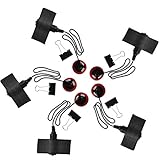
- 【Professional Piezo Pickup】Professional piezo contact microphone pickup components can help you capture clear and accurate sound.
- 【Easy to Install】Standard 1/4-inch female jack with 10 inch cable for amplifiers, preamps or other recording equipment, including fixing clip, for easy connection. And guitar pickup can be sticked near sound hole with self-adhensive, easy and convinent.
- 【No Battery Driven】Piezo contact microphone transducer use high-quality piezoelectric elements as the main body, the pickup vibration signal is converted into an electrical signal output.Even if you do not have a battery, you can use violin pickup.
- 【Reduce Interference】Guitar microphone pickup works by directly contacting the sound source. So zither mic pickups can eliminate almost all external sound interference, and is not affected by sound reflections from nearby objects.
- 【Multiple Usage】Self-adhesive instrument pickup fit for most box sound instrument, such as guitar, ukulele, erhu, zither, violin, mandolin, banjo, lyre, etc.
What is—and is not—established about its sound
Maloney calls it “surprisingly high-fidelity” and says it works well based on the video. That is a qualitative impression, not an instrumented audio review. The report provides no frequency-response curve, sensitivity, distortion, signal-to-noise ratio, or test method. It therefore supports saying that the demonstrated build appears to produce usable sound, but not assigning it a measured performance level or comparing it objectively with other microphones.
Historical context: the Hughes pencil microphone
John Munro’s Heroes of the Telegraph describes a Hughes pencil microphone using a carbon crayon between carbon supports on a light pine board, with a battery and telephone completing the circuit. Munro explains that contact pressure could be suited to different sound levels and describes an adjustable contact arrangement. He writes: “The contact between the rod and the block in this ‘hammer-and-anvil’ form is, of course, the portion which is sensitive to sound.” That is Munro’s narration of Hughes’s microphone work, not a quotation by Hughes and not evidence that the modern Hackaday build reproduces a particular historical model. Munro’s book provides historical context, while Hackaday documents the modern project.
Quick Recap
Best Value
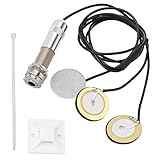
- Premium Material : Quality ABS Plastic, Electronic Part: Metal, Color: black lines, silver tone.
- Prptable Size : Small size, portable and easy to use. Cable Length: approx. 57cm/ 22.44", 3-pack Piezo electric Disk Dia. : approx. 27mm/ 1.06", Endpin Jack Dia. : approx. 6mm / 0.24".
- Self Adhesive : The plastic squares is a self adhesive block to mount the extra wire in your box, without pre amp they will work well.
- Installation : No Battery and Soldering Required, pre-wired piezo mic save time for you, easy to install, convenient to use.
Rank #4

- A professional piezo contact microphone pickup - 1/4" jack with 10.6" cable.
- Contact microphones pick up sound by being in direct contact with the sound source.
- Able to eliminate external sounds interference and not be influenced by sound reflections from nearby objects.
- Just plug it into your amp, bass amp or other recording equipment.
- Comes with double sided tape and self adhesive hook and loop fastener for multiple mounting options. You can amplify your guitar, mandolin, banjo, violin, ukulele, viola, cello.
Rank #3
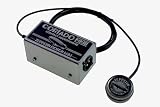
- All-new sensor design is nearly indestructible
- Phantom-powered onboard preamp circuit is housed in rugged steel chassis
- 6′ (1.8m) shielded cable from sensor to chassis
- 23 Hz – 40 kHz bandwidth
- Switchable onboard high pass filter (called "Bass Boost")
Product prices and availability are accurate as of the date/time indicated and are subject to change. Any price and availability information displayed on Amazon at the time of purchase will apply.

