
iTechGuides is reader-supported. When you buy through links on our site, we may earn an affiliate commission. As an Amazon Associate I earn from qualifying purchases. Learn more
Some Hisense Mini-LED TVs are worth considering for bright rooms: independent testing found very high peak brightness and a matte anti-reflective coating on the U7SG. But the headline does not identify a model, size, or country, and Mini-LED is not equivalent to OLED. Check the exact regional model before relying on a price or specification.
Which Hisense TV does this refer to?
The title does not name a specific television, so it cannot support a model-specific verdict or a like-for-like OLED comparison. Current U.S. coverage discusses the U7SG and U6SF Pro, while Hisense’s 2026 U.S. announcement covers its U6 and U7 ULED Mini-LED families. These are possible candidates, not proof of which set the headline intended.
Hisense’s U.S. catalog includes U6 Pro, U7, and U8 Mini-LED offerings, along with older-generation listings. Hisense also says configurations, sizes, and smart-TV platforms can vary by retailer. Confirm the full model number, screen size, and regional version on the product listing; do not transfer a feature from one model or market to another.
Do these 3 things before closing this tab:
1Repair Windows errors before they cause bigger problems2Fix the driver behind crashes, sound loss and screen glitches3Clear out junk files and repair common Windows errorsWhy Mini-LED can suit a bright room
Mini-LED TVs use many small backlights with local dimming, allowing the screen to brighten highlights while dimming parts of the image. In RTINGS’ 2026 comparison, the tested Hisense U7SG delivered very high peak brightness and had a matte anti-reflective coating. That combination can help with daytime viewing, though the finding applies to the tested model, not every Hisense TV or screen size.
#1 Best Overall

- HI - QLED MINILED: Striking contrast and vivid, lifelike color put every scene in a new light. Whether it's a sunny landscape or a candlelit drama, the picture leaps off the screen. Mini-LED backlighting uses hundreds of precise light zones to enhance contrast across the screen. Paired with Hi-QLED technology, every color comes through with stunning depth and accuracy
- NATIVE 144HZ REFRESH RATE: Fast breaks, high-speed chases, live finales — every frame stays crisp and fluid, so the action is always exactly where you need it to be. Native 144Hz refresh performance keeps movement fast and sharp, reducing blur during gameplay and live sports. The quick response helps you stay in control during competitive gaming while making rapid camera shots in shows and movies easier to follow
- BUILT-IN SUBWOOFER: Immersive deep bass from the built-in subwoofer pulls you into the heart of the moment, from the rumble of an explosion to the thump of your favorite song. Feel like you’re a part of the action
- ANTI-REFLECTION & GLARE-FREE: Bright rooms are no match for this screen. The anti-reflection and glare-free display keeps your view clean and distraction-free, so you stay focused on what matters — the show
- UNIBODY SLIM DESIGN: Edge-to-edge display and a seamless design that disappears into your room — so all you see is the picture
Brightness is only one part of the experience. A TV can look vivid in a sunlit room yet show visible halos around bright objects against dark backgrounds. If reflections are the main problem, check reflection handling as well as brightness; if you watch films in a dark room, pay closer attention to black levels and blooming.
Mini-LED versus OLED: the trade-off
Local dimming improves contrast, but it cannot independently dim each pixel the way OLED does. As a result, Mini-LED can show blooming around subtitles, stars, or other small bright details on dark backgrounds. RTINGS found more light bleed and grayer blacks on the U7SG than on its higher-end comparator. Its tested U6SF Pro had good contrast and deep, uniform blacks in dark scenes, but fewer dimming zones and more haloing than the U7SG, as well as substantially lower brightness.
Those results describe the models RTINGS tested; they do not establish a universal winner between Mini-LED and OLED or predict every size and regional variant. A complete, same-size comparison with the unspecified TV in the title is not available here. If dark-room black levels matter most, compare the exact sets in person or consult testing for their precise model numbers rather than treating “Mini-LED” as shorthand for OLED picture behavior.
Rank #2
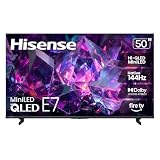
- HI-QLED MINILED: Mini-LED backlighting uses thousands of precise light zones to enhance contrast across the screen, revealing deeper shadows, brighter highlights, and more visible detail. Whether watching movies at night or sports during the day, the picture stays clear and impactful
- NATIVE 144HZ GAME MODE: High refresh performance keeps fast movement fluid and sharp, reducing blur during gameplay and live sports. The quick response helps you stay in control during competitive gaming while making rapid camera shots in shows and movies easier to follow
- DOLBY VISION & DOLBY ATMOS: Experience cinematic HDR with vivid brightness and deeper contrast through Dolby Vision, paired with immersive, room-filling sound from Dolby Atmos—so every scene feels bigger, clearer, and more lifelike from your couch
- AI PICTURE: Advanced AI processing analyzes content scene by scene and automatically optimizes brightness, contrast, and color for a clearer, more natural image. Whether you’re streaming shows, watching sports, or gaming, the picture adjusts in real time to look its best without manual settings
- AI SMOOTH MOTION WITH MEMC: Motion enhancement technology reduces blur and sharpens fast-moving scenes, keeping action crisp and easy to follow. From live sports to action movies and gaming, fast transitions stay smooth and comfortable to watch
What the cited prices do—and do not—show
The available U.S. price points cover different products and should not be read as a current, like-for-like comparison:
| Model and size | Reported price | What it represents |
|---|---|---|
| Hisense U7 series | $1,299 starting MSRP | Hisense’s March 2026 U.S. announcement; an MSRP statement, not a guaranteed retail price. |
| Hisense U6SF, 55-inch | $499 | A retailer-linked price quoted by Tom’s Guide in 2026; a date-specific listing. |
| Hisense U7SG, 65-inch | $649 | A retailer-linked price quoted by Tom’s Guide in 2026; a different model and size from the U6SF listing. |
These figures do not establish what a model costs today, how much it saves against a same-size OLED, or whether the listed configuration is available in your region. Check current listings for the exact SKU, size, warranty, and return policy before deciding whether it is affordable for your use.
Picture processing, motion, and gaming still matter
Brightness and color are not the whole picture. In its 2026 Hisense report card, Tom’s Guide reviewer said Hisense TVs “often lag behind comparable sets from LG, Samsung and Sony” on upscaling, motion handling, color gradients, and HDR EOTF tracking. That is the publication’s review judgment, not a universal lab result for every model. It is relevant if you watch lower-resolution streams, fast sports, or films with subtle gradients.
Rank #3

- HI - QLED MINILED: Striking contrast and vivid, lifelike color put every scene in a new light. Whether it's a sunny landscape or a candlelit drama, the picture leaps off the screen. Mini-LED backlighting uses hundreds of precise light zones to enhance contrast across the screen. Paired with Hi-QLED technology, every color comes through with stunning depth and accuracy
- NATIVE 144HZ REFRESH RATE: Fast breaks, high-speed chases, live finales — every frame stays crisp and fluid, so the action is always exactly where you need it to be. Native 144Hz refresh performance keeps movement fast and sharp, reducing blur during gameplay and live sports. The quick response helps you stay in control during competitive gaming while making rapid camera shots in shows and movies easier to follow
- BUILT-IN SUBWOOFER: Immersive deep bass from the built-in subwoofer pulls you into the heart of the moment, from the rumble of an explosion to the thump of your favorite song. Feel like you’re a part of the action
- ANTI-REFLECTION & GLARE-FREE: Bright rooms are no match for this screen. The anti-reflection and glare-free display keeps your view clean and distraction-free, so you stay focused on what matters — the show
- UNIBODY SLIM DESIGN: Edge-to-edge display and a seamless design that disappears into your room — so all you see is the picture
For gaming, RTINGS lists 165Hz and variable refresh rate (VRR) among the tested U7SG’s features. Verify that the exact model and size you are considering support the refresh rate, VRR, and HDMI ports you need; do not assume a U7SG specification applies to a U6 or another regional configuration.
The U8Q is a separate, higher-tier example, not a stand-in for the unidentified TV. T3 describes the 2025–26 U8Q as U8QG in the United States and reports 165Hz refresh, 2,048 dimming zones, a stated 4,000-nit brightness figure, three HDMI 2.1 ports, and 80W audio for the model it reviewed. Those are model-specific reported specifications, not guarantees across sizes or regions. T3 displayed a £2,199 launch price for the 65-inch set and a £1,299 review-time price; both are time-sensitive. Its review also notes a thicker chassis than high-end OLED models and discusses OLED competitors with stronger picture presentation.
Independent reader supportYour contribution helps us test, update, and keep practical guides available for everyone.How to assess a Hisense Mini-LED for your room
- Identify the exact set. Match the complete model number, screen size, country, and retailer configuration. Regional specifications and smart-TV platforms may differ.
- For a sunny room, check brightness and reflections. Look for testing of the exact model’s peak brightness and reflection handling, not just a family-level marketing claim.
- For dark-room viewing, examine dimming behavior. Seek evidence about black uniformity, blooming, and local-dimming performance in dark scenes.
- For sports or gaming, verify motion and connections. Check tested motion handling and the exact SKU’s refresh rate, VRR support, and HDMI ports.
- For mixed use, weigh processing and ownership terms. Consider upscaling, color accuracy, HDR tracking, the smart-TV platform, current price, warranty, and return policy alongside brightness.
Verdict: a plausible OLED alternative, not a named recommendation
A bright-room viewer may find a tested Hisense Mini-LED model appealing, particularly when high brightness and reflection control outweigh the need for OLED-like pixel-level black control. The evidence supports that case for specific models such as the U7SG, with meaningful local-dimming and processing trade-offs. Because the title does not identify the TV, the sensible next step is to compare the exact regional SKU with an OLED of the same size and check current pricing before buying.
Quick Recap
Product prices and availability are accurate as of the date/time indicated and are subject to change. Any price and availability information displayed on Amazon at the time of purchase will apply.

