
The Tool Desk
Outbyte Driver Updater FREEScan for outdated or missing drivers - takes under a minuteDriver Scan →Outbyte PC Repair FREERepair Windows errors before they cause bigger problemsFix Now →iTechGuides is reader-supported. When you buy through links on our site, we may earn an affiliate commission. As an Amazon Associate I earn from qualifying purchases. Learn more
Choose a headless table when your team needs precise control over markup, styling, and interactions—and can build and maintain that interface. Choose a full grid when its ready-made controls and workflows fit the product, so configuration is preferable to assembling the UI yourself. Neither choice is automatically faster or more performant: the answer depends on the features, data path, workload, and team.
What is the difference between a headless table and a full grid?
Headless: table logic without a supplied interface
A headless library provides table state, data processing, and APIs, but leaves rendered markup, styles, and interaction surfaces to the application. TanStack describes headless UI as libraries and utilities that provide logic, state, processing, and APIs “but do not provide markup, styles, or pre-built implementations.” TanStack Table’s overview documents sorting, filtering, pagination, row selection, grouping, pinning, resizing, and custom feature composition. Those capabilities supply building blocks; they do not automatically create the finished controls or user experience.



This model can make a table fit an established design system or an unusual workflow closely. The trade-off is ownership: your application must build and maintain the visible controls, their states, and the interactions that connect them to the table model. TanStack documents adapters for multiple frameworks, including React, Vue, Svelte, Angular, and others, and compatibility with CSS and component libraries.
Free tools Windows power users keep installed
One-click scans. No signup required.
Full grid: a component with a supplied interface
A full grid packages presentation and common interactions into a ready-to-use component, with configuration and customization points for adapting it. For example, MUI X describes its Data Grid as a styled, accessible React component with editing, sorting, filtering, and pagination among its documented features. Its React and Material UI orientation can be an advantage for a matching stack, but the UI is shaped by the component’s APIs and composition model.
#1 Best Overall
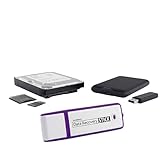
- The Data Recovery Stick requires no technical skills — simply plug it into your Windows computer, click Start, and the software automatically begins scanning and recovering lost files within minutes. Compatible with Windows Vista, 7, 8, 10, & 11, it's designed to be a reliable first step when accidental deletion occurs.
- Recover photos (JPG, BMP, PNG, TIFF), Microsoft Office documents (Word, Excel, PowerPoint, Publisher, Access), Open Office files, MP3 music files, PDFs, RTF documents, AutoCAD files, and HTML web pages. Whether it's personal memories or critical business files, the Data Recovery Stick covers the file types that matter most.
- Works with hard drives, USB drives, SD cards, memory sticks, and other common storage formats that use FAT or NTFS file systems — making it a single solution for hard drive recovery, USB drive recovery, SD card recovery, and more. Note: a media reader is required for micro SD cards and some mass storage devices.
- No Installation Required - The Data Recovery Stick runs entirely from the USB drive with no software installation on your computer — helping prevent new data from overwriting the files you're trying to recover. This also makes it ideal for use across multiple computers or in emergency situations where installation isn't practical.
- Use the Data Recovery Stick on as many computers as often as needed — simply clear the recovered data between uses to free up storage space. Software updates keep the tool compatible with newer systems and devices, backed by 25+ years of data software expertise from Paraben Consumer Software.
AG Grid also offers a React grid and distinguishes its free Community edition from licensed Enterprise capabilities; its documentation says Enterprise features require an Enterprise license for production use. Check the current product documentation rather than assuming a feature is included in a particular edition.
How do the trade-offs affect your implementation?
| Decision area | Headless library | Full grid | Question to answer |
|---|---|---|---|
| Interface ownership | Your application writes the markup, styles, controls, and interaction surfaces around the provided state and APIs. | The component supplies a working interface and exposes customization hooks. | Does the product require exact design-system control, or does the supplied UI fit? |
| Assembly and maintenance | More interface and interaction work belongs to your team. | Less UI assembly is needed, but your team maintains configuration and integrations specific to the grid. | Which work can the team sustain over the product’s life? |
| Feature coverage | Features are modular; some experiences may need custom code or companion libraries. | Common controls may be built in, but access can depend on the product edition. | Are every required feature and its license entitlement confirmed? |
| Framework and design system | TanStack documents adapters for multiple frameworks and use with CSS or component libraries. | MUI X is React-oriented and integrated with Material UI; AG Grid documents support for multiple frameworks. | Which framework and component system must the table fit? |
| Server-backed data | Your application owns fetching and server-side operations, with table state helping represent them. | A grid may offer a data-source abstraction, but your application still supplies the backend and data connection. | Where must authoritative filtering, sorting, and pagination happen? |
| Commercial terms | Review the library’s license and any companion packages you plan to use. | Advanced features may require a paid tier or license. | What terms apply to the exact production features you need? |
Does virtualization solve the large-data problem?
No. Virtualization addresses rendering: instead of putting every row or column in the DOM, the UI renders the visible portion. It can reduce DOM work, but it does not reduce the need to obtain, filter, sort, or paginate data. If the complete dataset is too large or inappropriate to load in the browser, virtualization does not replace server-side processing.
Rank #2
TanStack’s React guide separates the table model from the virtualizer: the table manages rows, columns, cells, and state; a virtualizer selects visible items for rendering. TanStack Table can be paired with a virtualizer, while MUI X documents built-in row and column virtualization. Built-in or paired virtualization still needs realistic testing; it is not a guarantee of smooth performance on every device or workload. For small tables, ordinary rendering may be simpler.
Client-side virtualization also assumes the relevant data is available in the browser. When the full result set must remain on the server, filtering, sorting, and pagination need to operate against that authoritative dataset. TanStack’s client-side versus server-side guide leaves the application responsible for server operations and the fetch/request flow; the library does not supply a built-in fetching layer.
Rank #3
![Express Rip Free CD Ripper Software - Extract Audio in Perfect Digital Quality [PC Download]](https://m.media-amazon.com/images/I/41xx28xHa+L._SL160_.jpg)
- Perfect quality CD digital audio extraction (ripping)
- Fastest CD Ripper available
- Extract audio from CDs to wav or Mp3
- Extract many other file formats including wma, m4q, aac, aiff, cda and more
- Extract many other file formats including wma, m4q, aac, aiff, cda and more
How should server-side pagination and filtering work?
Use server-side operations when the browser should not own the complete dataset or when results must reflect the full backend collection. Make one system authoritative for filtering, sorting, and pagination. Applying an operation only to the currently loaded page can produce results that appear valid locally but omit matching rows or misrepresent the overall ordering.
With TanStack Table, the application connects table state to its backend requests and supplies the returned data. With MUI X, a developer can use its Data Source interface, including getRows, to fetch subsets; its server-side data documentation explains wiring filtering, sorting, and pagination to server mode or a Data Source. That abstraction can reduce fetching and state boilerplate, but it does not provide the application’s backend.
Which option fits your situation?
Choose headless when the interface is part of the product’s identity
Headless is a strong fit when the table must match a bespoke design system, use nonstandard interaction patterns, or work across a framework and component setup that a particular grid does not serve well. It is also appropriate when the team wants to compose table behavior from smaller parts and is prepared to own the resulting UI and accessibility details.
Quick wins for a faster PC:
Fix the driver behind crashes, sound loss and screen glitchesFind Drivers →Clear out junk files and repair common Windows errorsFree Scan →Choose a full grid when its workflows already match the job
A full grid is often the more direct route for an operational table whose needs align with its built-in editing, filtering, sorting, pagination, or other documented controls. Before committing, verify that each required capability is available in the selected edition and can be customized enough for the product.
Best Value
Do not decide from the word “large” alone
Identify the bottleneck. If rendering too many elements is the problem, virtualization may help. If transferring the dataset, browser memory, or backend queries are the problem, address data loading and server-side operations. These are separate concerns and may require different solutions.
How can you make the decision with evidence?
- List the actual interactions. Include editing, selection, keyboard navigation, grouping, pinning, export, tree data, saved views, accessibility needs, and column controls where they apply.
- Map each feature to its implementation and entitlement. Mark whether it is built in, requires a paid tier, needs a companion package, or will be application code. Confirm current product documentation and license terms.
- Set the data boundary. Decide whether loading the complete result set into the browser is practical, or whether filtering, sorting, and pagination must run against an authoritative backend.
- Prototype one representative table. Include realistic data and empty, loading, error, and high-volume states. Exercise the interactions the product actually requires.
- Measure the whole path. Check startup bundle size, data transfer, browser memory, interaction latency, row-processing time, DOM rendering, backend query time, and the effort required to implement the UI.
- Compare ongoing costs. Weigh maintaining custom controls and interactions against a grid’s licensing terms, customization constraints, and integration work.
For context—not as a comparison with a full grid—TanStack’s current overview states that its full v9 package is about 25 KB minified and Brotli-compressed, with exact savings depending on registered capabilities. That vendor-stated package figure does not establish the size of a complete application table or predict runtime performance. There is no universal implementation-time or performance winner: a representative prototype is more useful than an assumed row-count threshold.
Quick Recap
Product prices and availability are accurate as of the date/time indicated and are subject to change. Any price and availability information displayed on Amazon at the time of purchase will apply.

