
iTechGuides is reader-supported. When you buy through links on our site, we may earn an affiliate commission. As an Amazon Associate I earn from qualifying purchases. Learn more
A “full AV stack” is an integrated autonomous-driving software platform, not a single sensor or driving feature. In its May 11, 2020 landscape, EE Times grouped developers into robotaxi companies, automakers and their suppliers, and high-tech software platforms. The map shows who was building or supplying those systems and where testing was reported at the time; it is a historical snapshot, not a directory of companies’ status in 2026.
What a full AV stack means
In this context, a full autonomous-vehicle stack is the integrated software platform used to enable autonomous driving. The term is about the breadth and integration of the driving software, rather than a particular sensor, processor, or driver-assistance feature. EE Times framed the effort around the long road to Level 4 and Level 5 driving and the growing recognition that autonomous-vehicle development depended on an ecosystem of automakers, technology companies, suppliers, and service operators.
The 2020 article sorted that ecosystem into three broad groups: robotaxi platforms, automaker-led or automaker-linked efforts, and high-tech software developers. These categories overlap. An automaker could work with more than one platform provider, and a technology company could develop its own system while also supplying or partnering with others.
Who was building or backing AV stacks in the 2020 map?
Robotaxi-focused companies
The robotaxi group included Uber, Lyft, Didi, Aptiv-nuTonomy, FiveAI, Oxbotica, ZMP, and Zoox. EE Times identified Aptiv-nuTonomy, Didi, and Uber as appearing to make headway, while noting that Zoox and Aptiv-nuTonomy had their own autonomous-driving software stacks.
#1 Best Overall
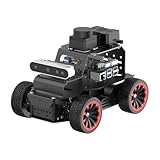
- For Raspberry Pi 5 & ROS2 Robot Car. MentorPi A1 smart AI robot car is powered by Raspberry Pi 5, compatible with ROS2, and programmed in Python, making it an ideal platform for AI robot development.
- High-Performance Hardware. Equipped with Ackerman chassis, closed-loop encoder motors, TOF lidar, depth camera, AI voice interaction box, and other advanced components to ensure optimal performance and efficiency.
- Advanced AI Capabilities. Supports SLAM mapping, path planning, multi-robot coordination, vision recognition, target tracking, and more, covering a wide range of AI applications.
- Autonomous Driving with Deep Learning. Utilizes YOLO model training to enable road sign and traffic light recognition, along with other autonomous driving features, helping users explore and develop autonomous driving technologies.
- Empowered by Large AI Model, Human-Robot Interaction Redefined. MentorPi AI robot car deploys multimodal models with ChatGPT at its core, integrating 3D vision and Al voice interaction box. This synergy enhances its perception, reasoning, and actuation capabilities, enabling advanced embodied AI applications and delivering natural, context-aware human-robot interaction.
Zoox, founded in 2014, was developing a purpose-built robotaxi. In the 2020 snapshot it was testing in San Francisco with retrofitted Toyota Highlanders, including in the Financial District and North Beach. Aptiv had acquired nuTonomy, an MIT spin-off working on self-driving cars and autonomous mobile robots. Aptiv also announced a US$4 billion, 50/50 joint venture with Hyundai.
Automakers and OEM-linked platforms
The automaker group included GM-Cruise, Hyundai, Volkswagen, Ford-Argo, BMW, Mercedes-Benz-Bosch, Volvo, and Toyota. The map distinguished between companies developing systems in-house and those relying on or partnering with specialist technology providers.
| Automaker or pairing | What the 2020 account described |
|---|---|
| GM-Cruise | GM’s effort used Cruise’s software. |
| Ford-Argo | The effort was based on Argo AI’s full stack. |
| Toyota | Developing an in-house platform. |
| Volvo | Had announced a partnership with AImotive. |
| BMW | Paired with Intel and Mobileye. |
| Volkswagen | Had shifted from Aurora toward Ford’s Argo.ai. |
| Hyundai | Was associated with both Aurora and Aptiv-nuTonomy; the relationship between those efforts was unclear in the account. |
| Mercedes-Benz-Bosch | Listed as an OEM-linked effort; the article did not specify further stack details in this account. |
The partnerships matter as much as the company names: a manufacturer’s presence on a stack map did not necessarily mean it owned every layer of its driving software. The relationships were fluid, and public descriptions did not always establish how responsibilities were divided.
The Tool Desk
Outbyte PC Repair FREERepair Windows errors before they cause bigger problemsFix Now →Outbyte Driver Updater FREEFix the driver behind crashes, sound loss and screen glitchesFind Drivers →High-tech software platforms
The high-tech group included Waymo, Aurora, Argo AI, AImotive, Drive.ai, Preferred Network, Baidu Apollo, AutoX, Momenta, WeRide, Pony.ai, Nvidia, Mobileye, and Tesla. EE Times described Baidu Apollo as an open-source autonomous-vehicle platform with a large developer ecosystem, and Tesla as building its own full AV stack. The article’s list is a record of participants it discussed in 2020, not a statement that every listed company had the same product scope or commercial role.
Rank #2

- REAL-WORLD ROBOTICS: Embark on an exciting journey by building your very own self-driving robot car! This DIY kit introduces beginners aged 11+ to the world of robotics, AI, and coding in a fun and engaging way.
- INTERACTIVE LEARNING EXPERIENCE: Control your robot via Wi-Fi or Bluetooth using the included custom-built controller. Drive it around, explore its autonomous driving capabilities, and interact with its sensors to understand how AI perceives the world.
- STEM FUN: Enhance creativity, problem-solving, and critical thinking through hands-on learning. Assembling and programming the robot introduces users to electromotors, sensors, computer vision, and machine learning, providing a comprehensive STEM education experience.
- THE PERFECT GIFT FOR YOUNG INNOVATORS: Ideal for kids who are passionate about robotics and technology, this DIY self-driving car kit offers a hands-on learning experience that makes it a standout gift for any occasion.
Where autonomous driving was being tested
The named examples in the 2020 accounts show public-road testing and development across several regions, but not a comprehensive inventory of test sites. Zoox was conducting trials in San Francisco’s Financial District and North Beach. The July 17, 2020 follow-up described Waymo operating completely driverless cars in certain areas of Arizona. Company and partnership activity in the broader landscape also involved Europe, Japan, South Korea, and China-linked markets.
Testing location alone does not show that two systems were being evaluated under equivalent conditions. Routes, operating areas, vehicle configurations, weather, safety-driver requirements, and reporting methods can differ; the articles do not provide a common test protocol for comparing all the companies listed.
How to compare the platforms without conflating them
A useful comparison starts with what a company was trying to build and how its platform was organized, rather than treating every name in the landscape as a like-for-like competitor.
Crashes, No Sound, or Screen Glitches?
Random freezes, missing sound and display glitches usually trace back to one bad driver. Find and replace yours safely.Free scan · under a minuteWindows Errors? Fix Them Before They Spread
Repair common Windows errors and clear accumulated junk for a smoother, more stable PC - no reinstall needed.Free scan · no reinstall- Ownership model: distinguish an in-house platform, a supplier relationship, a joint venture, and an open-source developer ecosystem.
- Target use: separate a robotaxi service from autonomy developed for an automaker’s vehicles or software intended for OEM development.
- Geographic evidence: identify the specific test region and whether the report describes a trial, a permitted test, or driverless operation in a defined area.
- Technical disclosure: compare sensor, compute, and software scope only where those details are actually disclosed. The 2020 accounts did not provide consistent technical specifications across companies.
- Evidence quality: separate a company’s reported test figures from independently comparable safety evidence.
- Partnership stability: treat announced pairings as time-bound. The Volkswagen-Argo and Hyundai-Aurora/Aptiv examples show why a static list can quickly become misleading.
What California disengagement reports did—and did not—show
California required companies actively testing autonomous vehicles on public roads to report miles driven and disengagements. The DMV definition reproduced in the July 2020 follow-up described a disengagement as the “deactivation of the autonomous mode when a failure of the autonomous technology is detected or when the safe operation of the vehicle requires that the autonomous vehicle test driver disengage the autonomous mode and take immediate manual control of the vehicle.”
Rank #3

- 【AI Large Model Interaction & Embodied Intelligence】Rosmaster A1 supports dual-model dynamic reasoning, enhanced RAG search, and free conversation interruption. It recognizes the described scene and boasts superior environmental perception, reasoning, and intelligent execution capabilities, enabling natural, smooth, and context-aware human-computer interaction.
- 【Controller Options for Diverse Applications】Rosmaster A1 Ackerman robot supports 5 different development board configurations: Jetson Orin Nano Super 8GB, Raspberry-Pi 5 (8GB), and Jetson Nano B01 4GB, catering to needs from beginners to advanced developers. Recommended for Orin Nano Super Version, high-performance deep learning research and computation, supporting more complex AI models.
- 【High-performance hardware configuration】Adopts Ackerman steering chassis to realize road sign and traffic light recognition, close to actual driving, helping users develop autonomous driving technology; equipped with Nuwa-HP60C depth camera+TminiPlus lidar/SLAM C1 Lidar, using high-torque 520 motor; large-capacity battery, battery life increased by 170%, and comes with a large-capacity TF card to meet multi-tasking needs.
- 【Relocalization SLAM Navigation】The upgraded SLAM with Relocalization system, high flexibility, requiring no environmental modifications. The map is stored in software, allowing for dynamic changes to tasks, paths, and destinations. It's ideal for complex, dynamic environments with frequent task changes. It also supports various AI applications such as SLAM mapping, path planning, object recognition, and target tracking.
- 【Open Source Ecosystem & Professional Support】Compatible with ROS2/open source code, it provides detailed tutorials and an SDK. Expandable with accessories like robotic arms and sensors, it's suitable for AI research, educational experiments, smart home control, and more. It's an excellent choice for STEM education and robotics programming enthusiasts.
EE Times reported a 2020 snapshot of 65 companies with California test-driving permits. In figures summarized by Egil Juliussen of IHS Markit, 567 vehicles were “qualified” and 420 were on the streets. Those counts describe the scale of the California testing landscape as reported at the time; they do not establish how much autonomous operation each vehicle performed or how safe the systems were.
The same follow-up reported Baidu’s 108,300 miles and 18,000 miles between disengagements, alongside 13,200 miles between disengagements for Waymo and 12,200 for GM. Industry observers questioned whether Baidu’s result was comparable to the other figures. More broadly, Carnegie Mellon professor and Edge Case Research co-founder Phil Koopman said, “Disengagement is the wrong metric for safe testing.” A disengagement rate can describe a particular reporting period and test setup, but the cited numbers are not a definitive safety ranking: operating conditions, definitions in practice, and test exposure are not shown to be equivalent.
How to read this 2020 landscape today
These accounts document how the full-stack field was organized and described in 2020. They do not verify which companies, partnerships, products, deployments, or regulatory requirements remain in place in 2026. Use the map to understand the participants and development models discussed at the time, not as a current corporate-status or availability guide.
Do these 3 things before closing this tab:
1Repair Windows errors before they cause bigger problems2Scan for outdated or missing drivers - takes under a minute3Clear out junk files and repair common Windows errorsQuick Recap
Product prices and availability are accurate as of the date/time indicated and are subject to change. Any price and availability information displayed on Amazon at the time of purchase will apply.

