
iTechGuides is reader-supported. When you buy through links on our site, we may earn an affiliate commission. As an Amazon Associate I earn from qualifying purchases. Learn more
The Fujifilm X-T30 II is an APS-C, interchangeable-lens camera with a 26.1-megapixel sensor, Fujifilm X mount, an electronic viewfinder and a tilting touchscreen. It is worth considering if you want direct physical controls and already own—or plan to buy—an X-mount lens. Its main compromises to weigh are the lack of in-body image stabilization and a screen that tilts but does not fully articulate; there is also a newer X-T30 III to compare before buying.
What the Fujifilm X-T30 II offers
Fujifilm specifies a 23.5 × 15.6 mm APS-C X-Trans CMOS 4 sensor with approximately 26.1 million effective pixels. The camera uses Fujifilm X-mount lenses, so the body alone is not a complete shooting setup. Buyers should check whether a listing includes a lens and account for the cost and weight of any lens they need to add.
| Feature | Specification |
|---|---|
| Sensor and resolution | 23.5 × 15.6 mm APS-C X-Trans CMOS 4; approximately 26.1 million effective pixels (Fujifilm technical specifications, accessed 2026). |
| Autofocus system | Hybrid phase- and contrast-detection autofocus (Fujifilm technical specifications, accessed 2026). |
| Lens mount | FUJIFILM X; body-only buyers need an X-mount lens (Fujifilm technical specifications, accessed 2026). |
| Viewfinder | 0.39-inch OLED, 2.36 million dots; 0.62× magnification using Fujifilm’s 35 mm-equivalent lens reference (Fujifilm technical specifications, accessed 2026). |
| Rear display | 3.0-inch, 1.62-million-dot tilting touchscreen (Fujifilm technical specifications, accessed 2026). |
| Memory card slot | One SD slot, UHS-I compliant; supports SD, SDHC and SDXC media (Fujifilm technical specifications, accessed 2026). |
| Battery compatibility | NP-W126S is listed as compatible by Fujifilm Canada. |
Fujifilm lists burst shooting up to 30 frames per second with the electronic shutter and a 1.25× crop, or up to 8 frames per second with the mechanical shutter. The maximum electronic-shutter rate is therefore not a like-for-like substitute for the mechanical rate: it uses a crop, and Fujifilm says available burst performance varies with shooting conditions and the card. Check the official specifications for the details that apply to your intended mode.
How it suits learning photography
The X-T30 II has an electronic viewfinder as well as a touchscreen, giving you two ways to compose and review images. Digital Camera World’s August 3, 2026 student-camera guide describes it as a strong option for learning manual controls, citing its compact body, classic styling and film simulations. That is an editorial recommendation, not a lab assessment or a guarantee that the camera will suit every beginner.
#1 Best Overall

- Built for ease of use with Auto mode to keep you in the moment
- Dial in your style with endless creativity powered by 20 built in Film Simulations
- Timeless design in a remarkably compact body
- Stay sharp when it counts with AI-powered subject detection autofocus
- Experience the freedom to explore with the new FUJINON XC13-33mmF3.5-6.3 OIS kit lens
For a new photographer, the practical question is whether the controls and lens system fit the way you want to learn. Consider what lenses you will use, whether you prefer composing through a viewfinder or on the rear screen, and whether you want hands-on exposure controls. A body-only deal may look less expensive while leaving the cost of a suitable lens outstanding.
Stabilization and screen trade-offs
Digital Camera World flags the lack of in-body image stabilization (IBIS) as a drawback. If stabilization matters to your shooting, check whether a lens you plan to use offers it, or whether your subjects and shooting technique make camera-body stabilization less important. Do not assume every X-mount lens provides stabilization.
Rank #2

- Assured Image Quality X-T30 II uses Fujifilm’s fourth-generation X-Trans CMOS 4 back-illuminated sensor, designed to minimize noise, while also extending sensitivity to ISO 160. The unique structure of the X-Trans color filter array also minimizes moiré and false colors, without the need for an optical low pass filter – ensuring the best possible image quality, packed with detail and vibrant, true-to-life color.
- Incredible Focusing in All Conditions Never miss a moment, thanks to the X-Processor 4 quad-core CPU inside X-T30 II. It offers fast, accurate autofocusing in as little as 0.02 secs on any subject, but significant enhancements have been made to the original X-T30’s ability to track moving subjects, optimizing autofocus for both stills and its powerful 4K/30p video capabilities. Low light focusing performance has also been expanded from the original X-T30 model, down to -7EV (with XF50mmF1.0 R WR attached) for even greater versatility.
- Advanced Video and Imaging Controls A truly versatile imaging device, X-T30 II offers the ability to record 4K video at 30 frames-per- second, or 240fps at 1080p, to create 10x super slow-motion effects. Filmmakers needing extreme color fidelity can record 10-bit, 4:2:2 color through the camera’s HDMI port, F-Log internally, or video using any one of X-T30 II’s 18 Film Simulation modes. Alongside these, X-T30 II makes it easy to define your own distinctive visual style on still images – offering in-camera control over film grain texture, color depth, clarity, sharpness, and highlight and shadow tones.
- In Touch With Your Creativity From the dial-based operation, and compact, lightweight body, to the latest-generation Fujifilm APS-C sensor, X-T30 II lights up the imagination and inspires creativity – fusing cutting edge, convenient features with a vintage aesthetic charm. The three-inch, two-way tilting screen, for example, offers impressive touchscreen functionality, making it easy to get high-quality results in challenging conditions. For those who want to focus purely on light and composition, the Advanced SR Auto mode – easily activated with a lever on the camera’s top plate – automatically chooses the optimum settings from 58 presets.
- Made for Sharing X-T30 II is primed for sharing. Use Bluetooth or Wi-Fi to share your memories with friends and family on social media, by connecting and downloading images to the FUJIFILM Camera Remote App – or instantly connect and print your favorites from any compatible FUJIFILM INSTAX Smartphone printer.
The 3.0-inch rear touchscreen tilts, but the cited guide notes that it is not fully articulating. That distinction matters if you want to frame yourself while recording or need to angle the display toward the front; a tilting screen is not equivalent to a screen that swings out and rotates.
Free tools Windows power users keep installed
One-click scans. No signup required.
What to know about video and storage
Fujifilm’s specification page lists H.264 MOV and MP4 recording and multiple frame-rate options up to 59.94P, depending on mode. It also lists 4:2:2 10-bit HDMI output. HDMI output describes a signal sent through the camera’s HDMI connection; it should not be mistaken for a claim that the same 10-bit signal is recorded internally to the card. The precise resolution, frame rate and recording options depend on the selected mode, so consult the X-T30 II Owner’s Manual, Ver. 1.20 before relying on a particular video setup.
Rank #3
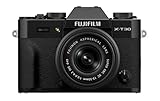
- Built for ease of use with Auto mode to keep you in the moment
- Dial in your style with endless creativity powered by 20 built in Film Simulations
- Timeless design in a remarkably compact body
- Stay sharp when it counts with AI-powered subject detection autofocus
- Experience the freedom to explore with the new FUJINON XC13-33mmF3.5-6.3 OIS kit lens
The camera has one UHS-I-compliant SD slot. If you are buying a card, choose SD, SDHC or SDXC media appropriate for your workflow and verify the camera’s requirements in Fujifilm’s documentation. The available evidence does not establish a universal card capacity or speed recommendation for every use.
X-T30 II or X-T30 III?
The newer X-T30 III changes the buying decision. Tom’s Guide reported on October 23, 2025, that Fujifilm introduced it as the successor, with a newer X-Processor 5, autofocus and power-consumption changes, and a film-simulation dial in place of the older drive dial. The report described the sensor as part of the same 26.1MP family and gave November 20, 2025 as its planned availability date. Check current local availability and product details rather than treating that original date as a statement about present stock.
Rank #4

- Camera: 26.1MP APS-C X-Trans BSI CMOS 4 Sensor; X-Processor 4 with Quad CPU; DCI and UHD 4K30 Video; F-Log Gamma; 2.36m-Dot OLED Electronic Viewfinder
- Camera: 3.0" 1.04m-Dot Tilting LCD Touchscreen; 425-Point Phase-Detection Autofocus; Extended ISO 80-51200, 30 fps Shooting; Bluetooth and Wi-Fi; Sports Finder Mode
- Lens: X-Mount Lens/APS-C Format; 23-69mm (35mm Equivalent); Aperture Range: f/3.5 to f/22; Three Aspherical Elements; Two Extra-Low Dispersion Elements
- Lens: Super EBC Coating; Optical Image Stabilization; Stepping Autofocus Motor; Two-Speed Power Zoom Adjustment; Rounded 7-Blade Diaphragm
- Bundle Includes: FUJIFILM X-T30 II Mirrorless Camera (Silver), FUJIFILM XC 15-45mm f/3.5-5.6 OIS PZ Lens, Manufacturer Accessories, 64GB Ultra SDXC Memory Card, Water-Resistant Sling Backpack, Universal Speedlite with LED Video Light, Multi-Coated UV Filter, Variable Neutral Density Filter (ND2-ND400), Padded Hand / Wrist Strap, 6 Ft. Micro to Standard HDMI Cable (A-D), Universal Lens Cap Keeper, High Speed Memory Card Reader, Trifold Memory Card Wallet, Deluxe 5PC Maintenance Kit
| Decision point | What to compare |
|---|---|
| Processing and autofocus | The X-T30 III has the newer X-Processor 5 and reported autofocus changes; consider whether those differences matter for your subjects and workflow (Tom’s Guide, October 23, 2025). |
| Controls | The reported X-T30 III layout replaces the X-T30 II’s drive dial with a film-simulation dial. Choose based on which control arrangement better fits your habits (Tom’s Guide, October 23, 2025). |
| Price and condition | Compare current local prices for new, used and refurbished bodies, plus warranty, included lens and accessories. Historical pricing is not a current quote. |
| System cost | Include the price and weight of the X-mount lens or lenses you need, especially if you do not already own any. |
TechRadar’s October 24, 2025 comparison listed historical X-T30 II body-only list prices of $999, £829 and AU$1,679. Those are dated reference figures, not current prices; local market and tariff changes may affect what you pay. Compare actual offers for the same condition and package before deciding whether the older model is the better value.
Who should consider buying it?
- Consider it if you want an X-mount camera with an EVF, a tilting touchscreen and manual-control learning potential, and the current price makes sense against the newer generation.
- Look elsewhere or compare carefully if in-body stabilization or a fully articulating screen is essential to your work.
- Check the complete kit if you are new to Fujifilm: confirm whether the body includes a lens, and budget for the lens, an SD card and any spare power you actually need. Fujifilm Canada lists the NP-W126S as compatible, but compatibility alone does not establish battery endurance.
- Verify exact video modes if a particular frame rate, resolution, recording duration or HDMI workflow is a buying requirement; use the official manual rather than assuming every listed option works in every combination.
Sources: Fujifilm X-T30 II technical specifications; Fujifilm Canada compatibility information; Digital Camera World student-camera guide, August 3, 2026; Tom’s Guide X-T30 III report, October 23, 2025; and TechRadar comparison, October 24, 2025.
Quick Recap
Product prices and availability are accurate as of the date/time indicated and are subject to change. Any price and availability information displayed on Amazon at the time of purchase will apply.

