
iTechGuides is reader-supported. When you buy through links on our site, we may earn an affiliate commission. As an Amazon Associate I earn from qualifying purchases. Learn more
A free time management calculator answers one question: after your recurring commitments are counted, how many hours are left in a day or a week? You enter the hours you spend on each activity, the tool adds them up, and it subtracts the total from a fixed budget of 24 hours per day or 168 hours per week. The remaining figure is only as accurate as your estimates, so the useful part is not the number itself but what it shows about conflicts and trade-offs in your schedule.
How the calculation works
Every calculator in this category uses the same arithmetic. The available window is fixed, the activity hours are summed, and the difference is what remains.
| View | Available hours | Formula for remaining time |
|---|---|---|
| Daily | 24 hours | 24 − sum of activity hours for one day |
| Weekly | 168 hours (7 × 24) | 168 − sum of activity hours for the week |
Some tools also show percentages. An activity’s share of the week equals its weekly hours divided by 168, multiplied by 100. Clockify’s free calculator describes weekly totals, percentages, and remaining free hours, and it supports both daily and weekly entry.
Quick wins for a faster PC:
Fix the driver behind crashes, sound loss and screen glitchesFind Drivers →Clear out junk files and repair common Windows errorsFree Scan →Scan for outdated or missing drivers - takes under a minuteDriver Scan →The 168-hour ceiling is a hard limit. The University of Wisconsin Online Collaboratives calculator states that allocated activities cannot exceed 168 hours. If your entries total more than that, the tool shows a negative remainder. That signals overlapping or overestimated entries, not extra time you have found.
#1 Best Overall
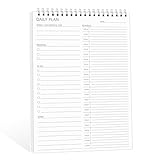
- ✔This daily plan pad features detailed hourly schedule timelines from 12 AM to 11 PM, perfectly segment your morning, afternoon and evening hours. Track meetings, appointments and fixed tasks hour by hour to eliminate procrastination and boost your daily time management efficiency.
- ✔ 1.Put an end to the time black hole: Every hour of activity is recorded, so you always know where your time goes and bid farewell to "being busy yet achieving nothing". 2.Cure procrastination: Visual time grids have an inherent sense of supervision; blank time slots serve as a direct reminder, with more binding power than phone alerts. 3.Gain instant a sense of accomplishment: Check off completed tasks with a simple tick. A filled time axis page by page delivers physical feedback that digital tools cannot match, making it easier to keep going the more you use it.
- ✔ 1.Students & Exam Takers: Plan class, review and practice time; allocate study hours for each subject precisely for targeted exam preparation. 2.Professionals: Schedule meetings, work projects and commute time; prioritize tasks clearly and bid farewell to chaotic overtime. 3.Freelancers & Stay-at-Home Parents: Clearly divide work/childcare/personal time to avoid blurring the boundaries between life and work. 4.Self-Discipline Enthusiasts: Check in on fitness, reading and learning; develop regular routines with hourly scales to build good habits effortlessly.
Step-by-step: running your numbers
- Pick the view you need. Use the daily view to inspect a typical day, such as a workday with an evening class. Use the weekly view to check whether the whole week balances.
- Record a representative week first. Before changing anything, log the hours you actually spend. Include routine commitments and occasional ones, and label unusual days so they do not distort the average.
- Enter hours in a consistent unit. Decimal hours work well: 30 minutes is 0.5 hour, and 15 minutes is 0.25 hour. Clockify explains decimal-hour entry on its calculator page.
- Read the remaining time and the distribution together. A large remainder with very little sleep logged is a warning sign, not a success. Check each category before drawing conclusions.
- Test a proposed change. Add a new commitment, such as a weekly class or a gym session, and see which existing block it displaces. This is the most practical use of a calculator.
- Leave a buffer. Do not plan every remaining hour. Keep some time open for transitions and interruptions.
- Compare plan with reality after a week. Most calculators record what you planned. If you did not track time automatically, note where the entries and your actual week diverged.
A worked example
The figures below are illustrative, not measured data. They show how a typical weekday might be entered in a daily view.
| Activity | Hours per day |
|---|---|
| Sleep | 8.0 |
| Work or classes | 8.0 |
| Commuting | 1.0 |
| Meals | 1.5 |
| Exercise | 0.5 |
| Household tasks | 1.0 |
| Personal care | 0.5 |
| Total entered | 20.5 |
| Remaining from 24 | 3.5 |
That 3.5 hours looks like free time, but it has to absorb errands, unplanned calls, and social time that was not entered. If the same person adds a two-hour evening course, the remainder falls to 1.5 hours, which is a clear signal to move something else.
Rank #2

- Stay Organized and Focused: This planner is specifically designed to help individuals with ADHD or busy lifestyles prioritize their day with clear prompts, ensuring that the most important tasks are tackled first
- Comprehensive Layout: With 100 thoughtfully designed pages, including sections for daily scheduling, task prioritization, self-care, and brain dumps, this planner helps reduce distractions and keep your thoughts organized
- Motivation Through Rewards: Keep yourself engaged and motivated with built-in checklists and reward systems that make completing tasks more satisfying
- Flexible and Undated Design: Use this planner at your own pace—it's undated, so you can start anytime without worrying about wasted pages
- Durable and Convenient: Featuring a 7" x 10" size, a sturdy hardcover, and spiral binding for durability, this planner is easy to carry and perfect for daily use
What to include so the remainder is honest
Many people enter only work and study, then wonder why the result looks too generous. The California Community Colleges Chancellor’s Office Daily Schedule Calculator uses categories that cover the full day: classes, studying, sleeping, exercise, working, family, personal care, dining, travel, entertainment, and other activities. Use a similar checklist:
Free tools Windows power users keep installed
One-click scans. No signup required.
- Sleep, including the time you actually spend in bed rather than an ideal figure
- Work, classes, and study
- Commuting and other travel
- Meals and food preparation
- Exercise and personal care
- Chores, errands, and caregiving
- Family and relationship time
- Entertainment and rest
- An “other” category for anything that does not fit
Comparing calculator options
The table below compares features as the publishers describe them. These are not results from testing the tools side by side.
Rank #3

- BOOST YOUR PRODUCTIVITY – Turn your to-do list into a clear daily schedule with a simple 3-step time blocking method: Brain Dump, Prioritize, then Time Block your day. A practical time management planner for work, school, and busy routines.
- CLEAR YOUR MIND – The Brain Dump section helps you get tasks, appointments, and ideas out of your head and onto paper. Designed as an ADHD-friendly planner for adults who want more structure and less overwhelm.
- VISUALIZE YOUR TIME – The daily hourly planner layout helps reduce procrastination by giving each task a clear place in your schedule. Time slots make it easier to plan work blocks, study sessions, appointments, errands, and focus time.
- FLEXIBILITY – 180 undated pages let you start anytime, skip days, and plan without wasting pages. Monthly pages provide a big-picture view of deadlines and goals, while flexible daily scheduling works for early birds and night owls.
- QUALITY – Durable hard cover with vegan leather finish, 100 GSM high-quality paper, elastic closure, and 2 bookmarks. Portable A5 size is perfect for your desk, backpack, work bag, or school bag.
| Feature | Clockify free calculator | UW Online Collaboratives Time Management Calculator | CCC Daily Schedule Calculator |
|---|---|---|---|
| Daily and weekly views | Both, per Clockify’s description | Not stated | Daily schedule |
| Remaining time shown | Remaining free hours | Hours Remaining | Not stated |
| Percentage breakdown | Yes, per Clockify’s description | Not stated | Not stated |
| Hard budget cap | Not stated | 168 hours | Not stated |
| Student-specific assumption | Not stated | Three study hours per credit, auto-populated | Not stated |
| Stated use | Retrospective review or prospective planning | Student planning | Daily activity planning |
Clockify presents the tool as usable both retrospectively, to inspect current habits, and prospectively, to plan a routine. The UW calculator is aimed at students, and its study-hour setting is a built-in assumption of that tool.
If you want a written template instead of a calculator, Smartsheet offers free time-management, daily-planner, and weekly-schedule templates. A template is one optional way to record a plan. Neither a template nor a calculator is required to do the arithmetic, which can be done on paper with the same 24- and 168-hour budgets.
Rank #4

- Easily Stay On Track & Make The Most Of Your Time: ZICOTOs’ daily planner makes it easier than ever for you to stay organized, reduce stress & enjoy more free time! Arrange your schedule, priorities, to do’s and jot down plans & ideas on the daily notes section
- Smartly Plan Ahead & Boost Your Productivity: Absolutely clever & efficient! With the to do list notebook / notepad you can break down your daily tasks into half-hourly focus blocks and map out priorities & follow-up duties to keep your day on track and enhance productivity
- Plenty Of Space For Efficient Planning: Stay focused & manage your time wisely! The 8.4x6.1” work planner & organizer notebook offers ample space for 105 days of life-changing planning with each day being spread across 2 pages - set yourself up for purposeful days
- Now Is The Best Time To Start: The daily planner is undated so you can start to add structure to your schedule and cultivate new planning habits right away! Beat procrastination, boost happiness & make each day count with the hourly planner
- Adds Beauty To Daily Planning: A luxury sage hard cover, chic golden letters, a gold ring wire and a clean, easy-to-use layout, elastic band - enjoy the lovely and modern design of the undated daily planner!
Student tools and the three-hour assumption
Student-oriented calculators can apply their own planning rules. The UW Online Collaboratives calculator auto-populates three hours of study time per credit and notes that more time may be needed depending on the program. That figure belongs to this calculator. It is a starting estimate, not a universal study requirement and not a predictor of academic results. Replace it with your own observed study time if you have it, especially for demanding courses.
Reading a negative or a large remainder
Two results need different responses.
- A negative remainder. Your entries exceed 24 hours in a day or 168 hours in a week. Look for overlaps first. Sleep and time at a desk often overlap with entertainment or meals, and both can be double-counted. Reduce estimates until the total fits.
- A large remainder. Check whether you left out sleep, travel, meals, or household work. If the entries look complete, treat the remaining hours as unallocated rather than guaranteed leisure. Omitted errands and transitions can absorb most of an apparent buffer.
What a calculator can and cannot show
A calculator makes conflicts visible: when a new commitment does not fit, or when a schedule has no slack. It does not measure how you actually spend time, and the published descriptions of these tools do not claim that using one improves productivity, grades, or wellbeing. Treat the output as a planning model. Its accuracy depends on how honestly and completely you enter the hours.
Best Value

- Plan Smarter, Stress Less: Our undated planner has 50 daily planning sheets per planning pad to help you keep your notes organized all in one place. Track important projects, tasks, time blocking, and goals with our planner.
- Enhance Your Productivity: The simple solution for managing your daily schedule. Helps you focus, especially those with ADHD. With our daily planner you can track your appointments and meetings throughout the week, organize your tasks in order of priority, jot down thoughts or ideas, and record when projects are due.
- Upgrade Your Office Supplies: The minimal design makes this a stylish and practical addition to your work from home essentials for both women and men. This to-do list notepad looks professional and keeps you organized.
- Give The Gift Of Organization: The sleek design makes this a beautifully practical gift for moms and dads who need a little extra help keeping track of soccer games, field trips, and doctor’s appointments. Also makes a wonderful gift for college students, coworkers, your boss, or the entrepreneur in your life to help them stay on top of busy schedules.
- Cultivate Healthy Habits: Plan and track your meals and water intake each day and use the checkbox as a visual reminder. Take a minute each day to write down something good that happened. Practicing gratitude is proven to increase happiness!
Publisher descriptions also describe calculators as free to use. Check the current terms on each site, since free access and features can change.
The model works best when you run it twice: once to describe the week you have, and once to test the week you want. The gap between those two results is usually where the useful decisions are.
Enter hours honestly, keep a buffer, and compare the plan with a week of observed time. The calculator will then show you what the schedule actually allows.
Quick Recap
Product prices and availability are accurate as of the date/time indicated and are subject to change. Any price and availability information displayed on Amazon at the time of purchase will apply.

