
Do these 3 things before closing this tab:
1Repair Windows errors before they cause bigger problems2Fix the driver behind crashes, sound loss and screen glitches3Clear out junk files and repair common Windows errorsiTechGuides is reader-supported. When you buy through links on our site, we may earn an affiliate commission. As an Amazon Associate I earn from qualifying purchases. Learn more
You can use Zebra to study Zcash mining or experiment with CPU mining on a test network, but you cannot turn Zcash into a CPU-mined chain by changing a mining setting. A separate CPU-oriented chain requires a deliberate consensus fork: nodes must agree on the proof-of-work rules, and compatible validation and mining software must be tested together. Zebra’s mining interfaces and the Zcash Foundation’s testnet tutorial are useful starting points—not evidence that a production-ready CPU-only chain is already available.
What “forking Zebra” means—and what it does not
Zebra is a Rust implementation of a Zcash full node. The Zcash Foundation describes it as an independent, consensus-compatible implementation. Running Zebra therefore means participating in the existing Zcash consensus rules; it does not, by itself, change those rules or restrict mining to CPUs.
A separate chain can reuse or adapt Zebra code, but changing the proof-of-work rules changes which blocks nodes accept. A modified node will not make the existing Zcash network accept blocks that violate its consensus rules. For a new chain, every participating node needs compatible validation rules, and miners need software that produces blocks satisfying those rules.
“CPU-mined” also needs a precise definition. A proof-of-work design can be intended to make CPU mining practical, but that does not automatically mean CPUs are the only hardware capable of mining it. The sources here do not establish a design that guarantees CPU exclusivity, nor do they provide a ready-made CPU-only Zebra fork.
#1 Best Overall
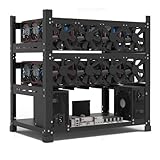
- SLOT - 6/8/12 GPU slots, support 2 ATX power supplies.
- MATERIAL - The open air mining frame case made up of the highest quality stainless steel material, strong, durable and available. Fully protecting your GPU and eectronic device.
- PERFECT DESIGN - Professional design for mining rig frame, accelerating the air convection, super cooling design for heat dissipation. Enough space reserved between the graphics cards.
- EASY TO INSTALL - Easy to install and strong structure. Keep all cables clean and organized, along with everything in your mining machine.
- NEED TO ASSEMBLE BY YOURSELF - For installation steps, please refer to the user manual. The Frame Only, Not includes Fans or other CPU, GPU, PSU, Motherboards, Cables. If you are not 100% satistifed with this Miner, please feel free to contact us, we will offer you a satisfactory soluiton within 24 hours.
Three project scopes, from exploration to a new network
| Scope | Consensus changes | Network and upgrade fit | Mining interface and evidence |
|---|---|---|---|
| Run unmodified Zebra and study its mining RPC | None; the node follows Zcash consensus. | Existing Zcash implementation; not a CPU-mined fork. | Zebra documents miner-related RPC methods, configuration including a miner address, and a getblocktemplate check. This shows node-to-miner integration, not a configurable proof-of-work algorithm. Zebra mining documentation |
| Reproduce the Foundation’s testnet CPU-mining experiment | None to Zcash consensus; it is an experiment against the documented testnet setup. | Testnet tutorial, not evidence of production readiness or current mainnet compatibility. | The guide uses nheqminer with a CPU Equihash solver and reports 2–4 Sols/s per core in its tutorial context. It does not give a publication year, current benchmark, or profitability forecast. Testnet mining guide |
| Develop a separate fork with changed proof-of-work rules | Substantial: block validation and proof-of-work consensus behavior must change consistently. | A separate network must coordinate its own compatible node upgrades and activation. The cited sources do not establish a turnkey launch plan. | Requires mining software compatible with the new rules; pool communication may also need an appropriate interface. Security, decentralization, performance, and economics are not established by the cited material. NU6.1 protocol specification |
For a solo developer, the first two scopes are useful for learning and controlled experiments. The third is a protocol project, not a miner-configuration exercise.
Why changing proof of work is a consensus project
The NU6.1 Zcash protocol specification includes Equihash solution validity and difficulty-threshold bits among block rules. Nodes use such rules to decide whether a block is valid. If a fork changes the proof-of-work algorithm, parameters, or acceptance conditions, the node’s validator must enforce the new rules, and block producers must create solutions those validators accept.
Rank #2

- 8 SLOTS - 8 GPU slots. (GPU is not included).
- MATERIAL - The open air mining frame case is made up of the highest quality stainless steel material, strong, durable and available. Fully protecting your GPU and eectronic device.
- PERFECT DESIGN - Professional design for mining rig frame, accelerating the air convection, super cooling design for heat dissipation. Enough space reserved between the graphics cards.
- EASY TO INSTALL - This mining case is easy to install and is with strong structure. Keep all cables clean and organized, along with everything in your mining machine.For installation steps, please refer to the user manual
- NOTICE - This mining rig frame is the Frame Only, not includes Fans or other CPU, GPU, PSU, Motherboards, Cables. If you are not 100% satistifed with this Miner, please feel free to contact us, we will offer you a satisfactory soluiton within 24 hours.
That makes “make it CPU-mined” an underspecified protocol goal. Before implementation, define what CPU-friendly means and how the network will judge a valid block. The design work includes, at minimum:
- The proof-of-work rule and parameters that validators will enforce.
- How difficulty is calculated and adjusted over time.
- How blocks are constructed and how miners obtain work from a node.
- Test vectors and validation tests so independent nodes agree on valid and invalid blocks.
- How upgraded nodes coordinate activation on the new network.
- How mining software, and any pool software, communicates with nodes and submits solutions.
These are engineering consequences of changing consensus, not a prescribed implementation recipe. The protocol specification is a reference for the existing Zcash rules; it does not supply a CPU-mined Zebra fork plan.
Rank #3

- 6/8 SLOTS - Support to 6/8 GPU . (GPU is not included).
- MATERIAL - The open air mining frame case is made up of the highest quality stainless steel material, strong, durable and available. Fully protecting your GPU and eectronic device.
- PERFECT DESIGN - Professional design for mining rig frame, accelerating the air convection, super cooling design for heat dissipation. Enough space reserved between the graphics cards.
- EASY TO INSTALL - This mining case is easy to install and is with strong structure. Keep all cables clean and organized, along with everything in your mining machine.For installation steps, please refer to the user manual
- NOTICE - This mining rig frame is the Frame Only, not includes Fans or other CPU, GPU, PSU, Motherboards, Cables. If you are not 100% satistifed with this Miner, please feel free to contact us, we will offer you a satisfactory soluiton within 24 hours.
Keep node RPC, pool communication, and consensus separate
Mining involves several layers that are easy to conflate. Zebra’s documented mining RPCs are an interface for miners or pool software to interact with a node. ZIP 301 defines a Zcash-specific Stratum protocol for communication between miners and pool servers. Neither interface defines which proof of work a node accepts: that is a consensus rule.
- Consensus validation: the rules a node uses to accept or reject blocks.
- Node mining RPC: a way for mining software or a pool to request work or interact with a node.
- Miner-to-pool protocol: a separate communication path, such as the Stratum variant described in ZIP 301.
For a new chain, compatibility at one layer does not guarantee compatibility at the others. Existing mining RPC support does not make a changed proof-of-work rule valid, and a pool protocol does not make nodes agree on consensus.
Rank #4

- The most elegant and solid GPU mining rig/case you can buy.
- Easy&Fast installation in 20 minutes with detailed guide.
- Stackable and durable. Full protection of GPUs and other electronic components.
- Super cooling design for heat dissipation. Enough space reserved between the graphics cards.
- Online support 7 days / week. 1 Year Warranty and 30-Day Return Guarantee.
What the official CPU-mining tutorial can demonstrate
The Zcash Foundation’s testnet guide documents a path using nheqminer with a CPU Equihash solver. Its build instructions use USE_CPU_TROMP=ON, and its run example uses one thread. The guide reports a typical rate of 2–4 Sols/s per core; the page does not state a publication year, so treat that as a historical tutorial figure rather than a present-day benchmark or estimate of earnings.
The guide also describes an experimental zebra-mining branch of the ZcashFoundation s-nomp fork. It says the branch includes fixes that disable pool-operator and miner payments and provide basic compatibility with Zebra RPC. The guide cautions that s-nomp “has not been officially updated for NU5 or later network upgrades (NU6, NU6.1)” and recommends pool software compatible with current upgrades for production mining.
Best Value
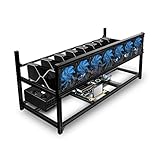
- ✅Premium Aluminum Construction: Constructed from high-quality aluminum for enhanced durability and heat dissipation, ensuring longevity and optimal performance.
- ✅ Accommodates 8 GPUs: Designed to house up to 8 graphics cards, providing ample space for expanding your mining setup and maximizing efficiency.
- ✅ Superior Airflow and Cooling: Engineered with optimized airflow design to prevent overheating and maintain optimal operating temperatures for prolonged mining sessions.
- ✅ Easy Assembly: Simple and straightforward assembly process allows for quick setup, getting you up and running in no time.
- ✅ Sleek and Space-Saving Design: Compact and minimalist design saves space while adding a professional touch to your mining rig setup.
That caveat matters: reproducing the tutorial can help you inspect CPU solver plumbing on the documented testnet path, but does not validate that pool setup for a current production network. Nor does a testnet experiment show that a new CPU-oriented chain will be secure, decentralized, or economically viable.
Independent reader supportYour contribution helps us test, update, and keep practical guides available for everyone.A practical solo-developer path
- Choose the scope first. If the goal is to learn Zebra’s mining interface, start with unmodified Zebra and its mining documentation. If the goal is to observe CPU solver behavior, treat the testnet tutorial as an experiment, not a production recipe. If the goal is a new network, write down the intended consensus changes before altering mining software.
- Build and run the node environment. Zebra’s public repository describes Docker and manual installation paths. Check the project’s current instructions and target-platform support before choosing a development machine; the Foundation’s download page notes that artifacts are not published for every platform or CPU architecture, including ARM64.
- Establish a baseline on a controlled network. Verify that the unmodified node follows the intended network and that its documented mining RPC works with the relevant mining client. Keep the observed solver rate, machine, build, and network context together; the tutorial’s per-core figure is not a substitute for a current measurement on your setup.
- Specify the fork’s consensus rules. Define the proof-of-work behavior and parameters, difficulty adjustment, block construction, validation cases, and network activation before expecting miners to produce useful blocks. A changed solver alone cannot establish agreement among nodes.
- Test node agreement before inviting miners. Run multiple upgraded nodes against the same test cases and confirm that they accept the same valid blocks and reject the same invalid ones. Then verify the node-to-miner and, if used, miner-to-pool interfaces against those rules.
- Keep a public launch separate from a private experiment. A private network demonstrates that your components can interact under controlled conditions. It does not establish public-network security, upgrade coordination, decentralization, or viable mining economics.
What to conclude before investing in hardware or a launch
A general development workstation can be used to compile Rust software and run a CPU-based test, but the cited material does not establish an optimal CPU, required workstation specification, comparative hardware performance, or profitable mining setup. Do not infer a hardware purchase or expected return from the tutorial’s 2–4 Sols/s-per-core figure.
The tractable first milestone for a solo developer is an experiment: get a compatible Zebra node and miner talking on a controlled network, then document exactly what that proves. A live CPU-oriented chain is a different undertaking: it needs a consensus design, coordinated implementations, and evidence from testing that goes well beyond a working miner interface.
Quick wins for a faster PC:
Repair Windows errors before they cause bigger problemsFix Now →Fix the driver behind crashes, sound loss and screen glitchesFind Drivers →Clear out junk files and repair common Windows errorsFree Scan →Quick Recap
Product prices and availability are accurate as of the date/time indicated and are subject to change. Any price and availability information displayed on Amazon at the time of purchase will apply.

