
Quick wins for a faster PC:
Fix the driver behind crashes, sound loss and screen glitchesFind Drivers →Repair Windows errors before they cause bigger problemsFix Now →Scan for outdated or missing drivers - takes under a minuteDriver Scan →iTechGuides is reader-supported. When you buy through links on our site, we may earn an affiliate commission. As an Amazon Associate I earn from qualifying purchases. Learn more
Choose the truck and the camper as one system. If you have not bought a truck yet, pick a camper style and estimate its realistic loaded travel weight before you shortlist trucks. If you already own a truck, use that exact vehicle’s posted loading information and a certified scale weight to find its real remaining capacity, then limit your camper search to what fits inside that number. Compare the specific truck configuration and the specific camper model. Generic labels such as “half-ton” or “one-ton,” and a manufacturer’s highest advertised payload figure, are not enough to decide.
Truck Camper Magazine frames the decision with a simple question: do you already have a truck, or do you have one in mind? The answer determines where you start, so the first half of this guide is organized around it.
The numbers that govern the decision
Most truck-camper mismatches come from mixing up weight terms. The table below separates the terms you will see on labels, in owner documents, and in camper specifications.
| Term | What it limits | Where to check it | Common mistake |
|---|---|---|---|
| GVWR (Gross Vehicle Weight Rating) | The maximum allowed weight of the whole loaded vehicle | The truck’s certification or loading label and its owner documentation for the specific configuration | Treating a camper’s dry weight as the full load |
| Payload | The weight the truck is designed to carry, including cargo, occupants, and added equipment, as Truck Camper Adventure puts it in editorial terms | Posted loading information for the exact year, model, cab, drivetrain, and options | Using a maximum payload figure printed for a different cab, drivetrain, or option package |
| GAWR (Gross Axle Weight Rating), front and rear | The maximum load each axle can carry | Same label and owner documentation as GVWR | Checking only the total, when the rear axle is often the limit with a camper aboard |
| Tire and wheel load ratings | The load each tire and wheel can carry at its inflation pressure | Tire sidewall and the tire placard | Assuming that new tires or upgraded wheels raise the vehicle’s rating |
| Camper dry weight | The camper as built, before the items a trip adds | The camper manufacturer’s specification sheet | Using dry weight as the basis for the purchase decision |
The key point is that GVWR is a whole-vehicle limit. Meeting it is necessary, but it does not prove that each axle and each tire is within its own rating. Ford’s 2025 RV & Trailer Towing Guide states: “Combined weight of vehicle, camper body, occupants and cargo must not exceed Gross Vehicle Weight Rating (GVWR).” That statement is specific to Ford’s 2025 guidance, and the wording of other manufacturers’ documents will differ.
#1 Best Overall
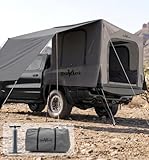
- 【INSTANT 2-MIN INFLATABLE SETUP】Say goodbye to heavy metal poles and complex assembly. Our truck bed tent features an innovative inflatable structure with a high-pressure manual pump included. One person can easily complete the setup in under 2 minutes, transforming your pickup into a cozy campsite instantly.
- 【DETACHABLE ZIPPERED AWNING】Featuring a versatile design, the front awning is connected to the side via a high-quality zipper system. This allows you to easily attach it for extra shade or detach it in seconds for a more streamlined look. It offers ultimate flexibility to adapt your shelter to changing weather or camping needs.
- 【HEAVY-DUTY 4-INCH PVC AIR BEAMS】Engineered for maximum stability, our tent is supported by 4-inch (10cm) diameter reinforced PVC air columns. This robust structure provides superior wind resistance and structural integrity, ensuring your "mobile nest" stays firm and maintains its shape even in breezy conditions.
- 【ALL-WEATHER PU3000 PROTECTION】Crafted with a premium PU3000mm waterproof coating, this truck camping tent ensures you stay bone-dry even during heavy downpours. The integrated floor design effectively prevents water, dust, and debris from entering through truck bed gaps, providing a clean, insulated, and secure "mobile nest" in any environment.
- 【UNIVERSAL FIT FOR 5.5FT-8FT BEDS】Measuring 7.2 x 5.9 x 5.4 FT, this versatile shelter is precision-engineered to fit most 5.5ft to 8ft truck beds. Whether you own a short bed or a long bed pickup, the adjustable securing system ensures a snug and stable fit for 2-3 adults.
Why truck class labels are only a starting point
Labels such as half-ton, three-quarter-ton, one-ton, SRW (single rear wheel), and DRW (dual rear wheel) describe broad categories. Two trucks sold under the same label can carry very different loads once cab size, drivetrain, axle ratio, suspension, wheels and tires, and factory options are considered. A single-rear-wheel truck and a dual-rear-wheel truck with the same nameplate can also have different payload and axle figures.
Use the class label to narrow the list, then check the actual vehicle. Do not assume that a higher class always solves a problem; the specific configuration and camper still have to be compatible.
Rank #2

- 1.【3 Mins Hassle-Free Quick Setup】TIPHOPE 2-in-1 truck bed tent mattress with built in rechargeable air pump(including charging cable),achieve 3 minute for quick setup by simply press the button,no complex assembly&manual pump.Saving more time enjoying the great outdoors.Perfect for truck camping, road trips, and outdoor adventures use.
- 2.【Heavy Duty & Durable】TIPHOPE Inflatable truck tent mattress features a skin-friendly flocking top surface and ergonomic pillows, durable PVC construction for robust support, can comfortably accommodate 2-3 person(about 660lbs). Creating a spacious and comfortable sleeping space for you. Built in storage pockets to keep your phone and keys organized and within reach.
- 3.【Use On Truck&Ground】Set it up in your 5.5-6.5ft truck bed or on ground directly.With Reinforced guy lines and upgraded stakes keep the tent rock-solid in wind.Featuring 12” ultra-thick air mattress,keeping you from moisture and cold ground.Ensures a comfortable sleep outdoor experience wherever you camp.Quickly deflates and packs away into the included carry bag when not in use, easy to carry.
- 4.【Weatherproof & Breathable】Truck bed tent for camping is crafted from 210D Oxford fabric and PU2000mm waterproof coating with high density mesh window for ventilation and mosquito protection,also ensuring you stay bone-dry and cozy during heavy rain.Built-in lantern hook allows you to light up your night,brings the comforts of home to the rugged outdoors.
- 5.【Packaged Including & Warranty】Including truck tent air mattress; Inflatable pillows; nozzles; repair patch; charging cable; stakes; reinforced rope; wireless electric air pump; carry bag; user manual.【2 Year Warranty】Please purchase and use with confident,we offer’2 Year Warranty’ for truck tent mattress,if have any problem,please feel free to contact us.
Calculate the travel-ready load, not the brochure weight
The weight you need is the weight of everything that will be on the truck when you travel. Build it as a list:
- Camper: dry weight plus every factory and aftermarket option installed on it
- Fluids: fresh water, gray and black tank contents if they will be carried, and propane
- Power: batteries and any solar or power equipment
- People and pets: every occupant and animal who will ride in the truck, measured realistically
- Gear: food, clothing, tools, spares, recovery equipment, bikes, and anything stored in the camper or truck bed
- Tie-down hardware: straps, brackets, and other attachment equipment
Tie-down equipment is part of the load you carry. It does not add capacity, and it cannot make an overloaded combination safe. Buy tie-down hardware only after you have confirmed that the truck and camper are compatible, because the right fittings depend on both.
Rank #3

- SPACIOUS & PRIVATE CAMPING SPACE: With a roomy 88.6" x 74.8" x 63" interior, this truck bed tent comfortably fits two people. Featuring three ventilated windows—two for sightseeing and one for hunting or observation—plus an internal top hook for hanging a light, this tent ensures both comfort and privacy, keeping unwanted debris out when needed
- SEAMLESS TRUCK-TENT INTEGRATION: Our innovative connection tunnel lets you easily run power cables and air conditioning from your truck to the tent. Whether powering your devices or staying cool, this design ensures maximum convenience and comfort on the road.
- ENHANCED WATERPROOF PROTECTION: Crafted from durable 210D polyester oxford with a PU3000mm waterproof coating, this truck tent offers excellent rainproof and waterproof performance. The sealed tent bottom layer prevents water infiltration, ensuring a dry and clean interior, perfect for use with an air mattress for extra comfort.
- QUICK & HASSLE-FREE SETUP: Designed for easy assembly, this tent includes a color-coded pole system to simplify installation. The detailed instruction manual ensures a smooth setup process.Spend less time assembling and more time enjoying the great outdoors.
- SPACIOUS & COMFORTABLE: Our tent is designed to maximize every inch of your truck bed, offering optimized headroom and a large entry door for easy access. Perfect for two campers, enjoy a comfortable and cozy camping experience right in your truck.
Weigh the actual truck
Published numbers describe a truck built to a specification. Your truck has its own starting weight, which depends on options, aftermarket parts, fuel, and accessories. A certified scale ticket gives you a measured figure to work from. Weigh the truck in a representative travel-ready state, with the occupants, cargo, and equipment you would normally carry, and record what was included. Then compare the measured total against GVWR and check the front and rear axle weights against their GAWR values.
Path one: you already own the truck
- Find the truck’s posted loading information and GVWR for its exact configuration.
- Take a certified scale ticket of the truck in travel-ready condition, noting who and what is included.
- Subtract the measured weight from GVWR to get the remaining capacity. Check front and rear axle weights against their ratings as well.
- Measure the bed length and width, along with any other fit dimensions the camper maker requires.
- Confirm the camper’s center of gravity falls within the placement limits set by the truck and camper manufacturers.
- Calculate the loaded camper weight, including people, options, fluids, tie-down hardware, and gear, and make sure it fits the remaining capacity with margin.
- Confirm the pairing with the camper manufacturer or a dealer, who can verify fit where needed.
Path two: you are choosing the camper first
- Choose a camper based on the layout and travel style you want.
- Estimate its real travel weight, adding the options, fluids, cargo, and occupants you expect to carry.
- Select a specific truck configuration whose posted loading information and ratings support that load.
- Check that the chosen truck’s bed fits the camper and that the camper’s center of gravity is acceptable for that truck.
- Verify the pairing with the camper maker or dealer, and check the truck’s model-specific loading documentation for the model year you plan to buy.
Comparing candidates on the same axes
When you compare two or more truck and camper combinations, put them on the same axes. The table below shows what to record for each candidate.
Rank #4
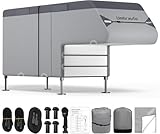
- All-Weather Shield: Our truck camper cover boasts a sturdy 7-ply top, guarding against rain, snow, dirt, and scratches, ensuring year-round protection for your camper/RV
- Durable Waterproof Ripstop Anti-UV RV cover for truck campers offers enhanced tear-proof protection for slide-in campers with its 7-ply non-woven fabric, UV-proof composite, and waterproof membrane
- Windproof Design: 1 windproof strap & buckles at the end, 2 bottom straps prevent cover from blowing away. Reinforced elasticized hem corners ensure snug fit for your pickup camper
- Accessible & Portable: Rollable zippered door on both sides allows easy access to RV doors, while the included storage bag ensures portability and convenience for your cabover camper cover
- Abundant Accessories: Includes Slide in camper cover, storage bag, adhesive repair patches, weighted toss puck, extra wind ropes, and gutter covers for comprehensive protection and convenience
| Axis | What to record | What a shortfall looks like |
|---|---|---|
| Truck carrying capacity | Posted payload or cargo information and GVWR for the exact configuration, adjusted for the truck’s measured weight and options | Remaining capacity smaller than the loaded camper weight, even if the truck class sounds suitable |
| Axle and running gear | Front and rear GAWR, plus tire and wheel load ratings | Rear axle or tires near their limit with a fully loaded camper, even when the total is within GVWR |
| Loaded camper weight | Dry weight plus options, fluids, occupants, and cargo | Total based on dry weight only, which understates the real load |
| Physical fit | Bed length and width, and any other clearances the camper maker specifies | A camper that is too long, too wide, or incompatible with the bed’s tie-down or rail layout |
| Center of gravity | The camper’s specified center of gravity relative to the truck’s rear axle, and the manufacturer limits for placement | A placement outside the stated limits for that truck |
| Configuration and use | Cab, drivetrain, SRW or DRW, truck class, intended terrain, towing needs, passenger space, and the reserve capacity you want | A setup that works on paper but leaves no room for the trips you actually take |
Record a reserve margin deliberately. The loaded weight should sit inside the remaining capacity with room to spare, because weight tends to grow as gear accumulates over time.
What’s actually slowing this PC down?
Pick the symptom - the matching free tool is one click away.
Statistics and benchmarks to avoid
There is no reliable, current industry statistic that tells you what share of trucks can carry a given camper, or what a typical truck’s payload is. Dated survey proportions and older maximum payload figures can look authoritative, but they describe past configurations and do not apply to your truck. Use the posted information for your truck and the specification for your camper instead.
Common mistakes and how to recover
- You bought the camper before checking the truck. Stop the purchase, weigh the truck, and calculate the loaded camper weight before you accept a delivery. If the combination does not fit, a dealer may be able to help you evaluate a different truck configuration.
- You are relying on a dry weight. Redo the calculation using the travel-ready list above, including fluids, batteries, and gear.
- You checked GVWR but not the rear axle. Compare the scale ticket’s axle weights with the rear GAWR and the rear tire load ratings.
- You are using a model-year source for a different year. Ford’s 2025 guidance applies to 2025 vehicles. Check the documents for your truck’s model year, cab, and drivetrain.
Checking the truck and camper in this order keeps the decision grounded in the specific vehicle and camper you will use, rather than in labels or marketing figures.
Quick Recap
Product prices and availability are accurate as of the date/time indicated and are subject to change. Any price and availability information displayed on Amazon at the time of purchase will apply.

