
iTechGuides is reader-supported. When you buy through links on our site, we may earn an affiliate commission. As an Amazon Associate I earn from qualifying purchases. Learn more
A workable student IoT project is a short loop: a sensor reads something, a controller processes it, a network carries the data to a dashboard or local display, and, in some builds, an actuator acts on the result. The ideas below are grouped by problem area and difficulty. For each one, the article names the input, controller, communication path, and output so you can judge whether it fits your hardware, timeline, and demonstration space. They are project concepts drawn from manufacturer roundups and student idea lists, not tested build instructions.
Choose the project before you choose the hardware
Most student IoT projects fail for reasons that have nothing to do with the code: the sensor does not match the question, the room has no reliable Wi-Fi, or the demonstration cannot show a clear result within the available time. Before you pick an idea, answer these questions:
- What problem am I solving, and does the build observe, alert, automate, or control?
- Which sensor am I planning to use, and what hardware do I already have?
- Am I building a mini project or a final-year project?
- What data will I collect, and does the system only display it or automatically act on it?
- What will I demonstrate, and can it be shown clearly in the room, lab, or schedule I have?
The same decision can be framed along five practical axes. The table shows the low-effort and high-effort ends of each.
| Axis | Lower effort | Higher effort |
|---|---|---|
| Problem and outcome | Observe a value and show it | Alert, automate, or control a device |
| Difficulty and skills | One sensor, basic Wi-Fi and dashboard work | Multiple sensors, relays, analytics, APIs, system architecture |
| Hardware on hand | A single board that already has wireless connectivity | Several boards, extra sensors, separate power and enclosure needs |
| Data and communications | Local readings with occasional sampling | Frequent sampling, cloud dependency, several networked devices |
| Demonstration reliability | A result you can show on a laptop in a minute | A physical actuator or outdoor setup that depends on conditions |
Use the same architecture for every idea: sensor or input, then controller and processing, then communication, then a dashboard or local output, then an optional alert or actuator. Build the smallest working version first, and add features only when they help answer the engineering question you started with.
#1 Best Overall

- 35+ Guided Electronics Projects: Progress from LEDs and buttons to RFID access, real-time clocks, motion and distance sensing, environmental monitoring, motor control and interactive displays for STEM learning, coding clubs and maker projects
- More I/O and Memory for Larger Builds: The MEGA 2560 R3 provides 54 digital I/O pins, including 15 PWM outputs, 16 analog inputs, 4 hardware serial ports and 256 KB flash for projects that combine more sensors, controls and displays
- 200+ Components for Prototyping: Includes LCD1602, RC522 RFID, RTC, DHT11, HC-SR501 PIR, ultrasonic and water-level sensors, GY-521, MAX7219, keypad, joystick, rotary encoder, relay, SG90 servo, stepper motor, DC motor, breadboard and more
- Learn, Modify and Create: Follow 35+ guided lessons with example code, then adjust sensor thresholds, timing, display text, motor behavior and control logic to turn structured exercises into access systems, monitors, alarms and interactive projects
- Organized for Repeatable Learning: Pre-soldered modules, a solderless breadboard, storage case and small-parts box reduce setup time and keep sensors, LEDs, ICs, wires and other components easy to find between projects
Beginner projects
Environmental monitoring with a Pico W
Collect temperature, humidity, pressure, or other local readings and display them on a cloud dashboard that can be opened from another device. Raspberry Pi’s March 2, 2026 roundup of Raspberry Pi Pico projects describes this kind of setup with a Pico W. It is a good first project because it has one clear output, a visible result, and a small number of moving parts.
Single-sensor monitors
A student idea list published on DEV Community groups temperature, light, motion, and water-level monitoring as beginner ideas. Each one needs one sensor, a controller, and a local readout or threshold alert. The DEV Community article is useful for phrasing and idea variety, but it is a community post rather than an independent test of any build.
Intermediate projects
Smart irrigation and plant care
Monitor soil moisture and trigger an alert or a watering action. Raspberry Pi’s roundup describes a Pico W with a grow kit that sends a text message when soil is too dry. A separate example in the same roundup uses a relay to switch on a pump for self-watering. Both are publisher examples; the roundup does not present them as tested instructions for your soil, pump, or power supply.
Free tools Windows power users keep installed
One-click scans. No signup required.
Rank #2

- TURN CODE INTO REAL-WORLD RESULTS — Follow 22+ guided lessons to make LEDs blink, read temperature and distance, move servo and stepper motors, control an LCD and respond to joystick or IR input; ideal for a family weekend build, homeschool unit, coding club or STEM classroom
- MORE PROJECT VARIETY IN ONE ORGANIZED KIT — Includes the UNO R3 controller, LCD1602 with pre-soldered header, breadboard power module, ultrasonic and DHT11 sensors, joystick, IR receiver and remote, SG90 servo, stepper motor, relay, DC motor, fan blade, displays, LEDs, buttons, resistors and jumper wires
- START WITHOUT SOLDERING — Plug-in modules, a solderless breadboard and the pre-soldered LCD help beginners focus on wiring, code and testing; the illustrated component list makes it easier to find each part and move from one lesson to the next
- LEARN THE LOGIC, THEN CREATE YOUR OWN — Use Arduino IDE and the included example code to understand digital input and output, analog sensing, timing, motor control and display functions, then change thresholds, speeds and sequences for alarms, environmental monitors, reaction games and motion projects
- CLEAR SETUP SUPPORT FOR FIRST-TIME BUILDERS — Download the latest tutorial and code, select the UNO board and correct computer port, check component polarity and breadboard rows, and keep power-module input at 9V or below; younger learners should work with an experienced adult
Home and classroom automation
Arduino Education names a home-security alarm and a classroom counter as examples of connected objects for students. The overview does not specify the sensor, the controller, or the implementation, so those are choices you make. A motion sensor feeding an alarm, or a beam or button counter feeding a display, are common ways to scope the idea. Confirm the sensor interface and power requirements before you commit.
Parking, fan control, and weather monitoring
The DEV Community student list places parking detection, fan control, and weather monitoring in the intermediate tier. These are idea categories rather than specifications. A parking project, for example, might use distance or occupancy sensing with a status display, but the list does not establish which sensors or services would suit a given lot.
Advanced projects
Urban farming devices
Arduino Education names an urban-farming device as an example for advanced college students. Arduino does not publish a build specification for it in the overview. A reasonable adaptation is a soil-moisture monitor with an irrigation controller, which combines the sensing from the irrigation idea with a valve or pump that needs careful power and water-handling design.
Rank #3
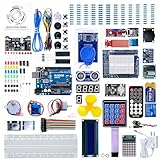
- 30+ Guided Electronics Projects: Start with LEDs and build toward LCD1602 displays, RFID access, motion detection, distance sensing, motor control and environmental monitoring for STEM learning, coding clubs, classrooms and hobby projects
- 200+ Components Across 63 Types: Includes an ELEGOO UNO R3 controller, LCD1602, RC522 RFID, RTC, HC-SR501 PIR sensor, ultrasonic sensor, DHT11, GY-521, MAX7219, keypad, joystick, relay, SG90 servo, stepper motor, breadboard and more
- Begin Without Soldering: Pre-soldered modules, a solderless breadboard, organized storage case and small-parts box reduce setup time and help beginners move from lesson to lesson while keeping LEDs, ICs, wires and sensors easy to find
- Learn, Modify and Create: Program the ELEGOO UNO R3 board with Arduino IDE using the included PDF tutorial and example code, then adjust sensor thresholds, timing, display text and motor behavior to turn guided lessons into original projects
- Flexible Power and Project Setup: Includes a 9 V, 1 A power supply, breadboard power module, 9 V battery and USB cable to support controller, breadboard and module experiments without sourcing basic setup accessories separately
Energy monitoring
The student list places energy monitoring at the advanced level. A practical scope is one circuit or one appliance, logged over time and shown on a dashboard. Metering mains-voltage circuits raises electrical-safety issues that a low-voltage sensor project does not, so treat that part of the design as a separate engineering decision.
Quick wins for a faster PC:
Repair Windows errors before they cause bigger problemsFix Now →Fix the driver behind crashes, sound loss and screen glitchesFind Drivers →Industrial machine monitoring and predictive maintenance
Monitoring a motor or machine for vibration, temperature, or runtime, and flagging unusual patterns, is listed as an advanced category. These projects depend on sampling rates and enough historical data to make any alert meaningful. Narrowing the scope to one machine and one measured quantity keeps the build demonstrable.
AIoT and multi-device systems
Adding analytics to sensor data, or coordinating several networked devices, is the top tier of the list. These projects introduce architecture decisions such as where processing happens, how devices identify themselves, and what happens when one node goes offline. Build the single-device version first and document how the second device would plug in.
Rank #4

- All-in-One Starter Kit for Beginners: Part of the Powered by Arduino program, this kit includes an original Arduino UNO R4 WiFi, 300+ high-quality components, 50+ hands-on projects (30 basic, 13 fun, and 8 IoT), and 100+ free video lessons co-created with renowned educator Paul McWhorter. Designed for beginners ages 8+, it provides a complete, step-by-step path to learn Arduino, electronics, coding, and IoT. RoHS compliant for added safety and quality, it also makes a thoughtful gift for tech enthusiasts, students, and aspiring makers for birthdays, holidays, and special occasions
- Powerful Arduino Uno R4 WiFi Board: Upgraded from the Arduino Uno R3, the Arduino Uno R4 WiFi features a 32-bit processor, more memory, and built-in WiFi and Bluetooth, enabling connection to third-party apps for more interactive and practical projects.
- 300+ Components for Endless Possibilities: With 300+ components and sensors, this kit is perfect for portable projects. It features step-by-step tutorials, open-source code, and compatibility with other Arduino boards like Uno R3 and Nano, offering endless customization and learning opportunities.
- Engaging Projects for Every Skill Level: Featuring 50 projects (30 basic, 13 fun, 8 IoT) with IoT app integration like Arduino IoT Cloud , this kit supports Arduino C++ programming, making it perfect for students, teachers, and engineers to learn, code, and create at any skill level.
- Dedicated Support for Beginners: Alongside online resources and video tutorials, SunFounder provides technical support and troubleshooting forums to help beginners solve programming challenges with ease.
Side-by-side summary of the main ideas
The table compares the concept families by the elements that matter most for planning. Where the cited overview does not name a component, the cell says so.
| Project family | Level in cited source | Input or sensor | Controller | Communication path | Output or decision |
|---|---|---|---|---|---|
| Environmental monitor | Beginner (Raspberry Pi roundup, March 2, 2026) | Temperature, humidity, pressure | Raspberry Pi Pico W | Wireless link to a cloud dashboard | Dashboard view on another device |
| Soil-moisture alert | Intermediate (student idea list) | Soil moisture sensor | Raspberry Pi Pico W with grow kit | Text message alert | Alert when soil is too dry |
| Self-watering pump | Intermediate (student idea list) | Soil moisture sensor | Not stated in the Raspberry Pi roundup | Not stated in the Raspberry Pi roundup | Relay switches a pump |
| Home-security alarm or classroom counter | Named as student examples (Arduino Education overview) | Not stated in the Arduino Education overview | Not stated in the Arduino Education overview | Not stated in the Arduino Education overview | Alarm or count display |
| Urban-farming device | Advanced college students (Arduino Education overview) | Soil moisture (adaptation) | Not stated in the Arduino Education overview | Not stated in the Arduino Education overview | Irrigation control (adaptation) |
| Energy monitoring | Advanced (student idea list) | Not stated in the student idea list | Not stated in the student idea list | Not stated in the student idea list | Usage display or analysis |
Hardware and learning options
Arduino Explore IoT Kit Rev2
The Explore IoT Kit Rev2 is a student-oriented physical option. Arduino’s product listing includes an MKR WiFi 1010, an MKR IoT Carrier Rev2, and sensing for temperature, humidity, pressure, VOC, ambient light, color, gesture, acceleration, moisture, and PIR motion. The carrier also includes two 24V relays, LEDs, a display, a buzzer, a battery holder, and an enclosure. The learning content uses Arduino Web Editor, Arduino IoT Cloud, and the IoT Cloud Remote app. Check the current contents and compatibility on the official listing before you buy.
The Tool Desk
Outbyte Driver Updater FREEScan for outdated or missing drivers - takes under a minuteDriver Scan →Outbyte PC Repair FREEClear out junk files and repair common Windows errorsFree Scan →Arduino describes the learning goal as “using real-world sensors to capture meaningful data from the environment and modify it by remotely controlling actuators such as LEDs, buzzers, displays, through the Cloud.” That wording is from the Explore IoT Kit Rev2 product page.
Best Value
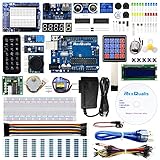
- The most economical kit comes with everything compatible with Arduino to starting programming for beginners .
- This is the upgraded starter kits come with a 9V 1A Power Adapter (At least $5.99 on amazon) to replace a 9V Battery , and the Lcd1602 module come with pin header(not need to be soldered by yourself).
- Include High Quality Base Board base on Arduino UNO R3 compatible with Arduino IED and Sensors, Servo, Motor, ULN2003 driver board, lcds, etc.
- Free PDF Tutorial and Datasheet are available to download from our official website or you can contact our customer service.
- All of the Components and Integrated Circuits are individually packaged and labeled, and packing in a plastic box which is bigger enough for you.
Arduino’s undated product page, accessed in 2026, estimates that its ten expanded, step-by-step projects take 15–25 hours. That figure is the vendor’s own estimate, not an independent measurement. The page says the kit suits groups of two or three and also works for an individual. It recommends basic programming and sensor experience, with extra activities for beginners.
The kit and the Arduino Cloud for Education School Plan are separate. The School Plan adds full content access and classroom management features, and Arduino describes it as paid per member. The official education overview is at Explore Arduino Education.
Raspberry Pi Pico W and Pico 2 W
For a lower-level microcontroller route, Raspberry Pi’s roundup covers Pico W and Pico 2 W projects. Model variants differ in processing power and wireless connectivity, so confirm which board you have before following any example. A bare board does not make a project turnkey: sensors, power, enclosures, and online services are separate choices that vary by project.
Recommended Free Tools
What these sources do not establish
- Exact cost. Kit prices, cloud plan prices, and sensor costs are not established here.
- Compatibility. Whether a sensor, relay, or cloud service works with a given board depends on the specific design.
- Radio rules. Wireless use is subject to regional regulations that the cited sources do not address.
- Electrical safety. Relays driving pumps or mains-voltage loads need their own design review.
- Completion time. The 15–25 hour figure is Arduino’s vendor estimate for its own kit projects, not a measurement for other builds.
- Popularity or job demand. None of the cited sources provide independent statistics on how common these projects are or how they affect careers.
The project ideas on this page are starting points for scoping. Treat any published example as a concept to validate on your own hardware.
Quick Recap
Product prices and availability are accurate as of the date/time indicated and are subject to change. Any price and availability information displayed on Amazon at the time of purchase will apply.

