
iTechGuides is reader-supported. When you buy through links on our site, we may earn an affiliate commission. As an Amazon Associate I earn from qualifying purchases. Learn more
An “embedded ID chip” usually means an RFID tag or transponder built into, attached to, or placed inside an object. It communicates an identifier to a compatible reader using radio waves. The phrase is descriptive, not a precise technical term: not every embedded chip is RFID, and RFID tags and readers are not universally interchangeable.
What is an embedded ID chip?
In many everyday contexts, an embedded ID chip is the identifying component of an RFID system. The tag or transponder combines a chip with an antenna arrangement so it can communicate with a reader. Depending on the system, it may provide a serial number alone or carry additional data; an identifier may also be used to look up a separate record in a database.
“Embedded” describes where the component is placed, not a specific technology. A chip may be integrated into a product label, attached to an item, or implanted for animal identification. The wording alone does not establish its radio frequency, protocol, data contents, or intended use.
How does an RFID chip work?
An RFID system has two basic parts: a tag and a reader. The reader emits radio waves, and a compatible tag responds. The tag’s antenna enables that radio communication. The FDA describes RFID in terms of this reader-and-tag exchange: Radio Frequency Identification (RFID).
#1 Best Overall
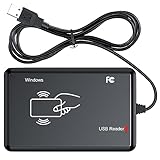
- RFID Reader Scanner read both 125KHz/13.56Mhz 1326 family ISO Prox whole family cards & EM ID EM4100 cards together, MF S50 S70 bank card and other 14443A protocol labels that support ISO14443-A/B protocol, ID card and other 14443B protocol labelsHID USB device no driver request.
- 125KHz/13.56Mhz Dual-frequency RFID reader supports EM4100 ID cards and also 1326 1346 1386 ISO Prox card, H10301 H10304 format etc.
- RFID Reader with 40 output formats for EM4100 ID card UID, max. 40 bits card number in 10H or 13 digital decimal format, configurable with config card by user.
- Proximity card reader sends 125KHz/13.56Mhz Dual-frequency proximity card 1326 family card number in 40 type formats or in raw wiegand bit data format, from 24 bit to 80 bits data, easy for understanding 1326 family card type.
- USB Inteface,Card reader only, Open the software or document that needs to be read,simulate keyboard input, works in Linux Andriod Windows Mac IOS.
Passive and active tags
- Passive tags have no battery for the communication described here; they rely on energy from the reader’s field to respond.
- Active tags have a battery. Their power source and system design differ from those of passive tags.
Some low-frequency devices use a single coil connected to the chip as both the power supply and the bidirectional communication interface. In that particular architecture, the antenna and chip together form the transponder; it is not a universal description of every RFID system. Microchip’s RFID product information describes its low-frequency transponders as operating in the 100–150 kHz range, with certain applications at 125 kHz or 134 kHz. Those specifications apply to the described products and applications, not to RFID as a whole.
Can a chip be read without touching it?
Yes. RFID uses radio communication, so a reader can identify a compatible tag without physically touching it. The reading conditions and range depend on the tag, reader, frequency, protocol, environment, and system setup; “read remotely” does not mean every reader can detect every tag from any distance.
Rank #2
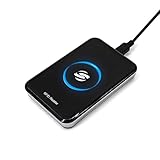
- New Metal Case RFID Reader Durable, Beautiful and More Accurate Reading.Note: 1. Not compatible with Mac, need to use with USB converter. 2. Windows system if you can not use, you need to install a patch in Windows: VCRedist 2008 SP1 (x64). 3. H10301, 8310 card does not support reading, setup tools, please go to the last link to download, thanks!
- RFID Reader Scanner read both 125KHz/13.56Mhz 1326 family ISO Prox whole family cards & EM ID EM4100 cards together, MF S50 S70 bank card and other 14443A protocol labels that support ISO14443-A/B protocol, ID card and other 14443B protocol labelsHID USB device no driver request.
- RFID Reader with 40 output formats for EM4100 ID card UID, max. 40 bits card number in 10H or 13 digital decimal format, configurable with config card by user.
- Proximity card reader sends 125KHz/13.56Mhz Dual-frequency proximity card 1326 family card number in 40 type formats or in raw wiegand bit data format, from 24 bit to 80 bits data, easy for understanding 1326 family card type.
- USB Inteface,Card reader only, Open the software or document that needs to be read,simulate keyboard input, works in Linux Andriod Windows Mac IOS.
What is the difference between a tag and a reader?
- Tag or transponder: the component associated with the item being identified. It contains a chip and antenna arrangement and responds to a compatible reader.
- Reader: the device that emits radio waves and receives a response from the tag.
A reader must be compatible with the tag’s specifications. A tag’s identifier is also not necessarily the same thing as the data associated with it: ISO/IEC 15963 covers numbering systems for unique RF tag identification and distinguishes an RF tag unique identifier from a permanent identifier of the integrated circuit. ISO/IEC 15963-3:2019 was reviewed and confirmed in 2024.
Do these 3 things before closing this tab:
1Repair Windows errors before they cause bigger problems2Fix the driver behind crashes, sound loss and screen glitches3Clear out junk files and repair common Windows errorsWhere are embedded RFID ID chips used?
RFID can identify objects, animals, or people, but each application may use different frequencies, protocols, standards, and controls.
Rank #3

- RFID Reader read both 125KHz 1326 family ISO Prox whole family cards & ID 4100 RF/64 RF/32 cards together, USB device no driver request.
- 125KHz RFID reader supports 4100 ID cards and also 1326 1346 1386 ISO Prox card, 10301 10304 format etc.
- RFID Reader with 40 output formats for ID card UID, max. 40 bits card number in 10H or 13 digital decimal format, configurable with config card by user.
- Proximity card reader sends 125KHz proximity card 1326 family card number in 40 type formats or in raw wiegand bit data format, from 24 bit to 80 bits data, easy for understanding 1326 family card type
- Advanced config process allow user to choice 20 clients format output and set prefix/suffix, ingore leading zero. This is read only. If you want to write card with ID/FC number, you may go ASIN:B0BCYRSLSF
- Products and supply chains: RFID can support product identification, traceability, anti-counterfeiting, and smart labels. The EUIPO technology guide describes these uses. For supply-chain applications, ISO/IEC 17360:2023 covers RFID tagging of products, packaging, transport units, and returnable transport or packaging items.
- Asset management, access, and payment: NIST lists asset management, tracking, access control, and automated payment among RFID applications. These uses do not necessarily share a tag or reader design. NIST’s RFID security guide was published in 2007 and updated in 2017, so it is foundational context rather than a current assessment of every application.
- Animal identification: Animal-ID products may follow specific standards. Microchip’s product information identifies ISO 11784/11785 modes for its animal-identification products; that does not make those products interchangeable with other RFID tags or readers.
What should you check before choosing or identifying a chip?
The phrase “embedded ID chip” does not tell you whether a particular tag will work with a particular reader. Check the system details that determine compatibility and what the system actually identifies:
- Use and environment: An animal-identification transponder, access credential, and supply-chain label serve different purposes.
- Frequency and protocol: The reader and tag need compatible radio specifications and air-interface protocols.
- Power type: Confirm whether the tag is passive or battery-powered.
- Identity and data: Determine whether the tag sends an identifier, additional stored data, or a key used to retrieve information elsewhere.
- Applicable standard: A standard may define identification, data, performance, or reuse expectations for a particular application.
- Reader and system controls: Consider who can read the tag, what a reader can access, and how the wider system protects the information.
Does an embedded ID chip track location?
Identification is not the same as continuous location tracking. An RFID reader can identify a tag when the system reads it, and connected readers may support monitoring. A passive identification transponder is not GPS: continuous location reporting would require a separate powered location system. What can be inferred about movement depends on where readers are installed and how the wider system uses their readings.
Rank #4

- 【Instant Plug & Play Setup】: No external power supply or battery needed. Simply connect the contactless card reader to your computer’s USB port, and it’s ready to use instantly—no complicated setup, and no additional software or drivers required, saving your time on installation.
- 【Lightning-Fast Performance】:Boost your efficiency with a high-speed response time of less than 0.2s. This 125kHz reader offers a stable reading distance of up to 8cm (depending on the tag type used), ensuring quick and reliable data capture without the frustration of repeated swipes.
- 【Universal OS Compatibility】:Designed for seamless integration across all your devices. This contactless reader fully supports Windows, Mac OS, Linux, Chrome OS, and Android 7.0+. Whether you're using a PC, laptop, or tablet, it provides consistent performance across multiple platforms.
- 【Standardized Data Output】:Specifically engineered for EM4100, EM4200, and TK4100 cards/tags. It automatically outputs the first 10 digits in a standardized format, making it perfect for office attendance, library management, and inventory tracking without manual entry errors.
- 【Standardized & Customizable Output】:Specifically engineered for EM4100, EM4200, and TK4100 cards/tags. By default, it automatically outputs the first 10 digits, making it perfect for office attendance and inventory tracking. Need a different format? Use our exclusive configuration tool to customize data output (such as 8-digit HEX, reversed formats, or adding a suffix like "Enter"), Setting tool is compatible with Windows system Only.
What are the privacy and security considerations?
Because RFID supports remote reading, the information a tag exposes and the people or systems able to read it matter. Risks and appropriate controls vary with the tag, reader, data, application, and deployment; the existence of a chip alone does not establish what information is accessible or how it is protected. NIST’s overview discusses RFID security and privacy across differing system designs, but its 2007 publication and 2017 update should not be treated as an application-specific current threat assessment: NIST SP 800-98.
The Tool Desk
Outbyte Driver Updater FREEScan for outdated or missing drivers - takes under a minuteDriver Scan →Outbyte PC Repair FREERepair Windows errors before they cause bigger problemsFix Now →Quick Recap
Best Value

- . IC card USB reader, Send data to cursor location, HID USB no driver is requested
- . usb reader supports iso14443A protocol cards
- .Support 4 byte UID and 7 byte UID 13.56M card
- .Emualte USB keyboard output, so easy interfaced into RFID system without changing the original software or program, selectable 28 formats are suitable for most common system
- .Default setting is 8H 10D format, Send card data in 10 digital datas to focused window as an external input device
Product prices and availability are accurate as of the date/time indicated and are subject to change. Any price and availability information displayed on Amazon at the time of purchase will apply.

