
What’s actually slowing this PC down?
Pick the symptom - the matching free tool is one click away.
iTechGuides is reader-supported. When you buy through links on our site, we may earn an affiliate commission. As an Amazon Associate I earn from qualifying purchases. Learn more
Many moored buoys do have anchors, or another fixed attachment on the seabed. A floating buoy stays at the surface, while a line or chain connects it to that bottom fixture and keeps it from drifting away. The arrangement varies with the buoy’s purpose, water depth, currents, and seabed—and the buoy may still move within a limited area.
How does a moored buoy stay in place?
A buoy floats because it displaces water. Beneath it, a mooring line, chain, or combination of materials connects the float to an anchor or other fixed seabed attachment. That connection transfers forces from the buoy to the bottom fixture, which restrains the system.
A typical mooring can include a surface float, line or chain, and anchor, with hardware such as swivels or ballast. For example, NOAA’s Chesapeake Bay Interpretive Buoy System describes a single-point mooring with ballast, swivels, chain, and a pyramid-style steel anchor. Its chain is approximately 2.5 times the local water depth; that is a specification for this system, not a general sizing rule.
PC Slower Than It Used to Be?
A free scan shows the junk files, broken settings and background clutter dragging Windows down - then fixes them in one click.Free scan · Windows 10 & 11Outdated Drivers Are Slowing You Down
One free scan finds every outdated or missing driver and matches the right update for your exact hardware.Free scan · exact hardware matchDo all buoys have anchors?
No. “Buoy” describes many kinds of floating objects, and their arrangements depend on purpose and location. This explanation concerns moored buoys, such as some weather and navigation buoys, that are restrained by a seabed connection. It should not be taken to mean that every floating marker or buoy is anchored.
#1 Best Overall

- Versatile and Heavy Duty: our 4ft long 1/4 inch diameter anchor chain displays impressive strength; It is capable of withstanding harshest weather conditions and handling any anchoring situations; Additionally, its lightweight design ensures easy operation and compatibility with your anchor and leader; Your boating equipment just got a versatile and reliable into addition
- Quality and Durability: crafted from PVC-coated galvanized steel, our 4ft boat anchor chain boasts durability and strength; Its external PVC coating not only enhances its lifespan but reduces potential harm to your boat's hull during use; Be assured of longevity with our corrosion-resistant boat anchor chain
- Seamlessly Simple Installation: thanks to our anchor chain's rust-free stainless steel buckle, installation is a breeze; There is no need to stress over connect and disconnect processes or to acquire extra equipment, quick and proficient anchoring and link-up for your boat, offering you tranquility during your aquatic adventures
- Added Protection Guaranteed: we go the extra mile to ensure your boat is sufficiently protected; Our boat safety chain is not only galvanized but also coated with durable black PVC; This gives it an added layer of protection against potential scratches and rust, keeping your investment in top shape for longer periods
- Easy to Store: the coated anchor chain's design not only enables high adaptability but also makes storage a breeze; In addition to being an integral part of your boating gear, the 4 Ft PVC coated boat anchor chain, with its compactness and easy-to-handle nature, won't take up unnecessary space, allowing you to organize your equipment better
Why can an anchored buoy move?
A moored buoy does not necessarily remain directly above its anchor. Current, line length, and mooring design can let it move around a nominal position. The area in which it can move is called its watch circle.
Slack-line moorings
A slack line is longer than the water is deep, leaving room for the buoy to move as currents act on it. NOAA explains that this movement reduces strain that could otherwise break the line or shift the anchor. The watch circle is an intentional part of the design, not necessarily a sign that the mooring has failed.
Rank #2
- Grade 30 chain designed for anchoring applications
- Enhances holding power and abrasion resistance
- Size: 5/16 inch x 5 feet
- Work Load: 1,875 pounds
- Break Strength: 7,500 pounds
Taut-line moorings
A taut line is shorter than the water depth and remains stretched, helping keep the buoy closer to its nominal position. “Taut” does not mean perfectly stationary: NOAA lists a watch-circle radius of 1.25 km for its Ocean Station Papa deployment. That figure applies to that deployment, not to buoys generally.
Free tools Windows power users keep installed
One-click scans. No signup required.
What determines the anchor and mooring design?
There is no single anchor or line setup suitable for every site. Designers account for the seabed, water depth, currents, the buoy’s hull, and its intended use. NOAA describes smaller buoys in shallow water using all-chain moorings, while large deep-ocean buoys may use a combination of chain, nylon, and buoyant polypropylene.
Rank #3

- Grade 30 chain designed for anchoring applications
- Enhances holding power and abrasion resistance
- Size: ¼ inch x 4 feet
- Work Load: 1,250 pounds
- Break Strength: 5,000 pounds
Bottom conditions also matter. NOAA’s Florida Keys guidance describes pin, U-bolt, and Manta Ray anchors. In hard or rocky areas, one approach is to drill into the bottom and cement a stainless-steel pin in place. NOAA’s Mooring Buoy Guide distinguishes Halas, Manta-Ray, and traditional systems and explains that seabed characteristics inform the choice.
The guide describes the Halas system as a stainless-steel eyebolt cemented into a drilled hole and connected to a surface buoy by line. It avoids the heavy block and chain used in conventional systems, which can damage the seabed. This is an option developed for particular environments, not a universal solution.
Rank #4

- Versatile and Heavy Duty: our 4ft long 1/4 inch diameter anchor chain displays impressive strength; It is capable of withstanding harshest weather conditions and handling any anchoring situations; Additionally, its lightweight design ensures easy operation and compatibility with your anchor and leader; Your boating equipment just got a versatile and reliable into addition
- Quality and Durability: crafted from PVC-coated galvanized steel, our 4ft boat anchor chain boasts durability and strength; Its external PVC coating not only enhances its lifespan but reduces potential harm to your boat's hull during use; Be assured of longevity with our corrosion-resistant boat anchor chain
- Seamlessly Simple Installation: thanks to our anchor chain's rust-free stainless steel buckle, installation is a breeze; There is no need to stress over connect and disconnect processes or to acquire extra equipment, quick and proficient anchoring and link-up for your boat, offering you tranquility during your aquatic adventures
- Added Protection Guaranteed: we go the extra mile to ensure your boat is sufficiently protected; Our boat safety chain is not only galvanized but also coated with durable red PVC; This gives it an added layer of protection against potential scratches and rust, keeping your investment in top shape for longer periods
- Easy to Store: the coated anchor chain's design not only enables high adaptability but also makes storage a breeze; In addition to being an integral part of your boating gear, the 4 ft PVC-coated boat anchor chain, with its compactness and easy-to-handle nature, won't take up unnecessary space, allowing you to organize your equipment better
Do moorings need maintenance?
Yes. Lines, anchors, and associated hardware can require inspection, cleaning, or replacement. NOAA’s Florida Keys National Marine Sanctuary describes recurring inspections of its buoys, pickup lines, through-lines, down-lines, protective housing, and anchors. That is an example of one program’s maintenance practice, not a universal inspection schedule for all buoy installations.
Quick Recap
Best Value

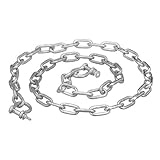
- ⚓Package includes 4FT boat anchor chain,2 shackle with lock rings; Note: item not include anchor;
- ⚓This item all parts made of marine grade 316 stainless steel,they can be used in fresh water and saltwater;
- ⚓Anchor chain OD is 5/16 inch(8mm), shackle OD is 3/8 inch,5/16″Chain Breaking Load :7600lbs ; 3/8″ Shackle Breaking Load:9200lbs;
- ⚓As our unique design on the shackle with a locking ring, the anchor will never be lost even if the bolt pin loose;
- ⚓The boat anchor lead chain function: it protects your anchor line from chafe caused at the seabed;keeping the angle of pull on your anchor parallel to the bottom.
Product prices and availability are accurate as of the date/time indicated and are subject to change. Any price and availability information displayed on Amazon at the time of purchase will apply.

