
iTechGuides is reader-supported. When you buy through links on our site, we may earn an affiliate commission. As an Amazon Associate I earn from qualifying purchases. Learn more
For a local basketball game, an operator-controlled electronic scoreboard is the closest fit: a scorekeeper enters points and other game information with buttons, and a separate display shows it. Before choosing parts, decide whether you need a full game scoreboard, a basic shot counter, or a screen for networked live scores—these are different projects with different controls and capabilities.
Choose the kind of scoreboard you need
Start with what the display must do and who will update it. A score-only counter is simpler in purpose than a system that also accepts clock or period changes. The documented projects below illustrate three distinct approaches; none establishes a universal, rules-compliant feature list.
| Build path | What it does | Documented components | Best fit |
|---|---|---|---|
| Operator-controlled game scoreboard | A scorekeeper enters scores and values such as the clock using a separate controller; a radio link sends information to the display, which includes a horn. | Controller: Arduino Mega 2560, LCD, button matrices and nRF24L01+ transmitter. Display: Arduino Uno, matching nRF24L01+ receiver, WS2812B LEDs and horn. | A local game where a person needs to control the displayed information. |
| Automatic shot counter | An IR obstacle-avoidance sensor detects an event and an Arduino-based project updates a four-digit display. | Arduino board, IR obstacle-avoidance sensor and TM1637 four-digit display; the documentation also lists a USB-C cable, breadboard and wires. | A basic counter or learning project, not a documented full game-management system. |
| Networked live-score display | A Raspberry Pi drives a matrix display for live sports scores and related information. | HUB75 32×64 RGB matrix, Pi Zero 2 W or Pi 3/4, Adafruit RGB Matrix Bonnet or RGB Matrix HAT plus RTC, and an appropriate power supply. | Showing networked sports information rather than controlling a local game. |
The component lists and project descriptions come from the Arduino scoreboard project, SunFounder’s counter project and its Basketball Game 1.0 documentation, and the Raspberry Pi sports scoreboard repository.
PC Slower Than It Used to Be?
A free scan shows the junk files, broken settings and background clutter dragging Windows down - then fixes them in one click.Free scan · Windows 10 & 11Crashes, No Sound, or Screen Glitches?
Random freezes, missing sound and display glitches usually trace back to one bad driver. Find and replace yours safely.Free scan · under a minuteHow the full game-scoreboard design works
Separate controller and display
In the Arduino build, the operator uses button matrices on a controller based on an Arduino Mega 2560, with an LCD for feedback. An nRF24L01+ transmitter sends information to a display unit built around an Arduino Uno and a matching receiver. The display uses WS2812B LEDs and has a horn. This separation lets the scorekeeper operate the system without entering information directly at the display.
#1 Best Overall
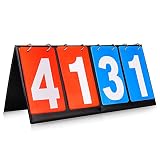
- Material: PU+ membrane paper; Color: red and blue
- Size: 14.2inch*6.1inch.
- Function: Scoreboard with number cards that can keep scores from 1 to 99. Different color of red and blue make it easy to distinguish the scores of different groups.
- Suitable for: Suitable for indoor and outdoor games, such as volleyball, basketball, table tennis and any competitive sport.
- Easy to use: The flip design easy to use. No need to write numbers on the scoreboards, just flip the number card will be OK.,its very convenience.
The project describes controls for home and guest scores and for entering values such as the clock. It does not establish that the system covers every feature a particular league requires. Decide separately whether you need period, team indicators, fouls, possession, or other information, then confirm that your chosen design and software can handle it.
Why this project uses WS2812B LEDs
The maker’s project account says he changed from hundreds of individual LEDs to a WS2812B LED string to reduce wiring complexity and enable colors and animations. That is the rationale for this particular build, not proof that addressable LEDs are always cheaper, easier to wire, or appropriate for every scoreboard.
Rank #2
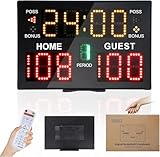
- 【Convenient Wireless Remote Operation】This digital scoreboard with remote offers quick and easy score control, making it an efficient electronic score keeper for all kinds of sports and athletic events.
- 【Compact Portable Design for Any Venue】Lightweight and easy to move, this portable scoreboard fits courts, gyms and outdoor facilities. A space-saving score board for daily training and competitions.
- 【Bright LED Screen for Clear Viewing】 High-brightness LED display ensures sharp and easy reading in all environments. This digital score board performs well for both indoor use and outdoor sports activities.
- 【Battery Powered for Cordless Use】This outdoor scoreboard runs on battery power for flexible placement without power outlets (Batteries are NOT included). Provides stable and reliable performance for long hours of sports use.
- 【Wide Compatibility for Multi-Sport Use】Functions well as a basketball scoreboard and supports various competitive sports. A practical score keeper for clubs, training sessions and indoor outdoor sports events.
What to decide before buying parts
Display the information your game actually uses
Write down the required fields before choosing a controller or display. A simple score display and a scoreboard that also accepts clock and period changes have different control needs. The available project descriptions do not provide a definitive regulation checklist, so check the rules for your league rather than assuming a maker project is competition-approved.
What’s actually slowing this PC down?
Pick the symptom - the matching free tool is one click away.
Choose manual entry or automatic detection
A scorekeeper-operated system and a sensor counter solve different problems. Manual controls let an operator enter game information; SunFounder’s IR sensor project is presented as a score counter. Its documentation does not establish support for a regulation game clock, team fouls, periods, possession, or a complete operator workflow. Do not treat the sensor counter as a substitute for a full game scoreboard unless you have independently confirmed the functions you need.
Rank #3

- MULTIFUNTIONAL: Time+Score+Period+Poss+Bonus. Our electronic scoreboard are designed for most competitional games, basketball, football, volleyball, baseball and etc.
- EASY TO USE: All functions can be operated easily with remote, 100ft super long control range.
- SIZE: 22.8”x13.7”x0.96” - 4.29 lb, super bright (5”+3”) LED lights.
- INSTALLATION: Put on table/ Wall mounted/ Tripod. All mounting accessories are included.
Match the display architecture to the installation
The Arduino project uses WS2812B LEDs for a custom scoreboard. The Raspberry Pi project uses a HUB75 RGB matrix for a networked information display. Compare the character layout you want, viewing distance, construction effort, controller support and power requirements before settling on either approach. The project sources do not establish tested brightness or viewing distance, so those details need to be verified for your intended setting.
Be realistic about setup and skills
SunFounder presents its counter as a sensor-and-display project. The Arduino scoreboard adds button matrices, a separate wireless controller and a custom LED display. The Raspberry Pi repository involves Linux command-line setup and matrix hardware. These differences help you judge what work is involved, but the sources do not provide a verified difficulty rating; choose a path that matches your electronics and software experience.
Rank #4

- Scoring & Timing - Keep track of the score(0-99) and the wins(0-9) for each side. There is also a countdown timer(99:59-00:00) and a count up timer(00:00-99:59), the time can be edited.
- Touchscreen Score Control – Effortless touchscreen to adjust home/away scores, easy for all ages to operate.
- Rechargeable & Long-lasting - Fast 3-hour charging for 24 hours use, wireless portable design for outdoor/indoor games.
- Bright & Loud - The scoreboard is bright enough to see even in the sunlight and the scoreboard beeps loud every time you adjust score so you get audible feedback on your changes.
- Portable & Durable - Mini lightweight size for easy carry and storage. Sturdy build for daily use. It works great for indoor or outdoor games.
Plan for where and how it will be used
Before ordering components, decide whether the scoreboard will be indoors or outdoors, how it will be mounted, how power will be routed, and whether it will be visible from the places that matter. The documented sources do not establish weatherproofing, safe outdoor operation, enclosure design or approval under league rules. Confirm those needs independently.
Parts and compatibility notes
- Arduino operator-controlled design: the documented architecture uses an Arduino Mega 2560 controller, LCD, button matrices, nRF24L01+ transmitter and receiver, Arduino Uno display controller, WS2812B LEDs and a horn. The Arduino article describes the project but does not provide a verified current-price bill of materials.
- SunFounder counter: the project page and documentation identify an Arduino board, IR obstacle-avoidance sensor and TM1637 four-digit display; the documentation also lists a USB-C cable, breadboard and wires. Follow the linked project documentation for its intended assembly and software rather than assuming its parts support a full scoreboard.
- Raspberry Pi live-score display: the repository lists a Pi Zero 2 W or Pi 3/4, HUB75 32×64 RGB matrix, an Adafruit RGB Matrix Bonnet or RGB Matrix HAT plus RTC, and an appropriate power supply. The repository says Pi 5 is unsupported in the version represented by its page. Compatibility can change, so check the repository’s current model support before choosing hardware.
These are separate designs, not interchangeable shopping lists. Before purchasing, check current board and display specifications, power requirements, wiring needs and software compatibility for the exact combination you plan to build.
Quick Recap
Best Value

- DESCRIPTION: Material: Wood. Size: Approx. 3.15 x 3.15 x 0.1 inch / 8 x 8 x 0.25 cm. Made of good natural wood , laser cut and polished.
- FEATURE: Wooden basketball shaped design hanging ornaments with ropes. Perfect for using as coasters, tags, party board, classroom board.
- USAGE: Each wood piece was well polished, blank wood slices are ready to be paint and write, you may stain, drill, curve and decorate them as you like.
- GREAT DECORATION: You can just used them for decorate your parties, dances, ceremonies or any special occasion. These charming ornaments will surely add festive atmosphere to your birthday, wedding party, Christmas party.
- APPLICATION: These basketball wood decor are also ideal for hangers, card making, embellishments, scrap booking, decoupage, sign making and many other art and craft projects. They also will be good props for house embellishments and they will be the best thing for Children.
Sources and project details
- Arduino Blog: “This DIY basketball scoreboard looks and sounds like the real thing” — published July 3, 2022; describes the operator-controlled scoreboard and its components.
- SunFounder: Arduino Basketball Score Counter with IR Sensor V1 — project page for the sensor-based counter.
- SunFounder documentation: Basketball Game 1.0 — project parts and lesson documentation.
- GitHub: gidger/rpi-led-sports-scoreboard — hardware list and setup notes for the networked display.
Product prices and availability are accurate as of the date/time indicated and are subject to change. Any price and availability information displayed on Amazon at the time of purchase will apply.

