
iTechGuides is reader-supported. When you buy through links on our site, we may earn an affiliate commission. As an Amazon Associate I earn from qualifying purchases. Learn more
A desktop AI agent is not automatically “just a CLI in a wrapper”—and a polished desktop window does not prove that its actions are safely contained. Electron describes how an app builds its interface and manages desktop features; the agent’s actual permissions depend on a separate execution harness, operating-system controls, and the mode you are using.
What Electron tells you—and what it doesn’t
In an Electron app, a main process manages the app lifecycle, windows, and operating-system features. A BrowserWindow displays web-based content in a renderer process. Electron recommends renderer sandboxing and context isolation, which limit how renderer code interacts with the system. Those controls concern the app’s interface processes; they do not, by themselves, establish what a separately launched agent command can read, change, or send over the network. Electron’s process model and security guidance describe these app-level protections.
That distinction is the useful part of the “Electron illusion” idea: packaging and presentation are not reliable evidence of an agent’s execution boundary. Some desktop surfaces may launch or coordinate a local command-line runtime, but that cannot be assumed for every product. A desktop app may also add workflow controls, orchestration, review tools, local integrations, or access to cloud tasks. Product-specific documentation or inspection is needed to establish its architecture.
Separate the interface from the execution boundary
There may be several layers between what you see and what actually runs. For example, a desktop interface can communicate with a model hosted remotely while a local tool runs commands against files on your computer. A cloud coding task can instead run on a provider-managed machine. The window alone does not tell you which machine holds the files or executes the task.
#1 Best Overall

- [INTEL POWERED CONTENT] - Built with a 8th Generation Hexa-Core Intel i5 and 32GB of DDR4 RAM; Modern, Windows 11 ready, with 4K support, Executive multitasking, media streaming and smooth, multi-tab web browsing; Perfect as an all-purpose multimedia computer; built for content creators; Plenty of RAM and Mass storage for photo and video editing powered by Intel HD 630
- [LATEST WIRELESS TECH] - This Dell Desktop Computer easily connects to the internet through the Built In WiFi / Bluetooth
- [SOLID STATE STORAGE] - This Dell Computer setup comes with an ultra-fast 1TB Solid State Drive (SSD); Setup as the primary boot device; Boot and load programs with lightning speed ; Additional expansion available
- [BUY & OWN WITH CONFIDENCE] - From the world's largest Microsoft Authorized Refurbisher; Quality Guarantee and Free Tech Support; Award-winning Customer Service; | Support Sustainable Business
- [MODERN HI-SPEED PORTS] - USB 3.0 (x4) | USB 2.0 (x4) | DisplayPort (x1) | HDMI Port (x1) | Audio Combo Jack (x1) | Audio Out (x1) | RJ-45 Ethernet (x1) | Internal SATA (x3)
OpenAI describes Codex as available through CLI, IDE, and desktop surfaces, with a conversation managed with a model in the cloud. Its Windows sandbox account describes commands launched with reduced permissions and constraints that propagate through the process tree, including filesystem and network restrictions. These are OpenAI’s descriptions of its documented Codex setup, not evidence that all desktop agents share that design. OpenAI’s Codex overview and account of its Windows sandbox distinguish the product surfaces from command execution controls.
Anthropic likewise documents OS-level restrictions for Claude Code’s bash tool, using Linux bubblewrap and macOS Seatbelt, with restrictions that cover scripts and subprocesses. Separately, its computer-use documentation says Claude interacts directly with desktop applications and that there is no sandbox between Claude and those applications. These are different execution modes, not interchangeable versions of one sandbox. Claude Code security documentation and computer-use guidance describe those distinctions.
Rank #2

- Model: Dell OptiPlex 7050 Small Form Factor (SFF)
- Processor: Intel Core i7-7700 3.60 GHz
- Memory: 32GB DDR4 Ram
- Storage: 1TB Solid State Drive (SSD) Fast Boot + Storage
- Operating System: Windows 11 Pro (64-bit)
Check these boundaries before trusting a desktop agent
Evaluate the controls for the mode you actually intend to use. A permission prompt, an OS-enforced sandbox, and a full-access mode do not offer the same guarantee.
| What to establish | Why it matters |
|---|---|
| Execution location: your computer, a managed cloud computer, or a hybrid | It identifies which machine runs commands and holds the working files. OpenAI says Codex Cloud tasks run on OpenAI-managed computers; remote access to a task on your own computer depends on that computer and its access settings. OpenAI’s Codex access guidance explains the distinction. |
| Filesystem scope: what the agent may read, write, or delete, and whether writable locations can be limited | This defines the potential impact of a mistaken action or hostile instruction. |
| Network egress: whether connections are blocked, proxied, allowlisted, or unrestricted | Network access affects whether data can leave the machine and which external services the agent can reach. |
| Child-process inheritance: whether shells, scripts, and subprocesses remain under the same restrictions | A limit applied only to the top-level tool may not constrain programs it starts. OpenAI and Anthropic describe process-tree or subprocess restrictions in their respective documented command scenarios. |
| Approval behavior: which actions prompt for approval, and what changes in autonomous or full-access modes | Prompts govern when a user is asked to intervene; they are not automatically equivalent to OS-level enforcement. |
| Computer-use access: whether the agent can see the screen or interact with apps, and which app permissions apply | Screen and GUI interaction are a separate access path from shell commands and their sandbox. |
| Interface and orchestration: whether you are using a terminal, IDE, desktop window, web client, or a combination—and which component controls local tools | These details help separate a user-facing surface from the components that communicate with a model or execute actions. |
What the comparison can—and cannot—establish
Official platform and vendor documentation can explain a particular implementation, but it is not a substitute for an independent security audit. The documented Codex and Claude Code controls show why it is important to ask how commands are constrained; they do not prove that an unnamed desktop application uses either implementation. Likewise, an Electron renderer sandbox is not evidence that an agent’s command runner is isolated.
Rank #3

- IMMERSIVE 24 INCH DISPLAY: Experience stunning clarity on a Full HD IPS screen with ultra-thin bezels, offering a 90% screen-to-body ratio that makes everything from spreadsheets to streaming come alive with vibrant colors and crisp details.
- POWERFUL INTEL PROCESSING: Tackle demanding tasks with ease thanks to the Intel processor and 16GB of high-speed memory, delivering smooth performance whether you're multitasking between applications or running productivity software.
- GENEROUS STORAGE: Store all your important files, photos, and programs with blazing-fast solid state drive technology that ensures quick boot times, rapid file access, and plenty of space for your digital life.
- ENHANCED PRIVACY AND COLLABORATION: Work confidently with the pop-up privacy camera that tucks away when not in use, plus dual microphones with noise reduction for crystal-clear video calls that keep you connected professionally.
- ECO-CONSCIOUS DESIGN: Feel good about your purchase with an EPEAT Gold registered and ENERGY STAR certified computer that combines premium performance with responsible environmental manufacturing practices.
There is no supported quantitative comparison here for performance or security between Electron desktop agents and CLI agents. Those outcomes depend on the product, platform, settings, and execution mode. To make a product-specific judgment, look for documentation that states where tasks run, which filesystem and network controls apply, whether restrictions follow subprocesses, and how GUI access is handled.
Quick Recap
Best Value

- Connectivity: Includes WiFi, Bluetooth, and LAN for wireless and wired connections
- Memory: Features 16GB DDR4 RAM for smooth multitasking and performance
- Storage: Combines 500GB SSD and 1TB HDD for ample storage space
- Graphics: Integrated Intel UHD Graphics 630 for crisp visuals and video playback
- Design: Sleek desktop tower with black color and slim profile for modern look
Rank #4
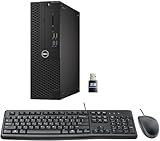
- This Certified Refurbished product is tested and certified to look and work like new. The refurbishing process includes functionality testing, basic cleaning, inspection, and repackaging. The product ships with all relevant accessories, a minimum 90-day warranty, and may arrive in a generic box. Only select sellers who maintain a high-performance bar may offer Certified Refurbished products on Amazon.com.
- Dell Optiplex 3050 SFF Desktop computer PC, Intel Quad Core i5-6500 up to 3.6GHz, 16GB DDR4, 256GB SSD
- Includes: USB Keyboard & Mouse, USB WiFi adapter, Microsoft office 30 days free trail.
- Port: Front: USB 3.0(2), USB 2.0(2); Rear: DP, HDMI, USB 3.0(2), USB 2.0(2), RJ-45.
- Support 4K (3840x2160) Dual display, makes it easy to connect two monitors at the same time, and you can expand working Windows, mirror content, or expand a single window across multiple monitors.
Product prices and availability are accurate as of the date/time indicated and are subject to change. Any price and availability information displayed on Amazon at the time of purchase will apply.

