
iTechGuides is reader-supported. When you buy through links on our site, we may earn an affiliate commission. As an Amazon Associate I earn from qualifying purchases. Learn more
Researchers have used deep-learning-guided design to create proteins that can shift between planned internal shapes. Unlike a static protein model, these designs aim to control motion within a protein domain—a subtle kind of switching found in nature that has been difficult to engineer from scratch.
How can a designer protein switch conformations?
A protein’s conformation is its three-dimensional shape. Some proteins naturally occupy more than one shape, and changing between those states can help them carry out a task or pass along a signal. Guo and colleagues’ 2025 study describes a general approach for designing proteins that change between specified geometries within a domain, rather than designing only one static structure.
The method is deep-learning-guided: computational predictions help guide the design of alternate conformations. The goal is not simply to make a protein fold into a plausible shape, but to create a protein with more than one intended shape and a controllable conformational landscape. The authors describe the work as a framework for constructing tunable protein signaling behavior in their paper in Science.
PC Slower Than It Used to Be?
A free scan shows the junk files, broken settings and background clutter dragging Windows down - then fixes them in one click.Free scan · Windows 10 & 11Outdated Drivers Are Slowing You Down
One free scan finds every outdated or missing driver and matches the right update for your exact hardware.Free scan · exact hardware matchWhat makes the protein switch?
Calcium in the troponin C-inspired example
A calcium-responsive example described by Chemistry World draws on the N-terminal domain of troponin C, a protein domain associated with muscle contraction. In that design, calcium binding favored one of the designed conformations. In other words, calcium acted as a ligand stimulus that shifted which state was favored; the example is not evidence that the engineered protein is itself a natural protein or a deployed biological sensor.
#1 Best Overall
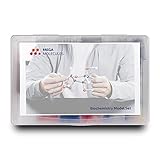
- Perfect for Visual Learners - This hands-on Biochemistry Model Kit is a tool that doesn’t just show you molecular structures; it lets you explore the magic of bonding, resonance, and chemical interactions like never before. It’s your key to understanding how molecular 3D structures influence chemical properties, such as in nucleotides and their base pairs, or in lipids and their hydrophobic behavior. You'll connect the dots between a compound's physical and chemical properties and its three-dimensional structure, deepening your understanding and making complex concepts intuitive.
- Versatile & Suitable for All Learning Levels - Whether you're a biochemistry student, an educator, or just passionate about molecular science, this model set will elevate your learning experience. It’s a powerful way to transform abstract molecular diagrams into tangible, interactive models you can touch, build, and explore. Get ready to turn curiosity into mastery—because biochemistry isn't just a subject, it's the science of life itself. With the Biochemistry Model Set, the possibilities are endless. Don’t just learn it—build it, see it, and truly understand it!
- High-Quality, Durable Components - Components are color-coded to international standards, with scaled bond lengths for accuracy. Rigid bonds allow easy single-bond rotation, while flexible bonds are ideal for double and triple bonds. Lost parts? No problem—Mega Molecules offers replacement atoms and bonds to keep your kit complete and long-lasting.
- Easy Assembly & Disassembly - Unlike many competitor kits that require special tools and make loud popping sounds during assembly or disassembly, Mega Molecules Model Sets offer a quiet, hassle-free experience. Atoms and bonds connect with a gentle push-and-twist motion and easily disconnect with a pull-and-twist—no noise, no tools needed. This thoughtful design minimizes distractions, making it perfect for classrooms, study sessions, and testing environments, ensuring a smooth, focused learning experience.
- Satisfaction Guarantee - Backed by a refund or replacement policy, this biochemistry building set offers a risk-free investment in chemistry education. Whether you're studying the protein structure, the base pairing in DNA, or the intricacies of a glycosidic linkage, this set brings your biochemistry lessons to life. Use it to model the relationships between carbon, hydrogen, oxygen, nitrogen, phosphorus, and sulfur as they form covalent bonds. With every build, you’ll gain deeper insights into the connections between molecular structure and function.
Ligands and mutations can tune the landscape
Guo and colleagues report that orthosteric ligands—molecules that bind at a protein’s primary binding site—and allosteric mutations can modulate the conformational landscape. These are different ways of influencing the balance among a protein’s possible states: a ligand binds, while an allosteric mutation changes the protein sequence at a site that can affect behavior elsewhere.
How is this different from a static design or a hinge?
A static design targets a single structure. A dynamic design seeks to specify multiple structures and the transition between them. The study’s emphasis is on changes between intradomain geometries—rearrangements within a domain—rather than relying only on a large hinge-like movement between parts of a protein.
Rank #2
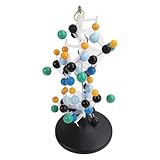
- [VIBRANT COLORS & SAFE DESIGN] The protein molecular model features bright and standardized atomic colors making it visually appealing and easy to identify. The high quality plastic construction ensures durability and safety for classroom use. The colorful balls and connecting are well made providing a tactile learning experience for students.
- [3D MOLECULAR VISUALIZATION] This model offers a comprehensive 3D representation of protein structures allowing students to study molecular and angles from all directions. The detailed design helps in understanding complex protein configurations making it an excellent tool for biochemistry and biology education.
- [HANDS ON LEARNING TOOL] Perfect for building both common and slightly complex protein structures this kit enhances interactive learning in classrooms and laboratories. The easy to assemble and disassemble design with included disconnect tool encourages student participation and engagement.
- [PORTABLE & USER FRIENDLY] Designed for convenience this molecular model is lightweight and easy to store or transport. The tightly held atoms and ensure stability during use while still allowing for effortless disassembly making it ideal for repeated classroom demonstrations.
- [EDUCATIONAL ENHANCEMENT] Specifically tailored for the QH3212 2 protein molecule this model aligns with textbook structures to boost student interest and comprehension. Teachers can leverage this visual aid to deliver more intuitive and effective lessons in molecular biology.
Chemistry World quotes study author Tanja Kortemme describing the motions as “more subtle” in comparison with larger hinge-like movements used in some earlier designed systems. That distinction matters because many biological functions depend on small internal rearrangements, not only dramatic movements of whole domains.
Quick wins for a faster PC:
Scan for outdated or missing drivers - takes under a minuteDriver Scan →Repair Windows errors before they cause bigger problemsFix Now →How did the team validate the designs?
The researchers report four solved structures that validate designed conformations. They also report that physics-based molecular-dynamics simulations agreed with deep-learning predictions and experimental data. Together, these results support the claim that designed conformational motions can be realized in the tested research systems; they do not show that every predicted design will work or that the approach is ready for practical deployment.
Rank #3

- FOR BASIC TEACHING TO ADVANCED SCIENCE: 444 pieces molecular model kit, including 136 atoms, 158 bonds and 150 parts for Carbon-60(Fullerene), provides to students from Grade 7 to Graduate level.
- TWO CHEMICAL STRUCTURE MODELS: The ball-and-stick models use spheres to represent atoms and sticks to represent chemical bonds. In the space-filling model, the spheres are drawn to scale and are next to one another as atoms are in real molecules.
- CHEMISTRY EDUCATIONAL MOLECULE MODEL IN 3D: It can display chemical structure, molecular bond, and bond angle in all directions. Demonstrate fundamental molecular geometry, chemical molecular structure, stereochemistry with 3D modeling studies.
- EASY TO LEARN: The universal standard adopted for each atom's color makes it easier for you to use and learn. Atoms and chemical bonds combine tightly and firmly and can be easily disassembled by disconnecting tools.
- If you’re not in love with it for whatever reason, we’ll give you a full replacement or refund—no questions asked. If you have any doubt, please tell us. With nothing to worry about, or even to share with your friends, try it now.
In the paper’s abstract, Guo and colleagues state that the approach “demonstrates that new modes of motion can now be realized through de novo design” and provides a framework for biology-inspired, tunable protein signaling. The experimental structures are important because they provide structural validation alongside computational predictions, rather than treating a model alone as proof of the intended behavior.
Independent reader supportYour contribution helps us test, update, and keep practical guides available for everyone.What this advance does—and does not—show
- It shows: deep-learning-guided design can produce proteins with planned changes between intradomain geometries, with structural validation reported for four solved structures.
- It suggests: ligands and mutations can be used to tune conformational behavior, a capability relevant to future efforts to design protein signaling.
- It does not establish: a clinical treatment, commercial biosensor, consumer product, or protein already functioning in an organism. The cited study and report describe a research demonstration and design framework, not a ready application.
The study, “Deep learning-guided design of dynamic proteins,” by Amy B. Guo and colleagues, was published in Science 388(6749), article eadr7094, on 22 May 2025. Its significance is the move from designing proteins primarily for static structures toward designing controlled, subtler internal motion.
Quick Recap
Best Value

- Model the molecular mechanics of gene expression — from DNA to protein. The Protein Synthesis Molecular Model Set from Mega Molecules is a hands-on educational tool designed to guide students through the complete process of protein synthesis: transcription and translation. Using color-coded components, this set allows learners to construct and manipulate accurate physical models of DNA, mRNA, tRNA, and amino acids—making the molecular biology behind gene expression tangible and engaging.
- This model set supports an active learning experience in which students construct DNA nucleotides using phosphoric acid, deoxyribose, and the four nitrogenous bases: adenine, thymine, cytosine, and guanine.
- Users build a DNA strand from a gene sequence (e.g., T-A-C-C-T-G-C-A-G-A-C-T), physically connecting the nucleotides via gray bonding links to represent covalent bonds.
- Users transcribe mRNA by pairing RNA nucleotides (adenine, uracil, cytosine, guanine) to the DNA template, demonstrating base pairing rules (e.g., A–U, C–G).
- Users model tRNA molecules with built-in anticodons and specific amino acid attachments—highlighting how tRNA ensures accurate translation at the ribosome.
Rank #4
- Build common and slightly complex protein structures with this molecular model kit, perfect for teaching and lab use.
- Brightly colored balls and connectors follow standard color coding, making it easy to identify and use.
- Ideal for demonstrating protein molecular features from textbooks, boosting student interest and helping teachers explain clearly.
- 3D modeling shows basic molecular structure from all angles, helping visualize molecular and angles.
- Easy to learn, store, and carry; atoms and connectors fit tightly yet can be easily disassembled with a disconnect tool.
Product prices and availability are accurate as of the date/time indicated and are subject to change. Any price and availability information displayed on Amazon at the time of purchase will apply.

