
Quick wins for a faster PC:
Scan for outdated or missing drivers - takes under a minuteDriver Scan →Clear out junk files and repair common Windows errorsFree Scan →iTechGuides is reader-supported. When you buy through links on our site, we may earn an affiliate commission. As an Amazon Associate I earn from qualifying purchases. Learn more
Porous pills were predicted in 2015 to become the largest-volume mass-manufactured product made with 3D printing. That was a forecast, not a confirmed current ranking. The example behind it was Spritam, Aprecia’s 3D-printed levetiracetam tablet: its porous structure lets liquid penetrate quickly, helping the tablet disintegrate for patients who have difficulty swallowing.
What the “largest industrial use” claim meant
The phrase came from a forecast attributed to MIT researcher Michael Cima in a Chemistry World report published on 20 August 2015. Discussing Aprecia’s Spritam, Cima said the dosage forms could soon become the largest-volume mass-manufactured objects made using these techniques. The available reporting does not establish that this prediction came true, and it does not provide a current market-size comparison across industrial 3D-printing applications.
The timing matters: the article appeared as Spritam received FDA approval. The prediction concerned the potential manufacturing volume of this product category, not proof that porous pills already dominated industrial 3D printing.
Crashes, No Sound, or Screen Glitches?
Random freezes, missing sound and display glitches usually trace back to one bad driver. Find and replace yours safely.Free scan · under a minutePC Slower Than It Used to Be?
A free scan shows the junk files, broken settings and background clutter dragging Windows down - then fixes them in one click.Free scan · Windows 10 & 11How 3D printing makes a porous pill
Aprecia’s ZipDose process
Aprecia made Spritam, a reformulation of the anti-seizure medicine levetiracetam, using its ZipDose process. In the 2015 report, Aprecia intellectual-property manager Thomas West described spreading thin layers of powder and selectively depositing liquid droplets to bind the powder layer by layer into a three-dimensional form. This is binder jetting: liquid binder is applied selectively to powder rather than shaping the whole tablet from a conventional solid mass.
#1 Best Overall
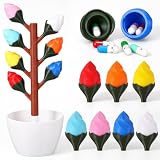
- Flower Pill Box: you will receive a creatively designed flower shaped pill box, including a pot base and 7 colorful magnetic flower buds that can be attached and detached; It serves as both a home decoration and a bright addition to your healthy lifestyle
- Ample Capacity: our cute pill organizer stands about 11 inches / 28 cm tall, offering ample space, suitable for storing your weekly needs of pills, vitamins, fish oil and other supplements
- Quality Material: this 3D printed flower pill container is made from food grade 3D Printing material applied for pill storage, sturdy and lightweight with no smell; Suitable for long term daily apply
- 7 Day Plan: each colorful bud on the creative flower pill organizer represents a day of the week, can twists open to reveal the inner storage space, making it convenient to plan and track your daily pills or supplements
- Wide Applications: this flower pill dispenser case is not only suitable for storing pills, vitamins, supplements, or small household items, but also makes a thoughtful gift for family and friends
Why porosity affects the dose
The resulting tablet has a highly porous structure. Water can move into it and help it break apart rapidly. Chemistry World reported that Spritam dispersed in water after four seconds; that is a figure reported for this particular formulation and process, not a general disintegration time for porous pills.
The structure also offered a way to incorporate a high dose in one tablet. A Nature Biotechnology report published on 8 October 2015 said the technology could produce individual pills containing up to one gram of drug. That is a historical report about the technology’s capability, not a specification for every Spritam tablet or every 3D-printed medicine.
Rank #2
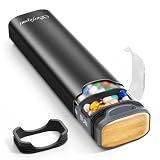
- MODERN AESTHETIC PILL ORGANIZER- Are you tired of old cheap plastic,clinical looking pill case? Are you feeling embarrassed when you take out your pill organizer in public? This 7 days pill organizer has sleek design and blends into your desk objects well. No one knows it is a pill box. No more pesky questions when people come over. This gives you more privacy. You can keep it on your table as an reminder for you to take pills
- NO MORE POPPING OPEN BY ACCIDENTALLY - Stop using tape or rubber band to seal trational pill boxes. This product is a slide in/out design pill organizer. It uses a silicone gasket to seal the pill case.Don't worry about if it will get loose after several months. The gasket supports 5000 times use and a spare gasket provided for free. No more risk of popping open. No mess of pills in your bags
- UPGRADED INDIVIDUAL LIDS- Unlike the lids of most pill boxes on the market that use plastic hinges (which can cause the lid to detach due to plastic fatigue), our design employs a latch mechanism that ensures the lid remains securely in place for years without detaching. Thanks to the ergonomic design, the lid's optimal tension ensures ease of use without excessive tightness, making it arthritis-friendly for effortless access
- PORTABLE ALUMINUM 7-DAY TRAVEL PILL CASE- The pill organizer has 7 large compartments. Overall size:6.5in*2in*1.3in,each compartment size 1.7in*0.8in*1.1in. It can store up to 16pcs capsule or 14pcs vatimines. It is a good medicine box for travel. Aluminum case is very sturdy,making it scratch & dent resistant. Even you stuff your bag really rough, the aluminum pill case won't get damaged at all
- SAFE MATERIAL- The pill organizer is composed of aluminum case and ABS pill holder. Both of them are BPA free. No awful odor give out. No harm to health.
What benefit the design is intended to provide
A rapidly disintegrating tablet can be easier to administer to someone who struggles to swallow a large pill. The 2015 Chemistry World article placed this in the context of children with epilepsy and reported that around a sixth of nearly three million people with epilepsy in the United States were children. Those are dated figures from that report, not a current prevalence estimate.
Rapid disintegration is a delivery and administration feature. It does not, by itself, show that the medicine works better clinically than another formulation containing the same active ingredient. Nor should a result reported for Spritam be generalized to all porous tablets: performance depends on the formulation, materials, printing parameters and intended release profile.
Rank #3

- Material:ABS+PP
- Size: 9cm diameter x 2cm high.
- Pocket sized for travel convenience.
- It is easy to be disassembled for thorough cleaning.
- Press and release the center button once to rotate one notch,Helps to remember your medication daily.
How pharmaceutical 3D-printing methods differ
Porous fast-disintegrating tablets are one use of pharmaceutical 3D printing, not the only one. A 2025 review of 3D printing in oral drug delivery describes research into customized doses, layered or combined medicines, and designs intended to control drug release. These are areas of development; their discussion does not mean all such products are routine commercial medicines.
| Method | Potential strengths described in the 2025 review | Important tradeoffs |
|---|---|---|
| Binder jetting | Can produce highly porous tablets and avoids heat during printing. | Lower mechanical strength can be a concern, and the method has limitations for extended-release forms. |
| Selective laser sintering | Can create porous structures and customized release designs. | Heat can constrain use with sensitive ingredients; pharmaceutical-material compatibility is also a challenge. |
| Fused deposition modeling | Accessible and potentially cost-effective. | Active ingredients may be exposed to heat, and suitable materials are required. |
No method is automatically best for every drug. A development team has to match the printing method to the active ingredient and excipients, desired release profile, tablet geometry and strength, production throughput, reproducibility, and regulatory requirements.
Rank #4

- 💊 Large Capacity: You don't have to worry about the pill pack thing on the go. Our floral pillcase have enough space for filling and sorting all your pills for seven day a week, it can hold 6 big fish oils or 8 big vitamins in each slots, perfect for pills, vitamins, melatonin gummies, and other supplements
- 💊 BPA-Free: Our weekly lightproof pillbox is made of food grade material PP plastic, no chemical smell,safe for medical use.
- 💊 Travel Friendly Pill Sorter: Compact size for travel, easy to take with, stay closed, won't pop open, ensure that your pill will not slip out.
- 💊 Practical Design & Easy to Use: All the petals can opened from the center at once, easy to fill. The pill container will stay closed once locked and securely snap will keep your pills safe all the way.
- 💊Gift: Pill organizer is an essentials for travel enthusiasts, workers, the ages, health nut, especially for women,and a thoughtful gift which saves you from having to spend a lot of time and effort in differentiating pills.
Why a promising formulation is not automatically an industrial-scale success
Manufacturing a medicine reliably at scale involves more than printing a workable tablet once. The 2025 review identifies several barriers to broader pharmaceutical use:
- Finding pharmaceutical-grade materials that are compatible with the drug and remain stable.
- Getting repeatable results as printing parameters or production conditions change.
- Meeting regulatory expectations, particularly for small-batch or decentralized production.
- Managing equipment and material costs, production speed, and the need for specialized expertise.
These constraints help explain why a notable approved product is not enough to verify a broad industrial ranking. The cited sources describe a specific product and the promise and challenges of pharmaceutical printing; they do not establish the current volume of printed pills relative to other 3D-printed goods.
Best Value
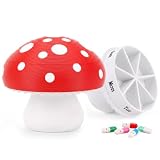
- Mushroom Pill Box: you will receive a creatively designed mushroom shaped pill box, Includes a mushroom base and a red mushroom head with 7 small compartments; It serves as both a home decoration and a bright addition to your healthy lifestyle
- Ample Capacity: our cute pill organizer stands about 3.94 inches / 28 cm tall, about 4.92 inches/12.5 cm wide, offering ample space, suitable for storing your weekly needs of pills, vitamins, fish oil and other supplements
- Quality Material: this 3D printed mushroom pill container is made from food grade 3D Printing material applied for pill storage, sturdy and lightweight with no smell; Suitable for long term daily apply
- 7-Day Plan: each compartment on this creative mushroom pill box represents a day of the week; Rotate to open and reveal the internal storage space, making it easy to plan and track your daily pills or supplements
- Wide Applications: this mushroom pill dispenser case is not only suitable for storing pills, vitamins, supplements, or small household items, but also makes a thoughtful gift for family and friends
Other printed-tablet designs are not the same as Spritam
Pharmaceutical printing can pursue goals opposite to fast disintegration. In a 2025 MIT News report, Enzian Pharmaceutics was developing an investigational fibrous tablet designed to expand and release medicine over time. The company reported animal-study retention of 12 to 24 hours and validation in a small number of healthy volunteers at the time of the report. Those results concern a different design and stage of development; they should not be confused with Spritam’s rapid-dispersing porous tablet. The article also attributed to Enzian co-founder Aron Blaesi a statement that peak-to-trough blood concentrations can differ by up to 50 times for some oral cancer drugs. That is interview context about some medicines, not a general statistic for cancer treatments.
Did porous pills become the largest industrial use?
The cited sources do not answer that question. The “largest” wording was a 2015 prediction, and neither the later pharmaceutical review nor the 2025 MIT News article establishes a current ranking or market share for porous pills across industrial 3D printing. What the reporting does support is narrower: Aprecia’s Spritam was reported as the first FDA-approved 3D-printed prescription medicine, and its binder-jetted porosity served a practical formulation purpose. Whether that category became the largest industrial application remains unverified by these sources.
Quick Recap
Product prices and availability are accurate as of the date/time indicated and are subject to change. Any price and availability information displayed on Amazon at the time of purchase will apply.

