
Recommended Free Tools
iTechGuides is reader-supported. When you buy through links on our site, we may earn an affiliate commission. As an Amazon Associate I earn from qualifying purchases. Learn more
A 2023 study reported an organic amide catalyst that helps produce chlorine in chlor-alkali electrolysis, with strong results under the study’s test conditions. The concept is promising, but it is not evidence that factories have adopted the catalyst or that it will last in industrial service: reported activity declined with use, and long-term durability remains the central question.
Why chlor-alkali electrolysis uses so much electricity
Chlor-alkali electrolysis turns sodium chloride solution, or brine, into chlorine and sodium hydroxide (caustic soda), two widely used chemical feedstocks. In a conventional membrane cell, chloride ions are oxidized at the anode to form chlorine. At the cathode, water is reduced to hydrogen and hydroxide ions; sodium ions cross the membrane and combine with hydroxide to form sodium hydroxide.


The electrolysis step is the most energy-intensive part of US chlor-alkali manufacturing, according to the US EPA and ENERGY STAR guide. The 2023 study cites an estimate that the sector uses about 4% of global electricity, or roughly 150 TWh per year. Those figures are an estimate cited by the paper, not a new measurement of current global consumption. [Nature, 2023]
What the 2023 organic catalyst does
The study, “CO₂-mediated organocatalytic chlorine evolution under industrial conditions,” tested organic quinazoline-2,4-dione compounds containing an amide group on a titanium-and-carbon electrode. The researchers bubbled carbon dioxide (CO₂) through the cell. They propose that CO₂ binds reversibly to the amide nitrogen, helping form a radical species involved in chlorine generation. [Nature, 2023; Chemistry World, 2023]
#1 Best Overall
Under the reported experimental conditions, the team measured a current density of 10 kA m−2, 99.6% selectivity, and an overpotential of 89 mV. These are cell-study results, not proof of performance across commercial plants. The work addresses chlorine evolution at the anode; it should not be confused with a claim that the catalyst replaces every component or reaction in an industrial chlor-alkali cell.
Why the result is not yet an industrial energy-saving claim
Durability in chlorine is unresolved
The Chemistry World report says catalyst activity declined with use, and the researchers suggested that preparation might be improved. That matters because a catalyst must retain its performance in the highly oxidizing chlorine-evolution environment, not just produce favorable initial measurements.
Rolf Hempelmann of the University of Saarland, quoted by Chemistry World, described the setting as “the harshest chemical environment one can imagine.” He also assessed that the demonstrated construction could not compete with the roughly 10-year lifespan of existing systems. That is Hempelmann’s assessment, not a verified lifespan for every plant or a direct long-duration comparison reported by the study.
Projected savings depend on worldwide adoption
The research team estimated that worldwide adoption might reduce the sector’s electricity use by approximately 1.8–4.6%. This is a conditional scale-up projection reported by Chemistry World, not savings measured in a commercial fleet. [Chemistry World, 2023]
Rank #3
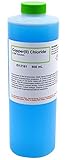
- 500mL bottle of copper (II) chloride
- Chemical for general purpose lab and educational use
- Used as a catalyst
- Perfect for use in any chemistry lab or classroom
- Includes directions for safe storage and SDS is available on product page and by request
The sources cited here do not establish whether the 2023 catalyst has since entered commercial deployment or passed independent, long-duration validation. Its industrial status should therefore be treated as unestablished, rather than assumed either adopted or abandoned.
A distinct 2024 organocatalyst study
A separate study, first published January 5, 2024, tested an organocatalyst anchored on a single-atom support at both electrodes: for hydrogen evolution at the cathode and chlorine evolution at the anode. Under the study’s industrial conditions, it reported overpotentials of 21 mV and 20 mV at 10 mA cm−2, and energy consumption 1.2% below that of a commercial system. [Angewandte Chemie International Edition, 2024]
Rank #4
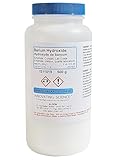
- LAB GRADE BARIUM HYDROXIDE || Contains 500g of barium hydroxide octahydrate, suitable for laboratory, industrial, and chemical research applications.
- STRONG BASE FOR ANALYSIS || Used in acid-base titrations, standardized against hydrochloric acid, and for barium salt preparation.
- SULFATE DETECTION & PURIFICATION || Forms insoluble barium sulfate in sulfate analysis, aiding in gravimetric testing and impurity removal.
- CATALYSIS & REACTIVITY || Functions as a base catalyst in organic transformations, supporting aldol condensation, elimination, and polymerization reactions.
- STORAGE & SAFETY || Store in a secure area as a toxic material; avoid inhalation, ingestion, and skin contact for safe laboratory handling.
This is a different catalyst design and test result, not a replication or validation of the 2023 CO₂-mediated amide system. The studies do not provide a common head-to-head comparison across the same electrode design, operating conditions, baseline, and duration, so their figures should not be ranked as if they came from one test.
What’s actually slowing this PC down?
Pick the symptom - the matching free tool is one click away.
What would show that the approach is ready for plants?
The key question is not only whether an organic catalyst can lower reaction losses in a test cell, but whether it can sustain useful output under the operating conditions and service life required by industrial equipment. Evidence that would help answer that question includes:
Best Value

- 300 color coded flashcards containing organic chemical reactions
- Topics include: Alkenes, Alcohols, Haloalkanes, Benzenes, Epoxides, Aldehydes, Ketones, Carboxylic Acids, Acid Halides, Acid Anhydrides, Amides, Esters, Enols, Carbohydrates, Amino Acids Memorization, and more
- Improve memorization with color coded cards organized by classes of compounds and color coded atoms for efficient recognition
- Includes 3 bookmarks labeled: Mastered, Sort of Know, and Don't know to help students organize their progress
- Long-duration operation showing how activity, selectivity, and energy use change over time in chlorine-evolving conditions.
- A clearly specified comparison with a commercial baseline using the same operating conditions and system boundaries.
- Evidence that the electrode and catalyst can be manufactured and maintained at industrial scale without losing performance.
- Independent validation and a documented deployment status.
Until such evidence is established, the 2023 work is best understood as a promising laboratory result with a meaningful durability challenge—not a demonstrated reduction in the electricity use of operating chlor-alkali plants.
Quick Recap
Product prices and availability are accurate as of the date/time indicated and are subject to change. Any price and availability information displayed on Amazon at the time of purchase will apply.

