
The Tool Desk
Outbyte PC Repair FREEClear out junk files and repair common Windows errorsFree Scan →Outbyte Driver Updater FREEFix the driver behind crashes, sound loss and screen glitchesFind Drivers →iTechGuides is reader-supported. When you buy through links on our site, we may earn an affiliate commission. As an Amazon Associate I earn from qualifying purchases. Learn more
To connect a powered subwoofer to powered speakers, you feed the subwoofer a line-level (preamp) signal through a matching analog input, usually RCA or 3.5 mm. Never take that signal from an amplifier’s speaker terminals. The exact route depends on which outputs your speakers and subwoofer actually have, so check the rear panel and manual of each device before buying a cable.
Why the output type matters
An active (powered) speaker or subwoofer has its own amplifier. That changes what it can safely accept. Audioengine’s support FAQ states that active speakers should be fed from line-level or preamp outputs, such as a receiver’s preamp or line output, and that connecting an active speaker to an amplifier’s speaker-level terminals can damage it. The same applies to any powered device: a speaker-level signal is far stronger than the line-level signal the built-in amplifier expects.
A subwoofer connection is therefore a line-level connection. Your job is to find a line-level output on the speakers or the source, then match it to a line-level input on the subwoofer.
Recommended Free Tools
Step 1: Identify the ports on each device
The word “active” does not tell you which ports exist. Look at the rear panels and labels, and write down what you find:
#1 Best Overall

- [CONNECTIVITY] FosPower's premium Subwoofer single RCA male to single RCA male audio cable connects a subwoofer speaker to a stereo receiver, audio component or surround sound system. Great for connecting audio components with a single RCA Port/jack.
- [24K GOLD-PLATED CONNECTORS] These cables are made from high quality 24k gold-plated connectors that are corrosion resistant and reduce tarnish.
- [DUAL LAYER BRAIDED AND FOIL SHIELDING] The cables' dual layer shields are braided with copper and protected by aluminum foil, which provides cable flexibility and greatly reduces unwanted EMI/RFI interference.
- [PF INSULATOR] The cores of FosPower's cables are covered with polyethylene foam (PF) dielectric insulator, which greatly minimizes signal loss. The tin plated copper core reduces oxidation and increases the wire life.
- [LIMITED LIFETIME WARRANTY] Includes a Limited Lifetime Warranty
- Dedicated subwoofer output: labeled SUB OUT, LFE or similar. This is the cleanest option when present.
- Line-level RCA output: a pair of red and white RCA jacks marked as line output.
- 3.5 mm output: a stereo mini-jack, sometimes labeled as a line output.
- No analog output: some active speakers have no line-level output. See the section on no suitable output below.
On the subwoofer side, check for an LFE input, a mono or stereo RCA input, or a 3.5 mm input. Some subwoofers also have a speaker-level input, which is a separate case and not the path described here.
Connection patterns and cables
The table below summarizes the patterns that the manufacturer materials describe. Treat it as a guide to what to check, not as a guarantee that your particular pair will work.
Rank #2

- [SUBWOOFER CABLE WITH ZERO HUMMING] With FosPower's single RCA male to single RCA male cable, remove the humming noise coming from your audio. This cable is great for connecting audio components with a single RCA Port/jack, such as a subwoofer speaker to a stereo receiver, an audio component or surround sound system.
- [24K GOLD-PLATED CONNECTORS] This RCA to RCA cable is made from high-quality 24k gold-plated connectors that are corrosion resistant and reduce tarnish.
- [DUAL LAYER BRAIDED AND FOIL SHIELDING] FosPower's single RCA male to single RCA male cable is made with dual layer shields that are braided with copper and protected by aluminum foil. This provides cable flexibility and greatly reduces unwanted EMI/RFI interference.
- [PF INSULATOR] The cores of FosPower's RCA to RCA cables are covered with polyethylene foam (PF) dielectric insulator, which greatly minimizes signal loss. The tin plated copper core reduces oxidation and increases the wire life.
- [LIMITED LIFETIME WARRANTY] Includes a Limited Lifetime Warranty
| Speaker or source output | Subwoofer input | Cable | Notes from the manufacturer materials |
|---|---|---|---|
| Speaker RCA line output | RCA input | RCA-to-RCA | Audioengine’s S6 and S8 setup materials show this straightforward route. |
| Speaker 3.5 mm output | Analog input (confirm format) | 3.5 mm-to-RCA or 3.5 mm-to-3.5 mm, depending on the subwoofer | Audioengine’s S6 guide shows a mini-jack hookup option. Its HD5 support page describes a 3.5 mm-to-RCA adapter for that product’s own setup, not for every model. |
| Dedicated SUB OUT or LFE output | LFE input or RCA input | RCA-to-RCA (or RCA-to-LFE, if the subwoofer uses an LFE jack) | Audioengine’s S8 materials say a single sub/LFE RCA output connects to the subwoofer’s left RCA input. Audioengine also notes that its A1 and A1-MR speaker subwoofer output requires RCA even when other inputs accept 3.5 mm. |
| Receiver preamp or line output feeding the active speakers | Not applicable (feeds the speakers) | RCA or 3.5 mm, as the receiver provides | Use only the preamp or line output. Do not connect active speakers to the receiver’s speaker terminals. |
| No analog output on the speakers | Not applicable | Not stated | The manufacturer materials reviewed do not establish a universal workaround for this case. |
Choosing the right cable
Buy the cable after you have confirmed both ends. An RCA cable has two connectors per end, a 3.5 mm cable has one stereo plug, and an adapter cable converts between them. If the subwoofer has only an RCA input and the speaker has only a 3.5 mm output, you will need an adapter cable that converts 3.5 mm to RCA, and you should confirm the pinout in the manuals for both devices first.
Signal flow with one subwoofer
In most setups the source feeds the active speakers, and the speakers’ line output, or a dedicated subwoofer output, feeds the subwoofer. Follow the path your manual describes. Do not add a second splitter or adapter unless the manual shows that arrangement, because mismatched levels can cause distortion or unexpected bass behavior.
Rank #3

- IN THE BOX: (1) 4 foot 2-Male to 2-Male RCA audio stereo subwoofer cable
- CRYSTAL CLEAR AUDIO: Enhances audio connections; ideal for home-entertainment and high-fidelity (HiFi) systems
- RCA INPUT/OUTPUT: 2 RCA output (connect to either L or R input) and 2 RCA input; input can be high frequency (digital audio) or low frequency (subwoofer)
- GOLD PLATED CONNECTORS: Corrosion-resistant 24K gold-plated full-metal connectors
- RELIABLE PERFORMANCE: Eliminates unwanted noise/feedback for pure, clear audio; minimal signal loss for reliably consistent audio
Step-by-step setup
- Turn off the source, the speakers and the subwoofer. Connect cables with everything powered down.
- Connect the speaker or receiver line-level output to the subwoofer’s matching input, using the cable you chose in the previous step.
- If you use a receiver, confirm that the active speakers are connected to its preamp or line output, not its speaker terminals.
- Power on the source, then the speakers, then the subwoofer. Start with the subwoofer volume low.
- Play a familiar track with clear bass. Raise the subwoofer level gradually until it blends with the main speakers without standing out as a separate sound.
- Set the crossover by ear. Audioengine’s S8 setup guide says the best crossover point depends on speaker placement, room characteristics and personal preference, and recommends listening for a smooth blend. When the subwoofer is connected through its LFE input, the crossover control is inactive, so the speaker’s own filtering or the source’s bass management takes over.
- Check the phase control if one is present. Try the normal and reversed settings and keep the one that sounds fuller at the crossover point.
Crossover values are model-specific
Crossover settings differ widely between systems, so you should not copy numbers from another product. In the SVS Prime Wireless Pro manual, the speaker output applies an 80 Hz high-pass filter when a subwoofer is detected, and SVS recommends setting the subwoofer’s low-pass filter to 90 Hz. Those values belong to that system only. Other active speakers may have fixed passive crossovers instead. Audioengine says its powered speakers use fixed passive crossovers, and that adding a subwoofer extends low-frequency response below what the speakers reproduce on their own.
Troubleshooting
No bass from the subwoofer
- Confirm you used the correct output and input, not a speaker-level or unrelated jack.
- Check the source’s routing and bass-management settings, so that low frequencies are sent to the subwoofer path.
- Confirm the subwoofer is powered on and not in a standby or auto-sleep state described in its manual.
- Raise the subwoofer level and check that the cable is firmly seated at both ends.
Bass sounds boomy, weak or disconnected
- Adjust the subwoofer level in small increments first.
- Change the crossover point, if the subwoofer has a control and it is active in your input configuration.
- Try the phase control in both positions.
- Move the subwoofer around the room. Placement changes how bass is reinforced and can change the best settings.
Wireless line-level adapters as an option
If cable routing or placement makes a wired connection impractical, a wireless line-level adapter can help. SVS describes its SoundPath Tri-Band Wireless Audio Adapter as an RCA-connected transmitter and receiver for line-level devices. The adapter does not remove the need for compatible analog connections on both sides, and it needs its own power. Check the input and output type on the adapter’s product page before you buy it.
Rank #4

- IN THE BOX: (1) 8 foot 2-Male to 2-Male RCA audio stereo subwoofer cable; 23 AWG
- CRYSTAL CLEAR AUDIO: Enhances audio connections; ideal for home-entertainment and high-fidelity (HiFi) systems
- RCA INPUT/OUTPUT: 2 RCA output (connect to either L or R input) and 2 RCA input; input can be high frequency (digital audio) or low frequency (subwoofer)
- GOLD PLATED CONNECTORS: Corrosion-resistant 24K gold-plated full-metal connectors
- RELIABLE PERFORMANCE: Eliminates unwanted noise/feedback for pure, clear audio; minimal signal loss for reliably consistent audio
Wireless adapters add a small amount of setup complexity. Confirm that the speakers and subwoofer have line-level ports first, because the adapter only extends an existing path.
Quick wins for a faster PC:
Clear out junk files and repair common Windows errorsFree Scan →Fix the driver behind crashes, sound loss and screen glitchesFind Drivers →Notes on model and date
Port layouts, labels and manual wording change between product revisions. The guidance here reflects the manufacturer materials checked in October 2026, including Audioengine’s S6 and S8 setup materials and FAQ, the Audioengine HD5 support page, and the SVS Prime Wireless Pro manual and SoundPath adapter page. For any specific model, the manual printed with your product, or the current manual from the manufacturer’s site, takes priority over the examples above.
Quick Recap
Best Value
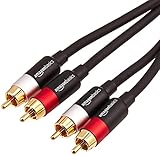
- IN THE BOX: (1) 15 foot 2-Male to 2-Male RCA audio stereo subwoofer cable
- CRYSTAL CLEAR AUDIO: Enhances audio connections; ideal for home-entertainment and high-fidelity (HiFi) systems
- RCA INPUT/OUTPUT: 2 RCA output (connect to either L or R input) and 2 RCA input; input can be high frequency (digital audio) or low frequency (subwoofer)
- GOLD PLATED CONNECTORS: Corrosion-resistant 24K gold-plated full-metal connectors
- RELIABLE PERFORMANCE: Eliminates unwanted noise/feedback for pure, clear audio; minimal signal loss for reliably consistent audio
Product prices and availability are accurate as of the date/time indicated and are subject to change. Any price and availability information displayed on Amazon at the time of purchase will apply.

