
Do these 3 things before closing this tab:
1Fix the driver behind crashes, sound loss and screen glitches2Clear out junk files and repair common Windows errors3Scan for outdated or missing drivers - takes under a minuteiTechGuides is reader-supported. When you buy through links on our site, we may earn an affiliate commission. As an Amazon Associate I earn from qualifying purchases. Learn more
Under the U.S. federal Fair Labor Standards Act (FLSA), covered, nonexempt employees generally earn overtime after 40 hours worked in a workweek, and time an employer allows them to work generally counts as work time. The FLSA does not require most employers to provide meal or rest breaks or give advance notice of ordinary schedule changes. These are federal baselines, not universal rules: state and local laws may be more protective, and the answer in an individual case can depend on location, coverage, worker classification and work arrangements.
What counts as work time?
The FLSA generally counts work an employer “suffers or permits” an employee to perform—even if the employer did not specifically request it. That can include job-related tasks before or after a scheduled shift. A scheduled shift does not necessarily mark the beginning and end of the workday: the U.S. Department of Labor (DOL) explains that the workday may run from the first principal activity to the last.
Does waiting at work count?
It depends on whether you are still on duty. If you are waiting for an assignment or for equipment to be repaired while expected to remain available for work, that time is generally compensable. If you are fully relieved for a sufficient period and can use it for your own purposes, the time may instead be unpaid waiting time.
Recommended Free Tools
Is on-call time paid?
There is no blanket rule that all on-call hours are paid or unpaid. Time spent responding to calls is work time. Whether the rest of an on-call period counts depends on the restrictions imposed and whether you can use that time effectively for personal activities.
#1 Best Overall
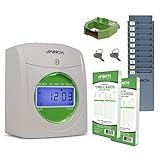
- Complete Solution - Includes HN3000 AutoAlign time clock, 100 time cards, rack, ribbon, and keys for instant tracking.
- Precise Punching - AutoAlign technology ensures accurate alignment for error-free payroll records.
- Robust Warranty - Two-year warranty with unlimited customer support (Monday–Friday) guarantees reliable performance.
- Simple Setup - Plug-and-play design with clear instructions enables tracking in minutes.
- Clear Printing - High-quality uPunch ribbons deliver legible, consistent punch punches.
Does travel time count?
An ordinary commute between home and your regular worksite generally is not work time. Travel between job sites during the workday generally is. One-day assignments away from your usual work location and overnight travel have separate rules; check the DOL’s travel guidance and the law in your state for those situations.
Does training or a meeting count?
Training, lectures and meetings are not automatically unpaid. They may be excluded from work time only when the applicable criteria are met. Relevant factors in DOL guidance include whether the activity is outside normal hours, voluntary, not job-related and does not involve concurrent work.
Are meal and rest breaks required or paid?
Federal law generally does not require employers to provide meal or rest breaks to most workers. If an employer does provide breaks, the distinction between a short rest break and a bona fide meal period matters:
Crashes, No Sound, or Screen Glitches?
Random freezes, missing sound and display glitches usually trace back to one bad driver. Find and replace yours safely.Free scan · under a minutePC Slower Than It Used to Be?
A free scan shows the junk files, broken settings and background clutter dragging Windows down - then fixes them in one click.Free scan · Windows 10 & 11| Break type | Typical duration in DOL guidance | Federal pay treatment |
|---|---|---|
| Short rest break | Usually 5–20 minutes | Generally paid and counted as hours worked when offered by the employer. |
| Bona fide meal period | Typically at least 30 minutes | May generally be unpaid only if you are completely relieved from duty. |
If you must answer calls, perform tasks or otherwise work during a meal period, that time may be compensable rather than an unpaid break. State or local rules may require meal or rest periods even where federal law does not.
Rank #2

- 𝗣𝗥𝗘𝗖𝗜𝗦𝗘 𝗔𝗧𝗧𝗘𝗡𝗗𝗔𝗡𝗖𝗘 𝗧𝗥𝗔𝗖𝗞𝗜𝗡𝗚: Our Punch Card Attendance Machine comes with a large 4" LED screen for clear visibility. Track your employees' start times, break times, lunch periods, and weekly work hours with precision, up to 6 entries per day. Each card holds 15 days of records per side, just flip for continuous tracking. Supports Dual-color printing, black for normal attendance, red for late or early departure, and a built-in speaker provide clear alerts, ensuring seamless and efficient workforce track & time management.
- 𝗙𝗨𝗟𝗟 𝗨.𝗦. 𝗧𝗜𝗠𝗘 𝗭𝗢𝗡𝗘 𝗖𝗢𝗩𝗘𝗥𝗔𝗚𝗘: This attendance machine supports 6 major U.S. time zones: Eastern, Central, Mountain, Pacific, Alaska, and Hawaii. Employees across different regions can be tracked accurately without confusion. Perfect for offices with multi-location teams.
- 𝗔𝗨𝗧𝗢𝗠𝗔𝗧𝗜𝗖 𝗗𝗔𝗬𝗟𝗜𝗚𝗛𝗧 𝗦𝗔𝗩𝗜𝗡𝗚 𝗔𝗗𝗝𝗨𝗦𝗧𝗠𝗘𝗡𝗧: The employee time clock automatically switches between Daylight Saving Time and Standard Time. It handles spring forward and fall back changes seamlessly. This ensures precise timekeeping year-round without manual adjustments.
- 𝗔𝗣𝗣 𝗦𝗨𝗣𝗣𝗢𝗥𝗧𝗘𝗗: This attendance machine comes with an easy-to-operate app for smarter management. The app also allows you to change between 6 major U.S. time zones, set Working Time, set Password, Print Format, Setup Paper, DST Setting, Music Time Setting, and other necessary attributes. NOTE: To calculate total workdays, late entries, leaves, and salary summaries, you need to do it manually from the punch card.
- 𝗛𝗜𝗚𝗛-𝗤𝗨𝗔𝗟𝗜𝗧𝗬 𝗕𝗨𝗜𝗟𝗗 & 𝗟𝗢𝗡𝗚𝗘𝗩𝗜𝗧𝗬: Made of durable ABS material, this compact punch card time recorder withstands daily use. Equipped with a premium-grade print head rated for millions of strikes, it ensures long-lasting, reliable printing with a smooth, fade-resistant surface. Ideal for offices, shops, and small businesses.
When is overtime due?
For a covered, nonexempt employee, the FLSA generally requires overtime pay of at least one and one-half times the regular rate for hours worked beyond 40 in a workweek. A workweek is a fixed, regularly recurring period of seven consecutive 24-hour days. Overtime is calculated separately for each workweek; hours cannot generally be averaged across multiple weeks to avoid overtime.
Does being salaried mean I am not owed overtime?
No. Salary alone does not determine whether a worker is exempt from overtime. The applicable classification and other facts matter. Some employees, including certain public-agency police and fire employees and some hospital or nursing-home employees, may be subject to special rules.
Do weekends, holidays or scheduled days off automatically earn overtime?
Not under the general federal rule. Weekend, holiday or scheduled-day-off work is not automatically paid at a premium; the key question is whether total hours worked in the workweek exceed the applicable overtime threshold. State law or an agreement may provide different terms. When federal and state overtime rules both apply, DOL guidance says the employee receives the standard that provides the higher pay.
What’s actually slowing this PC down?
Pick the symptom - the matching free tool is one click away.
How many hours can an employer require me to work?
Under the general FLSA rule, there is no federal cap on the daily or weekly hours employees aged 16 or older may be required to work. Child-labor rules restrict work by minors, and other laws may limit hours or require additional protections. State and local requirements can differ.
Rank #3

- VERSATILE 2-IN-1 SOLUTION: Includes uPunch CR1000 Digital Time Clock and Date Stamp, 50 time cards, one ribbon & 2 keys - perfect for small business time and document management.
- ACCURATE DIGITAL TIMEKEEPING: Eliminate manual errors in employee time tracking with this precise digital clock in machine for employees, easily monitoring arrival, break, lunch, and departure times.
- ADVANCED DATE STAMPING: Simplify document organization with built-in date stamp functionality, featuring preset messages and 3-way printing for efficient proof of receipt and processing.
- USER-FRIENDLY DESIGN: Strategically placed window in the cover allows for easy loading of time cards and documents, enhancing efficiency in daily operations.
- RELIABLE SUPPORT: Enjoy peace of mind with uPunch's commitment to quality, including warranty protection and dedicated customer support for all your time clock needs.
What counts as full-time or part-time work?
The FLSA does not set general definitions of full-time and part-time employment. As the DOL puts it, “The FLSA does not define full-time employment or part-time employment.” Employers generally set those labels, subject to applicable agreements and other laws.
Can my employer change my schedule without notice?
The FLSA has no general scheduling or advance-notice requirement for ordinary schedule changes, apart from some child-labor provisions. Under the federal baseline, an employer may generally change work hours without prior notice or consent unless an agreement or another applicable law says otherwise. State and local scheduling laws can change the answer.
What work-time records should I keep, and where can I get help?
DOL guidance says employers must keep time and pay records. For call-center work, the agency specifically describes recording daily and weekly hours, including job-related activities before and after a shift. You can also keep your own notes about shifts, breaks and work performed; a personal notebook or spreadsheet can help organize information but does not replace employer records or establish by itself that the employer complied with the law.
DOL describes its free DOL-Timesheet App as a way for workers to track regular hours, breaks and overtime. For a possible federal minimum-wage or overtime violation, contact the Department of Labor’s Wage and Hour Division. That agency may not handle every dispute involving promised wages, leave, breaks or final pay, so a state labor agency or another authority may be relevant. Check current federal and state agency information for your situation.
Quick Recap
What should I check before applying these rules to my situation?
- Location: State or local law may provide stronger break, overtime, scheduling or wage protections than the federal baseline.
- Coverage and classification: Whether the FLSA applies and whether a worker is nonexempt can affect the result; a salary by itself does not settle overtime eligibility.
- What happened during the time in question: Whether you were on duty, free to use time for personal purposes, performing work, traveling between sites or attending training can matter.
- Applicable agreements and special rules: Contracts, workplace agreements, occupation-specific provisions and child-labor rules may change what applies.
Product prices and availability are accurate as of the date/time indicated and are subject to change. Any price and availability information displayed on Amazon at the time of purchase will apply.

