
iTechGuides is reader-supported. When you buy through links on our site, we may earn an affiliate commission. As an Amazon Associate I earn from qualifying purchases. Learn more
CES 2025’s “World’s Smartest Motorcycle Helmet” was Intelligent Cranium Helmets’ iC-R platform, combining a heads-up display, cameras, recording, communications, proximity alerts and crash detection. Its “360 views” claim needs qualification: CES-era reporting described 300 degrees of camera coverage, while the company now describes broader 360° awareness using cameras and sensors.
The iC-R family is not simply a conventional helmet with a camera attached. Intelligent Cranium presents it as an integrated system containing a HUD, front and rear cameras, communication hardware, storage, motorcycle-mounted proximity sensors and an emergency-response feature called ESAS. However, the reviewed sources do not independently prove that the helmet prevents crashes, detects every accident or improves safety compared with a conventional certified helmet.
The original CES coverage was published on January 10, 2025, near the end of CES 2025. The manufacturer’s current pages list four versions priced from $650 to $1,850, but the shop currently describes new orders as made-to-order pre-orders with an estimated six-to-eight-week lead time.
Do these 3 things before closing this tab:
1Clear out junk files and repair common Windows errors2Scan for outdated or missing drivers - takes under a minute3Repair Windows errors before they cause bigger problemsKey takeaways
- Intelligent Cranium Helmets’ iC-R family combines a 1080p full-color HUD, front and rear cameras, communications, recording, proximity alerts and crash detection.
- The CES-era “360 views” description does not establish literal 360-degree camera coverage: the reported 240-degree rear view plus 120-degree front camera totals 300 degrees.
- The manufacturer currently markets “360° awareness” as a combination of rear cameras and motorcycle-mounted proximity sensors, which is different from a seamless 360-degree video view.
- CES-era reporting said the helmet could call 911 after more than 15 seconds without rider movement, but the available sources do not document the algorithm, cancellation process, phone requirement or reliability.
- The manufacturer lists the iC-R family from $650 to $1,850, while its shop page currently says orders are pre-order only and estimates a six-to-eight-week manufacturing lead time.
- The available evidence does not independently establish comparative safety performance, crash-prevention benefits, current production weight or real-world battery life.
What is the CES 2025 World’s Smartest Motorcycle Helmet?
The CES 2025 “World’s Smartest Motorcycle Helmet” was Intelligent Cranium Helmets’ iC-R platform, a product family designed to put several motorcycle technologies inside one helmet rather than requiring separate accessories. CES-era coverage published January 10, 2025 described an AI-enabled helmet with a drop-down HUD, rear-view cameras, crash detection, rider communications, proximity warnings and integrated recording.
#1 Best Overall
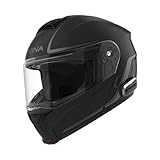
- Ride Connected: Keep in touch with the outside world through smartphone Bluetooth connectivity, or with other riders in your group through Mesh Intercom 3.0.
- No Limits: The Outrush 2 is WAVE Intercom compatible, allowing you to communicate with any brand motorcycle headset, over virtually any distance within cellular network coverage.
- Music That Moves With You: Add a soundtrack to your journey with Sena's 2nd Generation High Definition Speakers that turn your helmet into a sound studio.
- Ride Further Between Charges: If you forget to power down your helmet after a ride, Intelligent Power Management will automatically turn the Outrush 2 off, when it's accellerometers do not detect movement after several hours.
- Get the Best of Both Worlds: Feel the wind on your face with the chin bar up, and ride assured that the Outrush 2's P/J dual homologation keeps you protected with the chin bar up or down. Complies with Federal Motor Vehicle Safety Standard 218 (FMVSS 218)
The central promise is integration. A rider could theoretically see speed, navigation prompts, messages or camera information in the HUD, communicate with other riders, record the road, receive proximity warnings and trigger an emergency response without attaching several unrelated devices to a conventional helmet.
That description should not be confused with independent validation. The available CES report and manufacturer pages do not establish whether the CES unit was a finished retail helmet, a prototype, a demonstration unit or a final production configuration. The sources also do not include an impartial hands-on test, independent crash testing or measured evidence that the electronics reduce crashes or injuries.
Does the helmet really provide 360-degree camera vision?
No—not based on the CES-era camera figures. The reported 240-degree rear field of view plus a 120-degree front action camera adds up to 300 degrees of camera coverage, not a literal 360-degree camera view. The manufacturer’s current wording, “360° awareness,” appears to describe a broader combination of cameras and proximity sensors rather than a single seamless 360-degree visual recording.
Crashes, No Sound, or Screen Glitches?
Random freezes, missing sound and display glitches usually trace back to one bad driver. Find and replace yours safely.Free scan · under a minutePC Slower Than It Used to Be?
A free scan shows the junk files, broken settings and background clutter dragging Windows down - then fixes them in one click.Free scan · Windows 10 & 11| Term | What the available sources support | What it does not prove |
|---|---|---|
| Rear camera | A manufacturer-described 240-degree rear field of view | A complete view in every direction or unobstructed natural peripheral vision |
| Front camera | A manufacturer-described 1080p front-facing camera; CES reporting described a 120-degree front action camera | That the front and rear feeds are stitched into one continuous 360-degree image |
| HUD | A display that can show camera information, navigation, speed and alerts | That the display gives the rider normal human vision behind the head |
| Proximity sensors | Motorcycle-mounted sensors that alert the rider when objects enter a defined safety zone | A visual image of the object, perfect detection or complete coverage around the motorcycle |
| “360° awareness” | The company’s marketing description for the combined awareness system | Independently measured 360-degree hazard detection or camera coverage |
A rear camera feed shown in a HUD is not the same as looking over a shoulder or seeing a full sphere around the motorcycle. A proximity sensor can identify an object entering a detection zone without producing a camera image. Camera field of view, HUD presentation, sensor-based warnings and human visual awareness are four separate concepts.
This distinction matters because “360 views” can imply a stitched, complete video panorama. The CES article’s own reported figures support 300 degrees of camera coverage, while the manufacturer’s current site uses the broader phrase “360° awareness”. The safer interpretation is that the iC-R combines rear visual coverage with sensor alerts; the sources do not demonstrate literal 360-degree camera vision.
How does the iC-R heads-up display work?
The manufacturer says the helmet has a 1080p full-color HUD that can show navigation, speed, ride information and alerts. CES reporting similarly described a drop-down display for speed, navigation prompts and incoming messages.
The concept is potentially useful because the rider does not have to look down at a phone or motorcycle display for every instruction. The same integration also creates a distraction risk: a rear-camera feed, navigation prompt, incoming message and proximity warning could compete for attention in the rider’s field of view.
Free tools Windows power users keep installed
One-click scans. No signup required.
The reviewed pages do not fully answer several practical HUD questions:
- Whether the display is transparent, reflective or projected through the visor.
- Whether the display position can be adjusted for different riders and eye heights.
- How readable the display remains in direct sunlight.
- Whether a HUD failure leaves the rider’s forward view unobstructed.
- Whether navigation requires a phone, a companion app, cellular service, Wi-Fi or a separate data plan.
- Whether riders can disable messages and other nonessential notifications.
- How a tinted or photochromic visor affects readability.
- What happens when the phone, Bluetooth connection, camera or HUD disconnects.
Those are not minor details for a safety-related wearable. A buyer should confirm them before treating the HUD as a replacement for a conventional navigation setup.
Rank #2

- Premium construction smart communications helmet with seamlessly integrated speakers, microphone, and connectivity.
- Bluetooth smartphone connectivity for phone calls, navigation, or music while riding.
- Rider-to-rider communication with WAVE or Mesh Intercom.
- Composite fiberglass shell with EPS padding meets and exceeds DOT safety certifications. Complies with Federal Motor Vehicle Safety Standard 218 (FMVSS 218)
- Integrated front LED flashlight and taillights with brake-sensing technology. Integrated retractable tinted interior visor. Hands-Free Profile
What does the helmet’s AI actually do?
The available sources do not technically define the helmet’s AI. Intelligent Cranium emphasizes “wearable intelligence,” cameras, HUD functions, proximity sensors, communications and crash detection, while CES coverage labels the product an AI motorcycle helmet. Neither source identifies a specific AI model, training data, processing location, hazard-recognition capability, validation method or false-alarm rate.
Consequently, “AI-enabled” is best treated as an attributed product or editorial description, not proof that the helmet recognizes vehicles, lanes, obstacles or rider posture using a documented machine-learning system. The reviewed material does not establish whether processing occurs locally inside the helmet, through a connected phone or in the cloud.
The Tool Desk
Outbyte Driver Updater FREEScan for outdated or missing drivers - takes under a minuteDriver Scan →Outbyte PC Repair FREERepair Windows errors before they cause bigger problemsFix Now →There is also no supplied evidence showing that the AI prevents crashes or produces a measured reduction in accident risk. The manufacturer’s features may be useful awareness tools, but a warning system is not an autonomous riding system and cannot replace active observation, proper speed, safe following distances or protective equipment.
How does crash detection and automatic emergency calling work?
According to the CES-era report, the helmet can detect a crash and automatically dial 911 if the rider does not move for more than 15 seconds. The report also described the helmet maintaining communication until help arrives. The available sources do not independently verify that emergency workflow or establish that the system guarantees a response.
The manufacturer’s current product listings identify crash detection as ESAS, but the accessible product information does not explain what the acronym means or provide the detection algorithm. The following points remain unresolved:
- Whether the helmet calls 911 directly or routes the call through a paired phone, app or service.
- Whether a phone, Bluetooth connection, cellular coverage, GPS signal, battery charge or subscription is required.
- Whether the rider receives a cancellation countdown before an emergency call is placed.
- How the system handles a false alarm caused by dropping the helmet, sudden braking or a non-injury impact.
- How the system handles a serious injury in which the rider continues moving.
- How the system handles an unconscious rider who does not trigger the stated movement logic.
- What happens outside the United States, where 911 is not the universal emergency number.
- What the system does when the motorcycle is outside cellular coverage.
A no-movement threshold is not the same as reliable medical assessment. A rider could be seriously injured but still moving, or could be uninjured after a low-speed fall and unable to cancel an alert. Until independent testing supplies false-positive and missed-crash rates, ESAS should be viewed as an emergency-response ambition rather than a proven substitute for a phone, riding partner or personal emergency plan.
How do proximity alerts and lane-departure warnings work?
The manufacturer’s current page describes dual, motorcycle-mounted Bluetooth proximity sensors that create a safety zone and send real-time alerts to the helmet and HUD when objects enter that zone. CES coverage also reported proximity warnings and lane-departure warnings.
The proximity feature is therefore not necessarily self-contained in the helmet. A rider may need to install, align, power and maintain sensor hardware on the motorcycle. Rain, dirt, damage, mounting position and battery condition could all matter, although the reviewed pages do not provide waterproofing, operating-temperature or maintenance specifications.
The current accessible manufacturer material supports the proximity-sensor description more clearly than the lane-departure description. The sources do not explain whether lane departure uses a camera, GPS, inertial sensors, road-marking recognition or another method, and they do not confirm that the CES-era lane-departure feature is currently shipping in the same form.
Rank #3

- 【An Unprecedented Helmet Accessory】MOTOEYE can upgrade your helmet to an all-in-one smart helmet with head-up display, GPS, hands-free kit, mesh Intercom, rearview camera and voice command, allowing you to keep your eyes on the road at all times.
- 【AR Display】MOTOEYE displays maps, calls, music, speed...information directly in front of sight while riding, it is designed to be both bright and transparent. The automatic brightness adjustment feature ensures clear display at all times.
- 【HUD Navigation】Safety and simplicity, keeping your eyes on the road. Free your handbar, your google maps & apple music APP will follow via CarPlay and Android Auto.
- 【Bluetooth 5.2】The E6+ is equipped with a Qualcomm Bluetooth 5.2 chip, delivering superior sound quality. It can connect to two mobile phones simultaneously and display incoming call information on the HUD, ensuring you never miss a call from either phone.
- 【Bluetooth Intercom】The feature of Bluetooth intercom supports both active and passive modes. The strong compatibility allows the HUD to easily communicate with third-party helmet Bluetooth earphones directly, such as Cardo or Sena. What’s more, this feature does not affect the Bluetooth connection between the HUD and the mobile phone, and they can mix audio and work simultaneously.
| Warning type | Likely information source described in the dossier | Important limitation |
|---|---|---|
| Proximity alert | Motorcycle-mounted Bluetooth proximity sensors and a defined safety zone | Detection does not necessarily identify the object visually or measure its intent and speed precisely. |
| Rear awareness | Rear cameras displayed through the helmet system | Camera performance depends on lighting, weather, lens cleanliness, display latency and battery power. |
| Lane-departure warning | Reported in CES coverage | The current implementation and sensing method are not explained in the accessible manufacturer material. |
What cameras and recording features are included?
The manufacturer describes a built-in 1080p front-facing camera, rear camera coverage, front/rear recording and a rear camera system advertised at 240 degrees and 60 frames per second. Storage varies by model from 128GB to 512GB. The official site also provides a video playlist covering ride recording, firmware upgrades, rearview use and connectivity.
Quick wins for a faster PC:
Repair Windows errors before they cause bigger problemsFix Now →Fix the driver behind crashes, sound loss and screen glitchesFind Drivers →CES reporting said recording could be started with the voice command “Hey, record my ride.” That is a reported feature, not independent confirmation that the phrase remains current on every model or firmware version.
| Recording question | What is known | What buyers should confirm |
|---|---|---|
| Front camera | 1080p is listed by the manufacturer; higher trims specify 30 or 60 FPS | Whether resolution and frame rate apply to every recording mode |
| Rear cameras | Dual rear cameras and a 240-degree rear specification are listed | Whether the rear view is live, recorded, or both, and the actual feed latency |
| Storage | 128GB, 256GB or 512GB depending on model | Whether recording loops, what happens when storage fills, and how footage is exported |
| Voice recording | CES reporting described “Hey, record my ride” | Whether the command is still supported and how it behaves in noise or poor connectivity |
| Parking recording | Not established in the reviewed material | Whether cameras record while parked and how much battery that uses |
The product pages do not specify whether footage is timestamped, GPS-tagged, automatically looped, exported over Wi-Fi or USB, or recorded while the motorcycle is parked. Continuous recording can also reduce the claimed battery runtime. Integrated cameras create privacy considerations because recordings may capture passengers, pedestrians, license plates and other road users.
What communications and phone integrations are supported?
The manufacturer says the system supports one-to-one rider communication, groups of up to 15 riders, Cardo and Sena connections, mesh communication, Bluetooth, Wi-Fi, Android Auto and Apple CarPlay setup resources. CES coverage described Bluetooth, mesh communications and three communication modes.
“Unlimited range” requires careful interpretation. A local mesh network and a network- or cellular-dependent communication mode do not have the same range. Mesh systems depend on nearby riders or relay nodes, while an internet or cellular mode depends on compatible connected devices and service coverage. The available pages do not fully specify which functions work without cellular service, what hardware each mode requires or whether any mode involves a subscription.
What’s actually slowing this PC down?
Pick the symptom - the matching free tool is one click away.
Compatibility with Cardo and Sena is useful for riders who already own those systems, but compatibility does not automatically mean every feature works identically across every model. A buyer should confirm pairing steps, supported profiles, microphone and speaker behavior, group limits and whether the HUD can display communications controls.
How long does the battery last, and how heavy is the helmet?
CES-era reporting claimed approximately five to seven hours of battery life depending on use and reported a 3.7-kilogram weight, with a stated development target of approximately 3.3 to 3.4 kilograms. Those figures came from January 2025 coverage and may describe an earlier development stage rather than the current production helmet.
The manufacturer’s accessible current overview does not prominently provide a current helmet weight or independently measured runtime. Battery life will vary with camera recording, HUD brightness, rear-view use, communications, proximity sensors, phone integration, temperature and other settings.
A 3.7-kilogram helmet would be exceptionally heavy compared with ordinary motorcycle helmets. If that figure applies to a production configuration, the added mass could affect neck fatigue, balance, comfort and the practical experience of long-distance riding. The weight also makes fit especially important: electronics do not compensate for an incorrectly sized or poorly fitted helmet.
Rank #4
- Ride Connected: Keep in touch with the outside world through smartphone Bluetooth connectivity, or with other riders in your group through Mesh Intercom 3.0.
- No Limits: The Outrush 2 is WAVE Intercom compatible, allowing you to communicate with any brand motorcycle headset, over virtually any distance within cellular network coverage.
- Music That Moves With You: Add a soundtrack to your journey with Sena's 2nd Generation High Definition Speakers that turn your helmet into a sound studio.
- Ride Further Between Charges: If you forget to power down your helmet after a ride, Intelligent Power Management will automatically turn the Outrush 2 off, when it's accellerometers do not detect movement after several hours.
- Get the Best of Both Worlds: Feel the wind on your face with the chin bar up, and ride assured that the Outrush 2's P/J dual homologation keeps you protected with the chin bar up or down. Complies with Federal Motor Vehicle Safety Standard 218 (FMVSS 218)
Which iC-R model should you consider?
The manufacturer’s current landing page lists four iC-R variants from $650 to $1,850. The table below reflects the displayed specifications and prices supplied in the reviewed material; configuration, availability and certification should be verified before ordering.
| Model | Displayed price | Main camera and storage features | Other listed features |
|---|---|---|---|
| iC-Re Economy Edition | $650 | 128GB storage; no front-camera specification shown in the supplied model summary | HUD, one rider-to-rider communication channel, dual proximity sensors, ESAS crash detection, clear anti-fog visor |
| iC-R Rider Edition | $1,165 | Dual rear cameras; 128GB storage | HUD, three rider-to-rider communication channels, ESAS crash detection, clear anti-scratch/anti-fog visor, rear-awareness LEDs |
| iC-Rs Sport Edition | $1,675 | 1080p/30 FPS front camera, dual rear cameras, 256GB storage | HUD, three rider-to-rider communication channels, ESAS crash detection, clear and tinted visors, rear-awareness LEDs |
| iC-Rs+ Sport Plus Edition | $1,850 | 1080p/60 FPS front camera, dual rear cameras, 512GB storage | HUD, three rider-to-rider communication channels, ESAS crash detection, photochromic visor, theft lockdown and locator |
The official shop page currently says new orders are pre-order only, with helmets manufactured after ordering and an estimated lead time of six to eight weeks. The page asks buyers to choose a model, size, color, finish, carbon-shell visibility and either DOT or ECE 22.06 certification. Lead times may vary by country and made-to-order configuration.
What does the photochromic visor do?
The manufacturer lists a photochromic visor on the iC-Rs+ Sport Plus Edition and states a transition time of five to 20 seconds. The available material does not explain the visor’s performance in a tunnel, at dusk, in cold temperatures or behind a HUD, so riders should not assume the visor will transition instantly when lighting changes.
The Sport Edition includes clear and tinted visor options, while the Sport Plus Edition includes a photochromic visor in the supplied model summary. HUD readability through tinted or transitioning material remains an important unanswered question.
Recommended Free Tools
Is the iC-R safer than a conventional motorcycle helmet?
The available sources do not establish that the iC-R is safer than every conventional motorcycle helmet. A HUD, camera, proximity warning or crash detector may be designed to improve awareness, but those features do not replace impact protection, retention, fit, visor performance or a recognized certification.
The shop page presents DOT or ECE 22.06 as certification choices. A buyer should verify the exact certification documentation and mark for the purchased model, size and final production configuration. The available research does not independently establish whether electronics, batteries, cameras and mounting hardware are included in the certified configuration, nor does it provide comparative impact, penetration, retention or rotational-impact test data.
The practical safety checklist is therefore:
- Confirm the exact model and size fit correctly.
- Confirm the certification selected for the specific purchased configuration.
- Ask whether the electronics are part of the tested and certified configuration.
- Check whether adding or removing accessories affects compliance.
- Do not rely on the emergency feature as the only emergency plan.
- Replace a helmet after a significant crash even if the electronics still appear to work.
- Treat HUD alerts as supplementary information, not permission to reduce visual observation.
What are the main ownership risks?
The iC-R is a system, not merely a protective shell. Its usefulness may depend on batteries, firmware, a phone, Bluetooth, Wi-Fi, cellular coverage, apps, motorcycle-mounted sensors and replacement electronics.
| Situation | Potential consequence | Practical response |
|---|---|---|
| Dead battery | HUD, cameras, communications and alerts may be unavailable. | Confirm that the helmet remains usable as protective equipment and carry a separate communication or emergency plan. |
| No cellular coverage | Unlimited-range communications or emergency calling may not work if they depend on a network. | Confirm offline behavior and do not assume mesh communication can call emergency services. |
| Dirty camera or heavy rain | Rear-view imagery may become less useful; sensor performance may also change. | Keep lenses clean and confirm weatherproofing and operating limits. |
| Phone, app or firmware failure | Navigation, recording, communications or alerts may stop working. | Check update support, offline functions, recovery steps and replacement policy before purchase. |
| Crash involving the helmet | The shell may be compromised even if electronics continue operating. | Follow helmet-replacement guidance rather than judging safety by electronic function. |
| Privacy-sensitive recording | Passengers, pedestrians and license plates may be recorded. | Review local recording and privacy rules and understand storage and deletion controls. |
| Sensor installation problem | Incorrect mounting or alignment may affect proximity warnings. | Confirm installation, weatherproofing, power and maintenance requirements. |
Who should buy the Intelligent Cranium helmet?
The iC-R family may appeal to riders who specifically want an integrated camera, HUD, communication, storage and proximity-warning package. Touring riders and group riders may value the listed rider-to-rider communication features, while riders who already use separate cameras and intercoms may appreciate having fewer external devices.
The helmet is a weaker fit for riders who prioritize low weight, simplicity, immediate delivery, easy post-crash replacement or independence from apps and batteries. A conventional certified full-face helmet paired with a separate communication system and action camera may be easier to replace, upgrade and troubleshoot, although that combination will not provide the same integrated HUD and helmet-wide electronics.
Best Value

- DOT-rated Smart Motorcycle Helmet. Complies with Federal Motor Vehicle Safety Standard 218 (FMVSS 218)
- Built-Ins speakers and microphone, no installation necesary
- Integrated 4-way Bluetooth communication system for rider to rider communication
- Smartphone Connectivity to listen to music, GPS or take phone calls
- Retractable Sun Visor; Compatible with all Sena Bluetooth-equipped devices
The iC-R family should also be approached cautiously by anyone expecting independently proven AI crash prevention or guaranteed emergency assistance. The available evidence supports a feature-rich product claim, not a measured safety outcome.
What remains unverified before buying?
The reviewed CES report and manufacturer pages leave several purchase-critical questions unanswered:
- Independent impact-test results for the final production helmet.
- Exact DOT and ECE 22.06 documentation for each model and configuration.
- Current production weight.
- Independently measured battery runtime.
- Whether “AI” means machine-learning hazard recognition or a broader marketing label.
- The ESAS crash-detection algorithm and cancellation process.
- Whether automatic emergency calling requires a paired phone or subscription.
- False-alarm and missed-crash rates.
- Whether lane-departure warning is currently shipping.
- Rear-camera latency and HUD readability in sunlight, darkness and rain.
- Waterproofing and operating-temperature ratings.
- Availability and price of replacement batteries, cameras, visors and electronics.
- Warranty, return, repair and post-crash replacement policies.
- Whether the six-to-eight-week pre-order estimate applies to the buyer’s country and selected configuration.
Bottom line: is CES 2025’s smart motorcycle helmet worth it?
Intelligent Cranium’s iC-R is an ambitious, unusually integrated smart-helmet platform. The manufacturer’s listed features—HUD, cameras, recording, communications, proximity sensing, storage and crash detection—could appeal to riders who want one connected system instead of several accessories.
The headline needs a technical correction, however. CES-era reporting described 240 degrees of rear coverage plus a 120-degree front camera, or 300 degrees of camera coverage. The company’s current “360° awareness” wording appears to combine camera and sensor information, not prove a literal 360-degree visual field.
The same caution applies to AI, crash prevention and automatic emergency calling. The available sources document company claims and reported CES features, but they do not provide independent safety testing, crash-detection reliability, current production weight, independently measured battery life or a complete emergency-call workflow. At $650 to $1,850 and currently pre-order only, the iC-R makes the most sense for an early-adopter rider who values integration and accepts those unresolved questions—not for a buyer seeking a proven, lightweight replacement for a conventional certified helmet.
Frequently Asked Questions
Is the Intelligent Cranium helmet’s camera view really 360 degrees?
The available evidence does not establish literal 360-degree camera coverage. CES-era reporting described a 240-degree rear camera view plus a 120-degree front camera, totaling 300 degrees; the manufacturer’s current “360° awareness” wording also includes proximity sensors.
How much does the Intelligent Cranium iC-R helmet cost?
The manufacturer currently lists four variants from $650 to $1,850: the iC-Re at $650, iC-R at $1,165, iC-Rs at $1,675 and iC-Rs+ at $1,850. The shop page currently describes orders as pre-order only.
Do these 3 things before closing this tab:
1Repair Windows errors before they cause bigger problems2Fix the driver behind crashes, sound loss and screen glitches3Clear out junk files and repair common Windows errorsCan the helmet automatically call 911 after a crash?
CES-era reporting said the helmet could automatically dial 911 if the rider did not move for more than 15 seconds. The available product information does not explain whether a phone, cellular service or subscription is required, nor does it independently verify the feature’s reliability.
Is the Intelligent Cranium helmet independently proven safer?
No independent evidence in the reviewed sources proves that the iC-R prevents crashes or is safer than a conventional certified helmet. Buyers should verify the exact DOT or ECE 22.06 certification for the selected production configuration and treat smart features as supplemental awareness tools.
The Bottom Line
Bottom line: Intelligent Cranium’s iC-R is a feature-dense smart motorcycle helmet, not a proven autonomous safety system. Its “360 views” headline should be read as combined camera and sensor awareness rather than literal 360-degree camera vision. Because current orders are pre-order only and independent evidence on safety, crash detection, weight and battery life remains limited, buyers should verify the final certification and ownership details before paying up to $1,850.
Quick Recap
Product prices and availability are accurate as of the date/time indicated and are subject to change. Any price and availability information displayed on Amazon at the time of purchase will apply.
Free tools Windows power users keep installed
One-click scans. No signup required.

